Zhou Xiaochuan
People's Bank of China
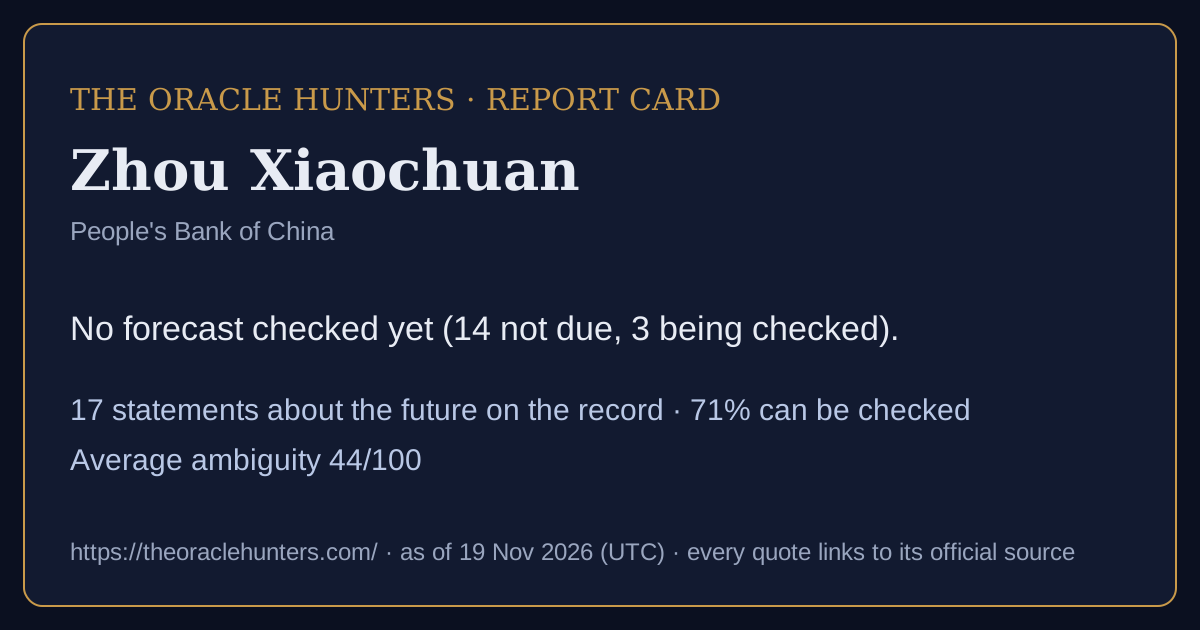
Track record: No forecast checked yet (14 not due, 3 being checked).
17forecasts & commitments on the record
71%can be checked as stated
44average ambiguity (0-100)
0goalpost moves recorded
0confirmed U-turns
Timeline
came true partly did not not due / being checked / too vague
Calibration score: shown after 10 checked forecasts with a stated likelihood (now 0).
How they speak about the future: based on data 11, educated guess 5, stated on authority 1.
Kinds of claim: forecast 9, scenario (if… then) 4, mixed claim 3, commitment 1. · Download this report card as a picture
In the nine words
πρόγνωσιςInference from evidence11 · 65%πρόνοιαPreparing for the future4 · 24%εἰκασίαConjecture1 · 6%προαναγγελίαPublic pre-announcement1 · 6%
How to read this
Each box is one sentence a public figure or institution said about the future, word for word, with a link to the official text. Can be checked means it names what will happen, by when, and how likely - so it can be compared with official figures later. Too vague to check means it does not. Ambiguity (0-100) is how many different ways the sentence can be read. When the date passes, the forecast is compared with official data and marked came true, partly or did not come true. Labels judge the sentence, never the person. Full guide and glossary.On the record (17)
The GDP growth was 6.9 percent in the first half and is expected to reach 7 percent in the second half of this year.
If we don't accelerate economic restructuring, shift economic growth mode, the economic development will be unsustainable.
If we divide the financial business too much, this will affect the growth of financial institutions, and their ability to satisfy ause one supervisor only need to know one sub-sector.
However, trade surplus suddenly escalated to US$100 billion in 2005, which could be mainly attributed to the slower growth of import in contrast to the steady growth of export (in 2005, export registered a growth of 28.4 percent while import increased by 17.6 percent).
In a high-growth environment, many enterprises will find themselves lacking of capital .If a company distributes all its profits, how can it continue development when it lack of capitals?
By the end of last year, China's foreign debt reached US$228.6 billion with the origins increasingly diversified.
Zhou: The excessively rapid increase of housing prices, if not duly contained, will bring risks to the market and adversely affect the individuals that plan to purchase or rent houses.
The new policy prescribes that preferential interest rate is no longer applied to the housing loans, and in the cities where the housing prices have been going up sharply, the minimum down payment may be raised to 30 percent of the total payment.
If financial bills issued by development banks were counted the ratio could be as high as 80 percent.
Through these reforms, we will build a strong financial system able to support the sustained, stable, and rapid growth of China's economy.
As planned, the draft AML law will be presented to the Standing Committee of the NPC for deliberation in early 2005.
If the young generation takes advantage of consumer credit while the share of aged population in the society increases, the sustainability of the PAYG system will be threatened, so will the future payments of the already under-funded pension system.
Banks of lower than 8 percent capital are 'under capitalized' and the correction actions include 'may not take trust deposits; may not make any capital distribution or pay a management fee; growth of total assets must be restricted; must submit capital restoration plan and prior approval is required to acquisitions, branching, and new lines of business and some discretionary actions'.
First, money supply grew faster than desired with actual M1 and M2 higher than predicted and so did credit with its growth rate 10 percentage points higher than that forecasted in the beginning of 2004.
I believe many foreigners will be surprised at the figure of 10 million, which shows the severity of China's employment problem.
Other rural credit cooperatives may set their lending rate within 90-150 percent of the benchmark rate.
Finally, China is expected to open its banking sectors in all areas - including market access, the range of customers and RMB business - in 2006.
Also said - not checkable as stated (12 newest)
Remarks about the future with no date, figure or likelihood that could be checked. They are kept on the record and shown here, but not scored.
We will promote fiscal reform to actively address the matter.
People may ask why the corporate sector had such a high leverage ratio and why the financial institutions, especially the commercial banks, were willing to lend so much to them.
This will be a more balanced debt structure.
Some of them may have already found a job, but they have not moved their family or found a residence or apartment in the cities.
This may cause competition and financial stability problems.
In the 1980s, very few believed that Chinese manufacturing products export could have a bright future.
The construction of the Belt and Road could provide extra room of development to financial institutions, for them to open offshore branches and provide better financial services for trade, investment and capital management.
The Third Plenary Session of the 18th CPC Central Committee has made it clear that the market would play a decisive role in resource allocation, meaning all important functions should adopt a market approach.
The last day of 2014 is about to leave us and we will soon see the first light of 2015.
Excessive liquidity, inflation, asset price bubbles, periodic non-performing loans and other risks may build up and undermine asset quality and resilience of China's financial sector.
After the outbreak of the crisis, the International Monetary Fund and the Financial Stability Board stated clearly that implementing macro-prudential policy should be central banks' responsibility.
The People's Bank of China, with a mandate in China's macro-economic management and financial stability, needs to build a counter-cyclical adjustment mechanism to increase flexibilities in macro-economic management.