Zeti Akhtar Aziz
Central Bank of Malaysia
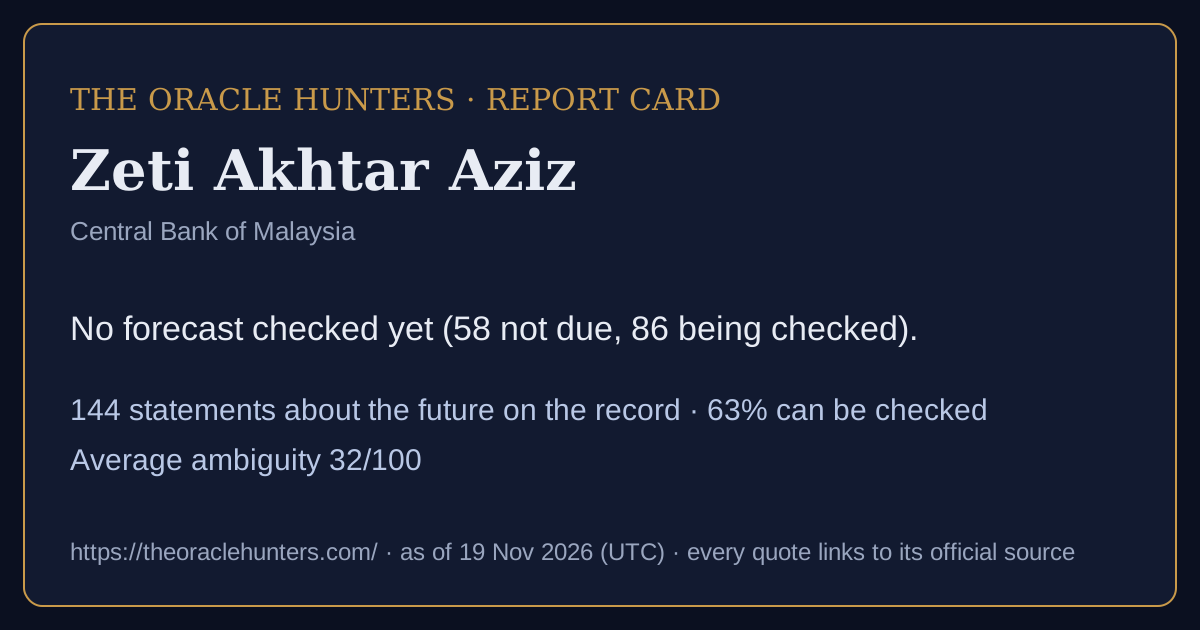
Track record: No forecast checked yet (58 not due, 86 being checked).
144forecasts & commitments on the record
63%can be checked as stated
32average ambiguity (0-100)
0goalpost moves recorded
0confirmed U-turns
Timeline
came true partly did not not due / being checked / too vague
Calibration score: shown after 10 checked forecasts with a stated likelihood (now 0).
How they speak about the future: based on data 116, stated on authority 24, educated guess 4.
Kinds of claim: forecast 135, mixed claim 5, scenario (if… then) 2, commitment 2. · Download this report card as a picture
In the nine words
πρόγνωσιςInference from evidence114 · 79%μαντείαInspired knowledge22 · 15%πρόνοιαPreparing for the future2 · 1%προαναγγελίαPublic pre-announcement2 · 1%εἰκασίαConjecture2 · 1%πρόβλεψιςSeeing the signs2 · 1%
How to read this
Each box is one sentence a public figure or institution said about the future, word for word, with a link to the official text. Can be checked means it names what will happen, by when, and how likely - so it can be compared with official figures later. Too vague to check means it does not. Ambiguity (0-100) is how many different ways the sentence can be read. When the date passes, the forecast is compared with official data and marked came true, partly or did not come true. Labels judge the sentence, never the person. Full guide and glossary.On the record (144)
The market for green bonds tripled in size in from 2013 to 2014, with over USD100 billion of issuances expected this year .
The region has experienced a long-term average annual growth of more than 5%, much higher than the global average, and this is expected to be sustained going forward.
By 2020, ASEAN is expected to account for more than USD2 trillion of additional consumption to the world economy.
If left unresolved it will impede future growth and performance of the industry.
We will also learn about other sources of energy from which we can tap on and strengthen.
Additionally, we will also help build more resilient and inclusive financial systems and thus contribute towards achieving more balanced growth and development.
Moving forward, the ASEAN Strategic Action Plan for SME Development 2016-2025 will also focus on promoting productivity, technology and innovation, access to financing, enhancing market access and internationalisation, while also enhancing the policy and regulatory environment, and promoting entrepreneurship and human capital development.
By 2020, ASEAN is expected to account for more than USD2 trillion of additional consumption.
With a projected annual GDP growth of 5.4% 1 over the next six years, the region is poised to reach an economic size of USD3.7 trillion by 2020, four times the size it was a decade ago.
Despite these developments, after a stellar performance in 2014, the economy is projected to remain on a steady growth trajectory with an economic growth being in the region of 4.5 - 5.5% in 2015 with the growth mainly being driven by domestic demand.
Against this backdrop, the financial markets are therefore expected to remain in a state of heightened volatility during this year.
In Asia, the growth for 2015 is projected to be sustained at 6.4%, while growth in the ASEAN-5 is projected to be in the region of 5%.
According to the International Monetary Fund (IMF), economic growth in the region is expected to be sustained at an average of 5.3% over the next five years to reach USD3.6 trillion by 2019, five times the size it was a decade ago.
2 According to IDC, between 2013 to 2020, the 'digital universe' which measures all the digital data created, replicated, and consumed in a single year, will grow by a factor of 10- from 4.4 trillion gigabytes to 44 trillion.
The United Nations projects that Asia's urbanisation rate would rise to 56% in 2030, and further to 64% in 2050.
The proportion of the Malaysian population living in urban areas has increased from less than 50 percent in 1990 to more than 70 percent in 2010, and is expected to rise further to 75 percent in 2020.
In Asia, it is estimated that a funding of US$8.3 trillion is required until 2020 for infrastructure projects, while the funding requirements in the Middle East are estimated to be US$2 trillion over the same period.
The bulk of this urban population will consist of the middle income, where the current middle class of more than 500 million people is projected to exceed 3 billion by 2030.
The SME contribution to GDP is now 33% and is projected to increase to 41% by 2020 as envisaged in the SME Master Plan that has been endorsed by National SME Development Council.
It is expected to become a mainstream asset class by 2015, reaching a projected total of more than 26 trillion US dollars of asset-under-management, accounting for 15 to 20 percent of the global market.
Five rounds of negotiations have been concluded, with the sixth round of negotiations expected to be concluded by next year.
Economic expansion is expected to be sustained at a rate of 5.8% in the next five years, significantly outpacing global growth.
The region's GDP is expected to triple to USD3 trillion by 2017 relative to a decade ago.
The Asian Development Bank estimates that the share of ASEAN's middle class population is expected to increase to 65% by 2030, consequently contributing to altering the global consumer landscape.
It is projected that another 1.1 billion people will be living in cities over the next 20 years, increasing the urban population to 55 percent by 2030.
The OECD also projects that by 2020, Asian consumers will account for 40 percent of global consumption.
This number is projected to increase by more than six-fold to 3 billion by 2030.
The same will hold true for businesses if they are to remain competitive, and, in particular, if they should venture into new areas and across borders.
Asia's current middle class of 500 million people is projected to increase by more than six-fold, to exceed 3 billion people, by 2030.
The Asian Development Bank has also projected that over this decade, Asia will require an investment of over 8 trillion US dollars in infrastructure development.
By 2030, it is projected that the current 500 million Asian middle class will grow by more than six-fold, to be more than 3 billion.
The economic integration is supported by the strong demand from the growing middle class Asian population, which is projected to reach 3.3 billion by 2030.
With the rapid growth in domestic demand, reinforced by the vast productive investment opportunities within and across the emerging economies, it is projected that the emerging world will account for 60 percent of total world output by 2030, higher by 20 percent from its current level.
More than half of total financing in 2020 will be raised through financial markets, while Islamic finance will continue to increase in prominence, growing at a faster pace to account for 40% of total financing.
It is envisaged that by 2020, the financial system is expected to expand from the current 4.3 times to six times of GDP.
This includes the Central Bank of Malaysia Act 2009 and the Financial Services Act expected to be tabled in Parliament in 2012 has strengthened the legal framework for the financial sector.
Correspondingly, the financial sector contribution to nominal GDP is projected to rise from 8.6% to between 10 to 12% in 2020.
By 2030, emerging economies are projected to account for 60% of total world output, from the current 40%.
This part of the journey will be completed in December 2012.
The journey for MobileLINK will begin today to cover about 50% of the identified the nonurban areas nationwide in the next 3 years.
With a growing middle class population that will reach 3.3 billion by 2030, Asia is projected to become the world's largest market for consumer goods and services.
The contribution of the financial industry to the country's GDP has increased from 9.2% in the year 2000 to 11.7% in 2009 and this figure is expected to grow further in time.
The World Economic Forum has projected that 'staggering' talent gaps will arise in large parts of the world by 2020, and this will have a bearing on national competitiveness while organisations compete for talent on an unprecedented scale.
Growth is expected to remain strong this year, although at a more moderate pace compared to 2010.
With respect to liquidity, our existing Liquidity Framework will be enhanced in 2011 to bring it in line with the Basel III standard, while making appropriate customisations to take into account the specific structural characteristics of our market.
The appropriate timing of transition to the new requirements, will be determined in 2011.
This Programme will be offered by Agensi Kaunseling dan Pengurusan Kredit (AKPK) through its nationwide establishments and will commence from January 2011.
Based on the rate of growth of the economy projected for the next decade, the financial sector is envisaged to increase in significance from 4.6 times of GDP currently, to between 5 to 6 times of GDP by 2020.
This will be further reinforced with the implementation of Pillar 2 from 2011, which will accord greater focus on the individual banks' own internal capital adequacy assessment processes to determine the adequacy of capital against their specific risk profiles and capital management strategies.
Meanwhile, the contribution of the financial services sector to GDP is expected to increase from 11.7% in 2009 to 14% by 2020.
Showing the newest 50 - the ledger has all 144.
Also said - not checkable as stated (12 newest)
Remarks about the future with no date, figure or likelihood that could be checked. They are kept on the record and shown here, but not scored.
Of significance, the signing of the "Paris Agreement", a global action plan on climate change, by 195 countries in December of 2015 will serve to further accelerate the momentum of green financing.
Of significance, aligning business practices towards responsible finance entails a paradigm shift away from the conventional thinking of finance - the most important distinction being the need to recognise and appreciate that responsible finance delivers value by focusing on its ultimate outcomes, rather than its immediate returns.
Of equal importance, the benefits of finance should be extended across all segments of society.
An important aspect in this process is that economic growth and development, no matter how stellar, will begin to fade when inequality sets in and when income disparities widen.
Given the role of the financial system in facilitating this, Bank Negara Malaysia has always given priority to the financial inclusion agenda to not only bring the underserved segments of society into the financial mainstream but to promote a more effective participation in the financial system which will in turn strengthen the potential for enhancing economic well-being.
By the response received, this initiative will inspire the many talents within the Malaysian research community to be more engaged to think and delve into greater research on Malaysian economic and development issues that have great importance to the country and the region that is expected to persist in our prevailing and future environment.
New institutional arrangements will need to be developed to render effective coordination across the public sector.
In particular, the urgency is for strong institutions that will transcend the passage of time and will ensure the path towards sustainable economic growth and development.
As a consequence, disequilibrium conditions and market failures may not only be detrimental to social welfare, but may also weigh on an economy's growth and development prospects.
My remaining remarks this afternoon will focus on institutional building and economic development from the perspective of Central Banks in emerging economies.
income disparities, that will effectively manage infrastructure development and urbanisation, that will accord environmental sustainability and finally that will accord importance to governance, accountability and integrity in the implementation and execution of the many endeavours to achieve a sustainable advancement.
This implies an important role of institutional building that will support the ability to address these challenges.