Yvette Cooper
Department of Health and Social Care · GBR
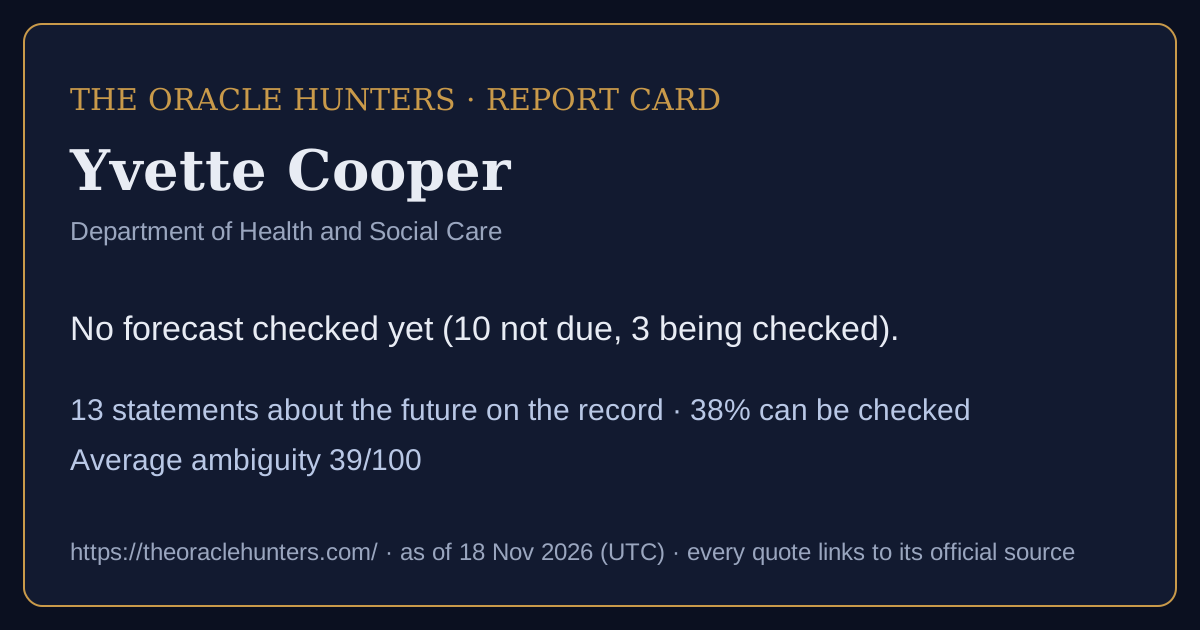
Track record: No forecast checked yet (10 not due, 3 being checked).
13forecasts & commitments on the record
38%can be checked as stated
39average ambiguity (0-100)
0goalpost moves recorded
0confirmed U-turns
Timeline
came true partly did not not due / being checked / too vague
Calibration score: shown after 10 checked forecasts with a stated likelihood (now 0).
How they speak about the future: stated on authority 7, based on data 6.
Kinds of claim: forecast 8, mixed claim 4, commitment 1. · Download this report card as a picture
In the nine words
μαντείαInspired knowledge6 · 46%πρόγνωσιςInference from evidence6 · 46%προαναγγελίαPublic pre-announcement1 · 8%
How to read this
Each box is one sentence a public figure or institution said about the future, word for word, with a link to the official text. Can be checked means it names what will happen, by when, and how likely - so it can be compared with official figures later. Too vague to check means it does not. Ambiguity (0-100) is how many different ways the sentence can be read. When the date passes, the forecast is compared with official data and marked came true, partly or did not come true. Labels judge the sentence, never the person. Full guide and glossary.On the record (13)
So, shortly, we will publish a new Urgent, Emergency and Planned Care Strategy, setting out more fully how we expect ICBs to commission the new care management service for next year, and the new Neighbourhood Support Teams that will deliver this service on the ground.
So we will also co-create a new campaign that leads to tangible action, based on the evidence of what works, we will tackle violence in all its forms - online and offline, in conflict and in peace - and we will build towards a global summit next year, while the UK is chairing the G20, designed to bring together governments, …
And I hope this shared endeavour that will carry us forward, whether it’s at the Hamburg Sustainability Conference, the multilateral events, or into the UK’s G20 presidency next year.
And moving into also providing expertise, such as the tax advice that has helped Ghana generate an additional 100 million in revenue to invest in its own education and health priorities, far more than a traditional UK aid programme could have provided.
As the World Food Programme has warned, some 45 million people in the global South are at risk of being pushed into acute hunger this year.
Over 100 million more children going to school, and nations benefitting from stronger job creation and growth.
The agricultural clock is ticking, and damage is already being done that will affect crop yields and food prices well into next year.
And we’ve got no illusion about the nature of the Iranian regime, as we saw earlier this year in its brutal repression of its own people and the threats projected through its proxies around the world, including Hezbollah.
In March this year the UK will hold a Peacebuilding Conference to bring together Israel and Palestinian civil society leaders to build trust and challenge divisions, because peace is built not just by governments, but by whole societies.
Falling energy revenues are squeezing the state budget, and oil revenues are now at a five-year low, but we will go further.
But I can tell you today that direct central government funding for policing will increase by more than half a billion pounds next year, including over 260 million pounds for the core grant and additional funding for neighbourhood policing, counter-terrorism and the National Crime Agency.
Next year we will publish a new white paper on policing.
It’s why we supported Bryn Hughes’ campaign, and why I’m so pleased that we will have the Elizabeth Emblems, the first ones been given out in the course of this year, but also why I will work with you to make sure that the Police Covenant is properly implemented and respected, so we can support police officers in everything that …
Also said - not checkable as stated (12 newest)
Remarks about the future with no date, figure or likelihood that could be checked. They are kept on the record and shown here, but not scored.
But let me be clear: the NHS will play its part in the early intervention that helps young people get back into education and work, because no one should lose training or qualifications opportunities because they can’t get mental health support.
So today we’re setting a new national ambition: that by the end of the decade, people with the greatest health and care needs will no longer have to fight their way through the system to get the support they need.
As we look towards the 130th anniversary of the King’s Fund next year, it has been hugely to the benefit of the NHS, of health policy, and the health of our nation.
So, in parallel, we’re also changing the way councils will need to support and commission domiciliary care, as Minister Ali McGovern has set out.
So councils will now need to designate and commission from a lead home care provider in every neighbourhood, instead of multiple, criss-crossing domiciliary care companies that they draw from currently.
We will develop national pledges as coalition members, setting out what each of us will be doing at home and internationally, based on what we know works.
So we will also establish a Survivor Advisory Board, to shape this work, challenge our assumptions and help make a real difference.
And survivors of sexual assaults, violence, of rape used as a weapon of war, will bear those scars and face that trauma for very many years to come.
They are the first responders, they are the people who actually will have the networks on the ground, who know where the responses are needed, and we need to be able to work with people and support them, particularly making sure that we are empowering women as part of that.
Although our funding may be lower, we are determined to mobilise more private finance, to mobilise more international finance, to use it in the most effective way possible, and to use that funding in partnership to deliver the most effective results.
Because when we look at the fragility of countries, when it comes to climate shocks, or economic shocks, or the impact of conflict - like the restrictions on the Strait of Hormuz, and Iran’s attempt to hijack the global economy - if countries are more vulnerable and less resilient, it means that when shocks happen, they are far more likely …
And so, in responding to this crisis, we should be turbocharging that shift, and it’s why I’m so pleased that we can announce today the BII’s investment, the British International Investment, additional investment, to deliver over £4.6 billion of climate investment in emerging markets to support the green transition, and to build energy security, too.