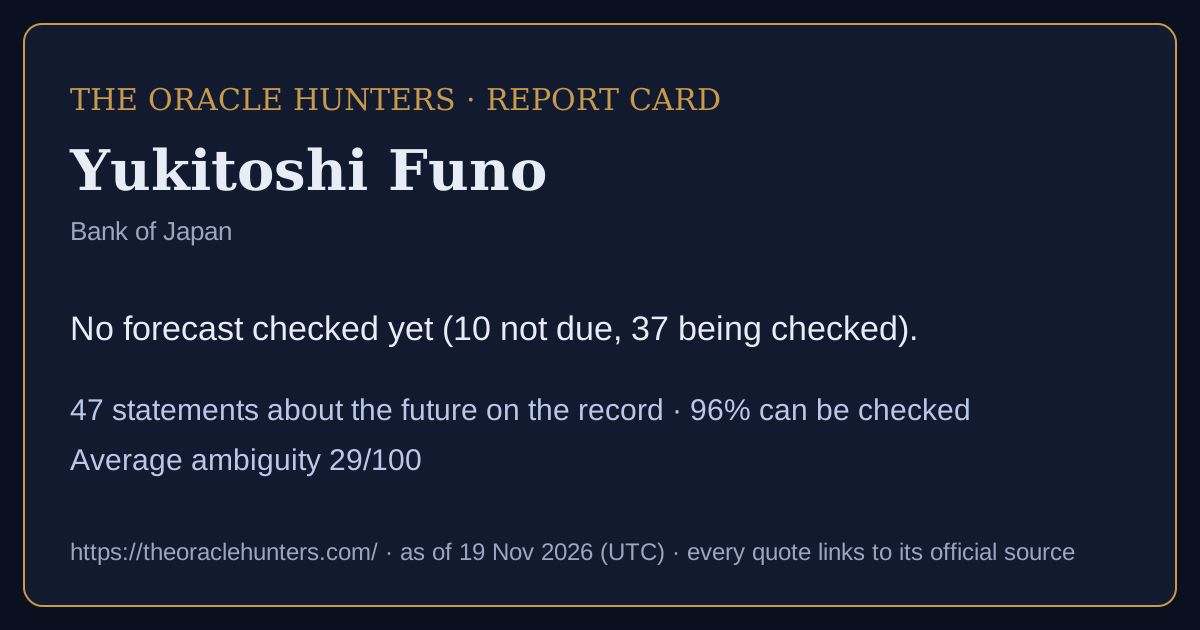
Yukitoshi Funo
Bank of Japan
Track record: No forecast checked yet (10 not due, 37 being checked).
47forecasts & commitments on the record
96%can be checked as stated
29average ambiguity (0-100)
0goalpost moves recorded
0confirmed U-turns
Timeline
came true partly did not not due / being checked / too vague
Calibration score: shown after 10 checked forecasts with a stated likelihood (now 0).
How they speak about the future: based on data 47.
Kinds of claim: forecast 44, mixed claim 2, commitment 1. · Download this report card as a picture
In the nine words
How to read this
Each box is one sentence a public figure or institution said about the future, word for word, with a link to the official text. Can be checked means it names what will happen, by when, and how likely - so it can be compared with official figures later. Too vague to check means it does not. Ambiguity (0-100) is how many different ways the sentence can be read. When the date passes, the forecast is compared with official data and marked came true, partly or did not come true. Labels judge the sentence, never the person. Full guide and glossary.On the record (47)
Specifically, according to the guideline for market operations, the Bank currently sets the short-term policy interest rate at minus 0.1 percent and purchases Japanese government bonds (JGBs) so that 10-year JGB yields will remain at around 0 percent.
In terms of specific figures, the medians of the Policy Board members' forecasts of the year-on-year rate of change presented in the July 2019 Outlook Report are 1.0 percent for fiscal 2019, 1.3 percent for fiscal 2020, and 1.6 percent for fiscal 2021. 1
In terms of specific figures for the economic growth rate, as provided in the July 2019 Outlook for Economic Activity and Prices (Outlook Report) released by the Bank, the medians of the Policy Board members' forecasts are 0.7 percent for fiscal 2019, 0.9 percent for fiscal 2020, and 1.1 percent for fiscal 2021.
The forecasts assume the following: (1) the consumption tax will be raised to 10 percent in October 2019 and a reduced tax rate will be applied to food and beverages -- excluding alcohol and dining out -- and newspapers, and (2) measures for free early childhood education will be introduced in October 2019, and other measures including free higher education …
According to the July 2019 World Economic Outlook Update released by the International Monetary Fund (IMF), global growth is forecast at 3.2 percent for 2019 and 3.5 percent for 2020.
Specifically, at present, according to the guideline for market operations, the Bank sets the short-term policy interest rate at minus 0.1 percent and purchases Japanese government bonds (JGBs) so that 10-year JGB yields will remain at around 0 percent.
It is assumed that the consumption tax will be raised to 10 percent in October 2019 and that a reduced tax rate will be applied to food and beverages - excluding alcohol and dining out - and newspapers.
In terms of specific figures, the medians of the Policy Board members' forecasts of the year-on-year rate of change presented in the April 2019 Outlook Report are 1.1 percent for fiscal 2019, 1.4 percent for fiscal 2020, and 1.6 percent for fiscal 2021. 3
In terms of specific figures for the economic growth rate, as provided in the April 2019 Outlook for Economic Activity and Prices (Outlook Report) released by the Bank, the medians of the Policy Board members' forecasts are 0.8 percent for fiscal 2019, 0.9 percent for fiscal 2020, and 1.2 percent for fiscal 2021. 2
Specifically, at present, according to the guideline for market operations, the Bank sets the short-term policy interest rate at minus 0.1 percent and purchases Japanese government bonds (JGBs) so that 10-year JGB yields will remain at around 0 percent.
2 It is assumed that the consumption tax will be raised to 10 percent in October 2019 and that a reduced tax rate will be applied to food and beverages -- excluding alcohol and dining-out -- and newspapers.
Specifically, the medians of the Policy Board members' forecasts of the year-on-year rate of change in the CPI (all items less fresh food) presented in the October 2018 Outlook Report are 0.9 percent for fiscal 2018, and, excluding the direct effects of the scheduled consumption tax hike, 1.4 percent for fiscal 2019 and 1.5 percent for fiscal 2020. 3
stock, and Olympic Games-related demand peaking out. 2 According to the October 2018 Outlook for Economic Activity and Prices (hereafter the Outlook Report) released by the Bank of Japan, the medians of the Policy Board members' forecasts of the economic growth rate are 1.4 percent for fiscal 2018, and 0.8 percent each for fiscal 2019 and 2020.
In fiscal 2019 and 2020, Japan's economy is expected to continue on an expanding trend although the growth pace is projected to decelerate due to a slowdown in domestic demand, reflecting the effects of the scheduled consumption tax hike, cyclical adjustments in capital
According to the October 2018 World Economic Outlook released by the International Monetary Fund (IMF), the global growth rate is projected to be 3.7 percent in both 2018 and 2019.
On this point, let me note that the April 2018 Outlook Report ceased to provide a description on the projected timing of achieving the 2 percent price stability target, so as to clarify that the timing is not a deadline by which the target will be achieved.
Specifically, the medians of the Policy Board members' forecasts of the year-on-year rate of change in the CPI (all items less fresh food) presented in the April 2018 Outlook Report are 1.3 percent for fiscal 2018 and - on a basis excluding the direct effects of the scheduled consumption tax hike - 1.8 percent each for fiscal 2019 and 2020. …
According to the April 2018 Outlook for Economic Activity and Prices (hereafter the Outlook Report) released by the Bank of Japan, the medians of the Policy Board members' forecasts of the economic growth rate are 1.6 percent for fiscal 2018, and 0.8 percent each for fiscal 2019 and 2020. 2
In fiscal 2019 and 2020, Japan's economy is expected to continue on an expanding trend supported by external demand, although the growth pace is projected to decelerate due to a cyclical slowdown in business fixed investment and the effects of the scheduled consumption tax hike.
It is assumed that the consumption tax will be raised to 10 percent in October 2019 and that a reduced tax rate will be applied to food and beverages - excluding alcohol and dining-out - and newspapers.
According to the World Economic Outlook , released in April 2018 by the International Monetary Fund (IMF), the global growth rate is projected to be 3.9 percent in both 2018 and 2019.
forecasts of the economic growth rate are 1.9 percent for fiscal 2017, 1.4 percent for fiscal 2018, and 0.7 percent for fiscal 2019.
In fiscal 2019, the economy is expected to continue expanding, supported by external demand, although the growth pace is projected to decelerate due to a slowdown in domestic demand. 2 According to the October 2017 Outlook for Economic Activity and Prices (hereafter the Outlook Report), released by the Bank of Japan, the medians of the Policy Board members'
Through fiscal 2018, domestic demand is likely to follow an uptrend, with a virtuous cycle from income to spending being maintained in both the corporate and household sectors, on the back of highly accommodative financial conditions and fiscal spending through the government's large-scale stimulus measures.
The rate will likely reach around 2 percent in around fiscal 2019.
According to the World Economic Outlook , released in October 2017 by the International Monetary Fund, the global growth rate is projected to be 3.6 percent in 2017 and 3.7 percent in 2018.
Specifically, the medians of the Policy Board members' forecasts of the year-on-year rate of change in the CPI for all items less fresh food presented in the July 2017 Outlook Report are 1.1 percent for fiscal 2017, 1.5 percent for fiscal 2018, and, excluding the direct effects of the scheduled consumption tax hike, 1.8 percent for fiscal 2019. 3
domestic demand. 2 According to the July 2017 Outlook for Economic Activity and Prices (hereafter the Outlook Report), released by the Bank of Japan, the medians of the Policy Board members' forecasts of the economic growth rate are 1.8 percent for fiscal 2017, 1.4 percent for fiscal 2018, and 0.7 percent for fiscal 2019.
In fiscal 2019, the economy is expected to continue expanding, supported by external demand, although the growth pace is projected to decelerate due to a slowdown in
According to the World Economic Outlook Update , released in July 2017 by the International Monetary Fund (IMF), the global growth rate is projected to increase from 3.2 percent in 2016 to 3.5 percent in 2017, and to 3.6 percent in 2018.
Currently, the momentum toward achieving the price stability target is being maintained, and the year-on-year rate of change in the CPI is expected to increase toward 2 percent.
On this point, the Bank makes clear that it will continue expanding the monetary base until the year-on-year rate of increase in the observed CPI (all items less fresh food) exceeds 2 percent and stays above the target in a stable manner.
As for the future conduct of monetary policy, the Bank will continue with QQE with Yield Curve Control, aiming to achieve the price stability target of 2 percent, as long as it is necessary for maintaining that target in a stable manner.
Specifically, the medians of the Policy Board members' forecasts of the year-on-year rate of change in the CPI (all items less fresh food) presented in the January 2017 Outlook Report are minus 0.2 percent for fiscal 2016, 1.5 percent for fiscal 2017, and 1.7 percent for fiscal 2018. 2
Report), the medians of the Policy Board members' forecasts for the economic growth rate are 1.4 percent for fiscal 2016, 1.5 percent for fiscal 2017, and 1.1 percent for fiscal 2018, and the economy is expected to continue growing at a pace above its potential through the projection period of fiscal 2016-2018. 1
Specifically, the medians of the Policy Board members' forecasts of the yearon-year rate of increase in the CPI (all items less fresh food) presented in the July 2016 Outlook Report are 0.1 percent for fiscal 2016, 1.7 percent for fiscal 2017, and 1.9 percent for fiscal 2018. 1
Meanwhile, assuming that crude oil prices will rise moderately from the recent level, the baseline scenario is that the timing of the year-on-year rate of change in the CPI reaching around 2 percent will be during fiscal 2017, although this is accompanied by considerable uncertainties including those surrounding overseas economies going forward.
The Bank will continue to steadily pursue monetary easing, making full use of all possible measures in terms of the three dimensions of quantity, quality, and the interest rate to achieve the price stability target of 2 percent at the earliest possible time.
More specifically, the contribution was expected to start to lessen in the second half of fiscal 2016 and reach around 0 percentage point in early fiscal 2017.
According to the Bank's July 2016 Outlook for Economic Activity and Prices (hereafter the Outlook Report), the medians of the Policy Board members' forecasts for the economic growth rate are 1.0 percent for fiscal 2016, 1.3 percent for fiscal 2017, and 0.9 percent for fiscal 2018, and the economy is expected to continue growing at a pace above its potential …
According to the World Economic Outlook (WEO) Update released in July 2016 by the International Monetary Fund (IMF), global growth projections have been revised slightly downward from the April 2016 WEO, particularly for Europe, but the longerterm projection that the global growth rate will moderately increase from 2015 through 2017, from 3.1 percent in 2015 and 2016 to 3.4 percent …
Specifically, the medians of the Policy Board members' forecasts of the year-on-year rate of increase in the CPI for all items less fresh food presented in the January 2016 Outlook Report were 0.1 percent for fiscal 2015, 0.8 percent for fiscal 2016, and, on a basis excluding the direct effects of the scheduled consumption tax hike, 1.8 percent for fiscal …
According to the Bank's January 2016 Outlook for Economic Activity and Prices (hereafter the Outlook Report), the medians of the Policy Board members' forecasts for the economic growth rate 1.1 percent for fiscal 2015, 1.5 percent for fiscal 2016, and 0.3 percent for fiscal 2017 - were more or less unchanged from the forecasts presented in October 2015.
Thereafter, through fiscal 2017, it is projected to maintain its positive growth, although with a slowing in its pace to around a level somewhat below the potential growth rate, due mainly to the effects of a front-loaded increase and subsequent decline in demand prior to and after the consumption tax hike planned in April 2017.
The Bank will continue to steadily pursue monetary easing, making full use of all possible measures in terms of the three dimensions of quantity, quality, and the interest rate to achieve the price stability target of 2 percent.
More specifically, the contribution was expected to start to lessen in the second half of fiscal 2016 and reach around 0 percentage point during the first half of fiscal 2017.
Based on this assumption, the timing of the yearon-year rate of change in the CPI reaching around 2 percent - the price stability target - is projected to be around the first half of fiscal 2017.
Also said - not checkable as stated (4 newest)
Remarks about the future with no date, figure or likelihood that could be checked. They are kept on the record and shown here, but not scored.
With regard to the outlook, Japan's economy is likely to continue on a moderate expanding trend on average, although it is projected to be affected by the slowdown in overseas economies for the time being and due attention needs to be paid to the effects of the October 2019 consumption tax hike on private consumption.
Conversely, attention should be paid to the fact that a change in the mindset and behavior of firms and households does not occur overnight and may in fact take a considerable amount of time.
In terms of the outlook, slowdowns are likely to continue for the time being; thereafter, however, overseas economies are expected to grow moderately on the whole with their growth rates rising somewhat.
As for the outlook, the growth rates of overseas economies are expected to increase moderately, as it is likely that advanced economies will continue growing steadily and a recovery in emerging economies will take hold gradually.