Yoshihisa Morimoto
Bank of Japan
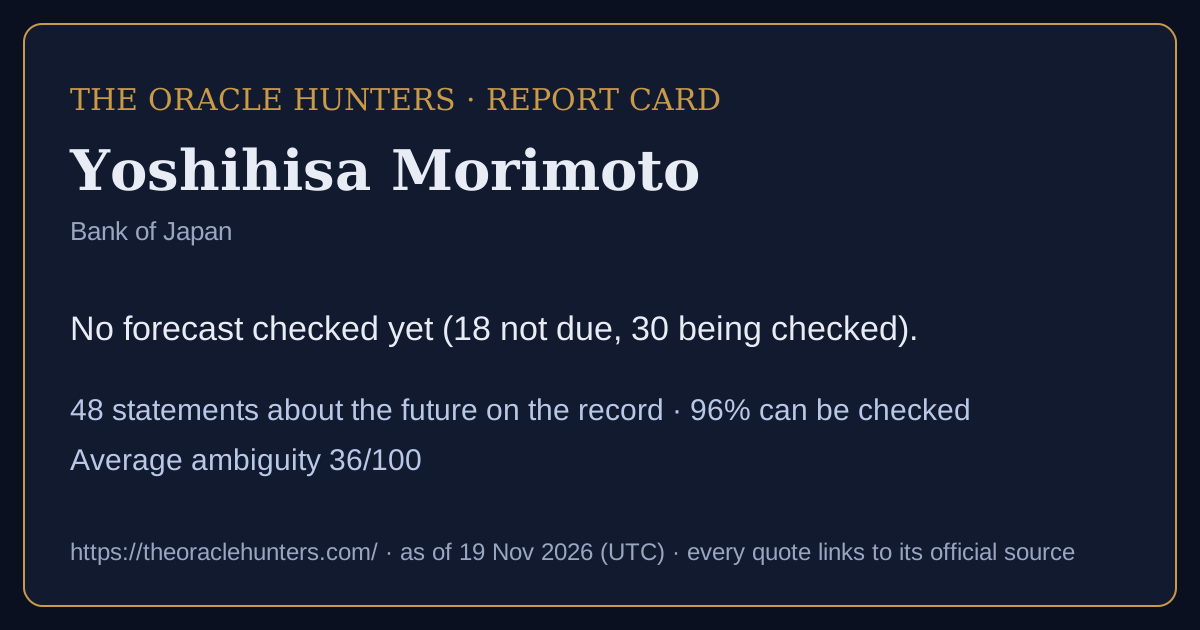
Track record: No forecast checked yet (18 not due, 30 being checked).
48forecasts & commitments on the record
96%can be checked as stated
36average ambiguity (0-100)
0goalpost moves recorded
0confirmed U-turns
Timeline
came true partly did not not due / being checked / too vague
Calibration score: shown after 10 checked forecasts with a stated likelihood (now 0).
How they speak about the future: based on data 39, educated guess 7, stated on authority 2.
Kinds of claim: forecast 37, scenario (if… then) 6, mixed claim 4, commitment 1. · Download this report card as a picture
In the nine words
πρόγνωσιςInference from evidence39 · 81%πρόνοιαPreparing for the future6 · 12%εἰκασίαConjecture1 · 2%προαναγγελίαPublic pre-announcement1 · 2%μαντείαInspired knowledge1 · 2%
How to read this
Each box is one sentence a public figure or institution said about the future, word for word, with a link to the official text. Can be checked means it names what will happen, by when, and how likely - so it can be compared with official figures later. Too vague to check means it does not. Ambiguity (0-100) is how many different ways the sentence can be read. When the date passes, the forecast is compared with official data and marked came true, partly or did not come true. Labels judge the sentence, never the person. Full guide and glossary.On the record (48)
The amount outstanding of fund-provisioning under this facility is expected to reach about 13 trillion yen as of end-June 2014.
If, through this summer, the upward momentum of the CPI weakens due to a fall-off of the effects of the weak yen and to a slack in supply and demand conditions resulting from the decline in demand following the consumption tax hike, due attention should continue to be paid to how this will affect inflation expectations, even during the process …
Specifically, in the Bank's April 2014 Outlook Report, the median of the Policy Board members' forecasts for the year-on-year rate of increase in the CPI (all items less fresh food, excluding the direct effects of the consumption tax hikes) was 1.3 percent for fiscal 2014, 1.9 percent for fiscal 2015, and 2.1 percent for fiscal 2016.
Thus, the rate of increase in the CPI is likely to reach around 2 percent - the price stability target - around the middle of the projection period, which is from fiscal 2014 through fiscal 2016.
In the Bank of Japan's April 2014 Outlook for Economic Activity and Prices (hereafter the Outlook Report), the median of the Policy Board members' forecasts for the economic growth rate was 1.1 percent for fiscal 2014, 1.5 percent for fiscal 2015, and 1.3 percent for fiscal 2016.
According to the projections for global economic growth released by the International Monetary Fund (IMF) in April 2014 in its World Economic Outlook , global growth is projected to strengthen to 3.6 percent in 2014 and then to 3.9 percent in 2015, rising at a moderate pace to reach a rate exceeding its long-term average.
As for the outlook, the year-on-year rate of increase in the CPI (all items less fresh food), excluding the direct effects of the consumption tax hike, is likely to be around 1-1/4 percent for some time as the effects of the upward pressure from prices of petroleum products subside.
As for the outlook, while Japan's economy will be affected by the front-loaded increase and subsequent decline in demand prior to and after the consumption tax hike, it is likely to continue growing at a pace above its potential, which is estimated to be around 0.5 percent, as a trend, as the virtuous cycle will continue to operate.
In January 2014, the International Monetary Fund (IMF) revised upward its projections for global economic growth in its World Economic Outlook , forecasting that the global economy would moderately accelerate its pace of growth from 3.0 percent in 2013 to 3.7 percent in 2014 and 3.9 percent in 2015.
Specifically, in the Bank's interim assessment in January of the October 2013 Outlook Report, the median of the Policy Board members' forecasts for the year-on-year rate of increase in the CPI (all items less fresh food; for fiscal 2014 and fiscal 2015, excluding the direct effects of the consumption tax hikes) was 0.7 percent for fiscal 2013, 1.3 percent for …
In the Bank of Japan's January 2014 interim assessment of the October 2013 Outlook for Economic Activity and Prices (hereafter the Outlook Report), the median of the Policy Board members' forecasts for the economic growth rate was 2.7 percent for fiscal 2013, 1.4 percent for fiscal 2014, and 1.5 percent for fiscal 2015.
The rate of increase in the CPI is likely to reach around 2 percent - the price stability target - toward the latter half of the projection period, through fiscal 2015.
And third, the Bank will purchase exchange-traded funds (ETFs) and Japan real estate investment trusts (J-REITs) so that their amounts outstanding will increase at an annual pace of about 1 trillion yen and about 30 billion yen, respectively.
Second, the Bank will purchase Japanese government bonds (JGBs) so that their amount outstanding will increase at an annual pace of about 50 trillion yen.
As the disaster areas are expected to see an increase in the demand for funds as reconstruction progresses, the Bank will continue to provide firm support to financial institutions engaged in reconstruction efforts so as to allow for active lending.
Specifically, in the Bank's interim assessment in July of the April 2013 Outlook Report, the median of the Policy Board members' forecasts for the year-on-year rate of increase in the CPI (all items less fresh food; for fiscal 2014 and fiscal 2015, excluding the direct effects of the consumption tax hikes) is 0.6 percent for fiscal 2013, 1.3 percent for …
The Bank will continue with QQE - consisting of these measures - aiming to achieve the price stability target of 2 percent, as long as it is necessary for maintaining that target in a stable manner.
The rate of increase in the CPI is likely to reach around 2 percent - the price stability target - toward the latter half of the projection period, spanning from fiscal 2014 through fiscal 2015, as the overall economy improves in a balanced and sustainable manner.
Although the economic growth rate is likely to decrease mainly due to a decline in demand following the front-loading of consumption prior to the consumption tax hike, growth is expected to remain above potential in fiscal 2014.
The Bank will provide a massive amount of funds exceeding 50 trillion yen by the end of March 2014 under the Asset Purchase Program and the Loan Support Program, and the amount outstanding of these programs will exceed 120 trillion yen.
Based on recent lending data, the amount of funds provided through the Stimulating Bank Lending Facility is expected to reach more than 15 trillion yen by the end of March 2014.
Specifically, from January 2014, the Bank will conduct purchases of financial assets totaling about 13 trillion yen each month for some time.
The Bank will continue to significantly increase the amount outstanding of the program until it reaches about 101 trillion yen by the end of December 2013.
However, as I explained earlier, the year-on-year rate of change in the CPI is projected to move closer to 1 percent through fiscal 2014 supported by a recovery in the economy.
Turning to the consumer price index (CPI) for all items less fresh food, the year-on-year rate of change since summer 2011 has been around 0 percent and is expected to stay at this level for the time being.
In the Bank's projection released in July 2012, the median of the Policy Board member's forecasts for the year-on-year rate of increase in the CPI (all items less fresh food) is 0.2 percent for fiscal 2012 and 0.7 percent for fiscal 2013.
Assuming that medium- to long-term inflation expectations remain stable, the year-on-year rate of change in the CPI is expected to gradually rise to a range of above 0.5 percent and less than 1 percent in fiscal 2013 as the negative output gap improves.
In the Bank of Japan's projection released in July 2012, the median of the Policy Board members' forecasts for Japan's real GDP growth rate is 2.2 percent for fiscal 2012 and 1.7 percent for fiscal 2013.
In fiscal 2013, with overseas economies continuing to see relatively high growth on the whole, the economy is expected to be firm, although the growth rate is expected to be somewhat lower than that in fiscal 2012, because the positive effects from reconstruction-related demand will gradually diminish.
The outstanding amount of the Program stood at 53 trillion yen as of July 20, and the Bank will continue to proceed with powerful monetary easing by steadily increasing the outstanding amount of the Program by about 17 trillion yen by around end-June 2013.
The National Institute of Population and Social Security Research forecasts that Japan's working-age population will decline to 44.18 million in 2060, which is roughly half of the peak of 87.27 million in 1995.
Private-sector forecasts expect growth to decelerate further in 2012 to around 8.5 percent.
As a result of the increased JGB purchases under the Program, the Bank will be purchasing, together with regular purchases to meet a trend increase in banknote demand, a large amount of JGBs until the end of 2012 at the pace of 3.3 trillion yen per month, or about 40 trillion yen for the year.
The Bank will continue with this powerful easing until it judges the 1 percent goal to be in sight.
In its forecast released in January 2012, the Bank projected the year-on-year rate of increase in the CPI (all items less fresh food) to be 0.1 percent for fiscal 2012 and 0.5 percent for fiscal 2013.
According to the Bank of Japan's forecasts released in January 2012, the real GDP growth rate is projected to be 2.0 percent for fiscal 2012 and 1.6 percent for fiscal 2013.
If we assess the loan disbursements carried out so far, it could be said the measure has played its intended role as a catalyst in prompting financial institutions to develop their own initiatives to strengthen the foundations for economic growth.
In addition, if international commodity prices rise further, this could lead to a decline in the purchasing power of households and a deterioration in corporate profits, which could depress private domestic demand in Japan.
On the other hand, medium- to long-term growth expectations by firms and households could rise if firms take the disaster as an opportunity to bolster efforts to implement growth strategies.
In addition, if concern about the growth potential of the economy increases due to the effects of the disaster, and firms' and households' medium- to long-term growth expectations decline as a result, this could depress firms' and households' appetite for spending and act to reduce economic activity for a protracted period.
In principle, the operations, whose expected maximum amount is 1 trillion yen in total, will continue every month until October this year.
The International Monetary Fund (IMF) in its World Economic Outlook released in April 2011 forecasts that the global economy will grow by around 4.5 percent in both 2011 and 2012.
For example, the appreciation of the yen may on the one hand encourage mergers and acquisitions abroad - a positive development - but on the other it is also likely to exert downward pressure on the profits of exporters and might damage economic activity if this were to hurt business confidence and lead firms to change their behavior.
If economic conditions in these economies are boosted further, Japan's economy could realize stronger-than-expected growth through the increase in exports to these economies.
Thereafter, the rate of increase is expected to start rising through fiscal 2012.
Therefore, the deceleration in the decline in the CPI on a year-on-year basis is likely to remain moderate and it will likely take until sometime in fiscal 2011 for the year-onyear rate of change in the CPI to enter positive territory.
As stated in the projection in the Outlook Report for the period ending in fiscal 2012, it will take considerable time for the supply and demand balance to improve because the drop in demand after the financial crisis was considerable and the pace of economic recovery has been moderate.
consolidation, which from next year will start in earnest also in the major economies, and to volatility in financial markets due to concerns over the public and private debt problems in some of the peripheral countries.