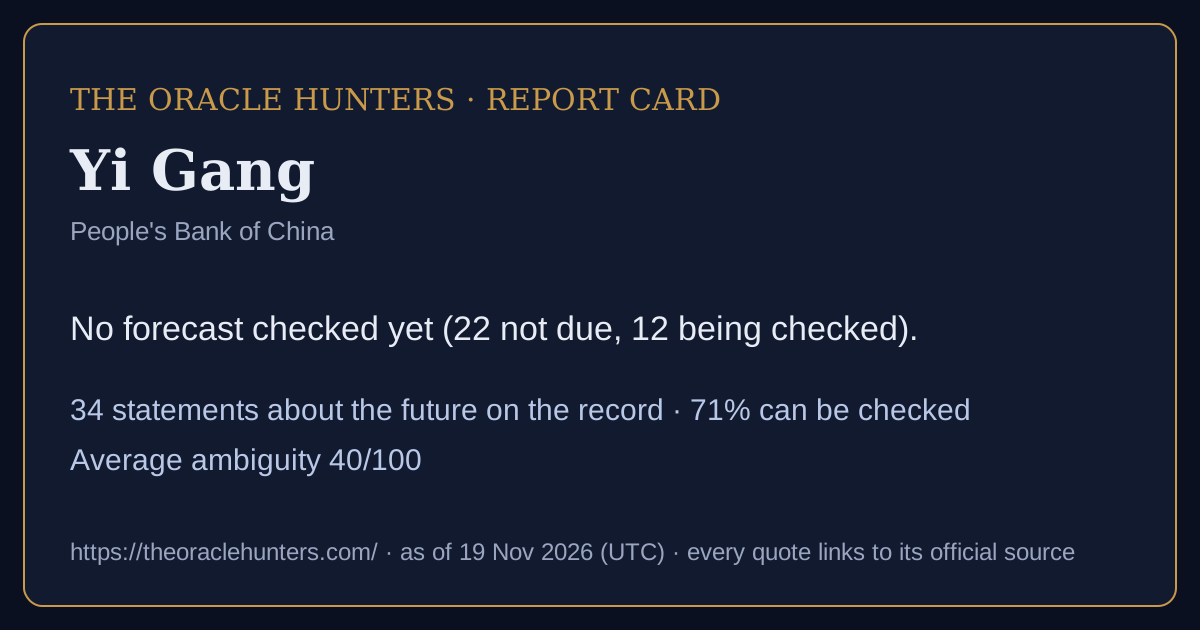
Yi Gang
People's Bank of China
Track record: No forecast checked yet (22 not due, 12 being checked).
34forecasts & commitments on the record
71%can be checked as stated
40average ambiguity (0-100)
0goalpost moves recorded
0confirmed U-turns
Timeline
came true partly did not not due / being checked / too vague
Calibration score: shown after 10 checked forecasts with a stated likelihood (now 0).
How they speak about the future: based on data 18, stated on authority 14, educated guess 2.
Kinds of claim: forecast 24, commitment 6, mixed claim 3, scenario (if… then) 1. · Download this report card as a picture
In the nine words
πρόγνωσιςInference from evidence17 · 50%μαντείαInspired knowledge8 · 24%προαναγγελίαPublic pre-announcement6 · 18%πρόνοιαPreparing for the future1 · 3%πρόβλεψιςSeeing the signs1 · 3%εἰκασίαConjecture1 · 3%
How to read this
Each box is one sentence a public figure or institution said about the future, word for word, with a link to the official text. Can be checked means it names what will happen, by when, and how likely - so it can be compared with official figures later. Too vague to check means it does not. Ambiguity (0-100) is how many different ways the sentence can be read. When the date passes, the forecast is compared with official data and marked came true, partly or did not come true. Labels judge the sentence, never the person. Full guide and glossary.On the record (34)
For carbon emission reduction loans issued by financial institutions to key areas in the regard, the PBOC provides funding for 60 percent of the principal through central bank lending for a certain period of time, with an interest rate of 1.75 percent, which provides targeted and direct support for green and low-carbon projects.
We will work to create an international financial asset trading platform, and accelerate the development of green finance, aiming to help Shanghai play a more important role in the overall economic and social development of China.
The interest rate is an important price of production factors and it directly influences consumption, investment, balance of payments, etc. It will not be good for economic growth, which is supposed to be steady and sustained, if the interest rate is too high or too low.
We will work hard to build a modern central banking system and maintain currency and financial stability, so as to promote full employment and economic growth and to contribute to Chinese modernization.
Fulfilling these tasks, we will help promote full employment and economic growth, thus contributing to Chinese modernization.
Meanwhile, indicators such as mortgage rates and PMIs throughout the world show that the likelihood of a slowdown or a recession sometime next year is on the rise.
Looking for next year, the inflation forecast is in the moderate range.
By the end of September 2022, around $35 billion equivalent (RMB240 billion) worth of carbon reduction credit facility has been used, mobilized around $60 billion equivalent (RMB400 billion) worth of carbon reduction loans, and financed carbon cuts of more than 80 million tons.
According to a BIS survey in May, 90% out of the 81 respondent central banks have started work on CBDC.
We expect the PPI to remain high for a few months before the upward pressure wanes at the end of this year.
It is estimated that by 2030, China will need to invest 2.2 trillion yuan per year to reduce carbon emissions, and this amount will further grow to 3.9 trillion yuan from 2030 to 2060.
In foreign exchange reserve investment, we will further increase the share of green bonds, limit investment in carbon-intensive assets, and incorporate climate risk factors into our risk management framework.
According to the International Monetary Fund (IMF), the global economy growth is projected at -4.4 percent in 2020.
China's GDP grew by 0.7 percent in the first three quarters, and is expected to achieve a positive growth for the whole year.
The macro leverage ratio has risen during the special period of pandemic containment this year, but it will be more stable when the GDP growth picks up next year.
We will make best efforts to maintain a normal monetary policy for a long time, as well as a normal, upward sloping yield curve, and provide positive incentives for economic entities.
As required by the Report on the Work of the Government this year, the PBC introduced two monetary policy tools that could provide direct support for the real economy on June 1.
At end-May, the growth rates of broad money (M2) and the aggregate financing to the real economy (AFRE) reached 11.1 percent and 12.5 percent respectively, both remarkably higher than those of last year.
In H2 2020, we will continue to keep liquidity adequate at a reasonable level through monetary policies, which is expected to bring about expansion in RMB loans by nearly RMB20 trillion and growth in AFRE by over RMB30 trillion throughout the year.
Moreover, Bloomberg has confirmed that it will include Chinese bonds in its Bloomberg Barclays Global Aggregate Index starting in April this year.
By the end of 2002, the non-performing loan ratio of rural credit cooperatives in China was as high as around 50%, and 97.8% of rural credit cooperatives were insolvent.
With the PBC's support, the credit protection that CBIC provides won't fail to be fulfilled upon crisis as what happened to AIG, so the payment will be 100% repayable.
Some may argue that RMB has depreciated since the beginning of this year.
External shocks may drive the interest rate up to 10%, 20%, or even several hundred percent.
For example, when the Asian financial crisis hit Hong Kong in 1998, the interest rates in HK could be as high as 300% plus.
For example, when the domestic economy faces downward pressure and credit crunch, the monetary conditions should be somewhat accommodative; however, if the conditions are overly accommodative, the excessively low interest rates will impact on the exchange rate.
Although the loan growth in this year is not slow, as the increase still goes slightly smaller than the decrease of off-balance-sheet activities, we may find the monetary conditions not that loose.
Notwithstanding the increased uncertainties in the external environment, domestic demand is expected to remain largely resilient and the Hong Kong SAR economic growth is forecasted to maintain at 3-4% for 2018 as a whole.
Most of the measures have been implemented, and the remaining ones are expected to take effect by the end of this year.
The Macao SAR economy is expected to maintain its positive growth trend in 2018 and 2019.
On April 10 this year, Secretary-General Xi Jinping pointed out at the Boao Forum for Asia that China will continue its fundamental national policy of opening-up, and that the door of opening-up will never shut and will only open wider.
Second, in the context of promoting RMB capital account convertibility, we will support Shanghai in the pilot reforms of foreign exchange management, increasing the functions of free trade accounts in the Shanghai Pilot Free Trade Zone, and promoting convenience in capital account management and convertibility of capital account.
For 2009 as a whole, real GDP is projected to contract by 3.5-4.5 percent and CPI inflation is projected at 0.5 percent.
The projected growth target for this year is within reach.
Also said - not checkable as stated (12 newest)
Remarks about the future with no date, figure or likelihood that could be checked. They are kept on the record and shown here, but not scored.
First, we should study and implement Xi Jinping's thought on ecological conservation in an earnest and profound manner, and make utmost efforts to peak carbon emissions before 2030 and achieve carbon neutrality before 2060 (the "30-60" Decarbonization Goal).
Among these factors, green finance will play an important role in the smooth realization of the goal.
Information disclosure will inform the public of the carbon emitters and their carbon footprint, so that all parties in the society can measure and verify carbon emissions and carbon reductions.
As government funds can cover only a small part of such huge funding demand, social funds will be counted on and mobilized, thus making market play a decisive role in allocating resources, and taping the price discovery and risk management functions of financial instruments to achieve the optimal growth path under constraints.
The on the People's Bank of Law of the People's Republic of China China, first enacted in 1995 and amended in 2003, stipulates the responsibilities of the People's Bank of China (PBOC) in a concise way, stating that the PBOC shall "formulate and implement monetary policies, guard against and resolve financial risks, and maintain financial stability".
It also states that "the aim of monetary policies shall be to maintain the stability of the value of the currency and thereby promote economic growth".
In terms of interest rates, we have likewise remained prudent and refrained from going to extremes, thereby keeping the fluctuations of policy interest rates within a relatively small range.
China's growth rate, however, is right now somewhat slower than expected due to COVID and other factors.
We will continue to build a modern central banking system, implement sound monetary policy to serve the real economy, prevent financial risks and deepen financial reforms.
We will also continue to support the Financial Street in developing into the national center of financial administration and in contributing even more to China's modernization.
This will help promote the mentality of green development, and the practice of carbon accounting and disclosure.
Going forward, the People's Bank of China will continue to take Xi Jinping Thought on Socialism with Chinese Characteristics as our guide and implement the guiding principles set forth by the 20th CPC National Congress.