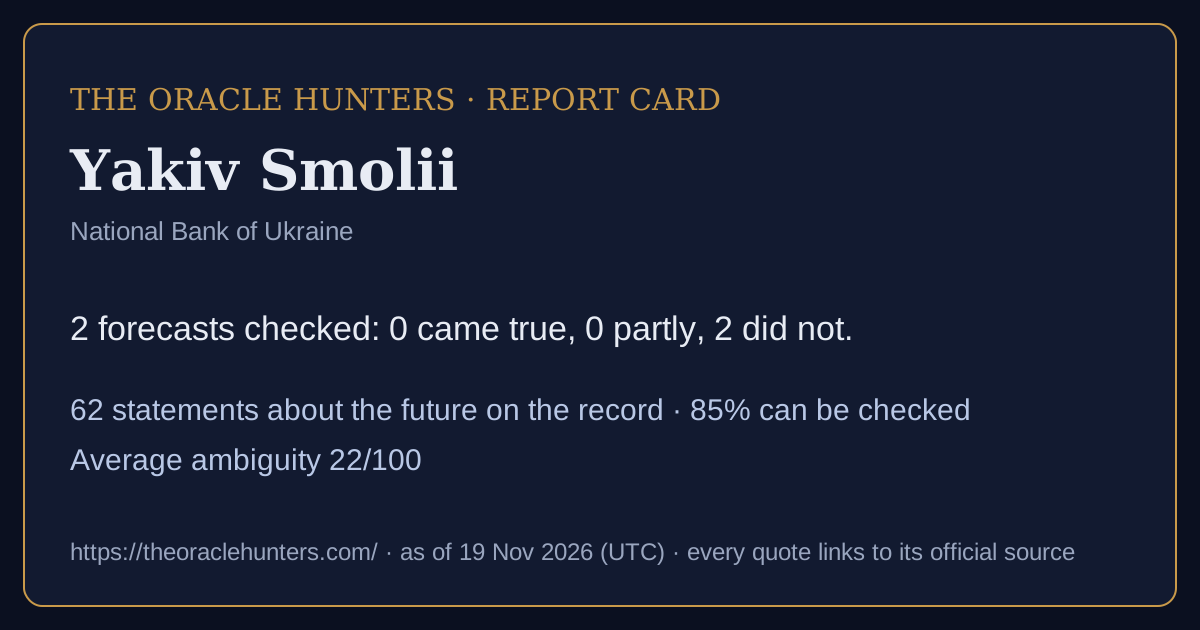
Yakiv Smolii
National Bank of Ukraine
Track record: 2 forecasts checked: 0 came true, 0 partly, 2 did not.
62forecasts & commitments on the record
85%can be checked as stated
22average ambiguity (0-100)
0goalpost moves recorded
0confirmed U-turns
Timeline
came true partly did not not due / being checked / too vague
Calibration score: shown after 10 checked forecasts with a stated likelihood (now 2).
How they speak about the future: based on data 54, stated on authority 7, educated guess 1.
Kinds of claim: forecast 58, mixed claim 2, scenario (if… then) 1, commitment 1. · Download this report card as a picture
In the nine words
πρόγνωσιςInference from evidence54 · 87%μαντείαInspired knowledge6 · 10%προαναγγελίαPublic pre-announcement1 · 2%πρόνοιαPreparing for the future1 · 2%
How to read this
Each box is one sentence a public figure or institution said about the future, word for word, with a link to the official text. Can be checked means it names what will happen, by when, and how likely - so it can be compared with official figures later. Too vague to check means it does not. Ambiguity (0-100) is how many different ways the sentence can be read. When the date passes, the forecast is compared with official data and marked came true, partly or did not come true. Labels judge the sentence, never the person. Full guide and glossary.Checked
This year economic growth will accelerate to 3.5%, up from 3.3% in 2019, and will reach around 4% in the following years.
Did not come true. Said: economic growth around 3.5% in 2020. Official figure for Ukraine: -3.8% (World Bank open data). Missed. Off by 7.2 points. official data · checked 14 Nov 2026 · automatic check against official data (rules v3)
Growth in real GDP will accelerate to 2.9% in 2020 and 3.7% in 2021.
Did not come true. Said: economic growth around 2.9% in 2020. Official figure for Ukraine: -3.8% (World Bank open data). Missed. Off by 6.7 points. official data · checked 14 Nov 2026 · automatic check against official data (rules v3)
On the record (62)
achieved an inflation target of 5% ± 1 pp sooner than expected, and inflation has since remained low.
We expect that unemployment in Ukraine will peak at 11.5% in Q2 2020 due to the corona crisis, compared to 8.2% last year.
According to the ILO forecast, by 2024, the burden on the working population by dependent people will increase compared to 2019 even more - by 6%.
A partial recovery will take place next year, but GDP will still be below pre-virus levels.
The global economy will lose 3% of real GDP this year, according to the IMF.
In the coming years, we again expect growth of 4%.
To stimulate the economy, we will probably be able to cut the key policy rate further during the current year.
The NBU leaves open the possibility of a greater easing in monetary policy this year if a fall in consumer demand due to quarantine measures and weaker business activity put stronger downward pressure on inflation than is currently expected.
Next year, Ukraine is expected to see a drop in gas transit revenues, as well as pent-up demand for consumer goods from households and for investment imports from businesses.
In Q1 2021, inflation will temporarily deviate from the target range against a low comparison base.
This will keep inflation from growing above the target level this year.
- Second, financing from the IMF and other official international partners will help maintain Ukraine's international reserves at USD 27 to 29 billion this year and in the coming years.
Price growth will accelerate moderately in the coming months, to reach 6% at the end of 2020.
As before, the NBU plans to decrease its key policy rate to 7% by the end of the current year.
The risk arising from the global spread of the novel coronavirus could, if realized, drive the global economy into a recession and cause a significant slowdown in the Ukrainian economy.
As a result, inflation is currently below the NBU's medium-term target of 5% that is the level optimal for the development of the Ukrainian economy.
In view of the above, the NBU Board continued its monetary policy easing cycle by cutting the key policy rate by 1 pp, to 10%, as envisaged by the central bank's January forecast.
Consumer inflation slowed down to 3.2% yoy in January and to 2.4% yoy in February, which was faster than foreseen in the forecast trajectory.
In January the NBU forecast inflation at 4.8% as of the end of 2020, but this forecast may be reviewed in A pril depending on further developments.
## The 2020-2022 current account deficit will remain acceptable
If the inflation rate stabilizes in its target range of 5% ± 1 pp, the key policy rate could be reduced to 7% by late 2020.
The current account deficit will range from 3% to 4% in 2020-2022.
This year economic growth will accelerate to 3.5%, up from 3.3% in 2019, and will reach around 4% in the following years.
Did not come true. Said: economic growth around 3.5% in 2020. Official figure for Ukraine: -3.8% (World Bank open data). Missed. Off by 7.2 points. official data · checked 14 Nov 2026 · automatic check against official data (rules v3)
Driven by the monetary policy easing, inflation in 2021-2022 will remain within the medium-term target of 5% ±1 pp.
However, inflation will accelerate in Q4 to 4.8% at year-end 2020.Therefore, it will return to the target range at the end of the year.
The macroeconomic forecast that the NBU published in October envisages that the key policy rate will be cut further, to 8%.
From March 2020, the NBU will introduce differing reserve ratios for different currencies.
The NBU believes that more active cuts in the key policy rate will not prevent it from maintaining inflation close to its 5% target, while at the same time promoting economic growth.
The stronger hryvnia made inflation decline towards the 5% target faster than envisaged in the latest macroeconomic forecast.
The next meeting of the NBU Board on monetary policy issues will be held on 30 January 2020.
With that in mind, the central bank will increase the amount of its planned interventions in the interbank market to purchase foreign currency from USD 30 to USD 50 million per day for the remainder of the current year and Q1 2020.
However, these factors will offset each other, which leaves this year's inflation forecast unchanged.
The NBU's forecast scenario envisages that the key policy rate will be cut further, to 8% as of the end of 2021, provided that inflation steadily declines to its 5% target.
In particular, it will narrow to 2.9% of GDP this year despite the stronger hryvnia.
The NBU has revised its economic growth forecast upwards, to 3.5% in 2019-2020 and 4% in 2021.
Inflation will m eet the target range of 5%+/-1 pp in early 2020 and reach the medium-term target of 5% at the end of 2020.
Same as before, the NBU expects inflation to decline to 6.3% as of the year-end.
How quickly the key policy rate is reduced to its neutral level of 8% will depend on both internal and external risks.
The NBU will continue the cycle of monetary policy easing, provided inflation is steadily declining to its 5% target.
Meanwhile, core inflation was 7.4% was in line with the NBU's forecast.
Despite seasonal decrease of prices in July, inflation in annual terms was higher than our forecast and made 9.1% The NBUestimates inflation to have declined in August, although still remaining above the forecast level.
The NBU is continuing the cycle of monetary policy easing, as it expects inflation to decline to the target of 5%.
The NBU reiterates its forecast that inflation will meet the 5% medium-term target at the end of next year.
The largest decrease is expected over 2020, along with inflation returning to the target range and inflation expectations improving.
As a result, international reserves will reach USD 23 billion in 2021.
## The 2019-2021 current account deficit will remain acceptable.
Economic growth will be dampened by a weak global economic activity and decrease in gas transit to European countries starting in 2020, due to the construction of bypassing gas pipelines.
The NBU has revised its economic growth forecast to 3% in 2019 (from 2.5%) and 3.2% in 2020 (from 2.9%) amid stronger domestic demand, better terms of trade, and larger harvest of grain crops.
The NBU reiterates its forecast that inflation will decline to 6.3% as of the end of 2019, return to the target range in early 2020, and reach the medium-term target of 5% at the end of 2020.
At the same time, the public will be able to exchange these coins without limitation and free of charge for coins and banknotes of other denominations during the next three years .
Showing the newest 50 - the ledger has all 62.
Also said - not checkable as stated (12 newest)
Remarks about the future with no date, figure or likelihood that could be checked. They are kept on the record and shown here, but not scored.
For months, the central bank has been pressurized to make decisions that are economically unsound, that focus on short-term, easy 'victories,' and that could take a tremendous toll on the Ukrainian economy and people in the long run.
Y es, it will be some time before low inflation and the low key policy rate have their full impact on the cost of debt.
It is imperative that the president, government, and political forces finally begin to work effectively with the central bank.
We will have two days to discuss, in particular, how monetary policy affects economic inequality and whether economic inequality should be among a central bank's goals.
Incidentally, we will have the opportunity to hear one of these researchers tomorrow.
Under this deal, we will receive dollars from the international organization to replenish our international reserves.
We will now accept not only government bonds, but also municipal and governmentguaranteed corporate bonds.
In the near future, we will have even more options to ensure fi nancial stability after the NBU has stepped in as a regulator of nonbank fi nancial institutions on 1 July.
- The fourth has been to create conditions in which the economy will quickly return to growth after the quarantine has ended.
We will pursue them until they become reality.
All customers must be confident that they will get high-quality services.
Could we have done a better job implementing the previous program?