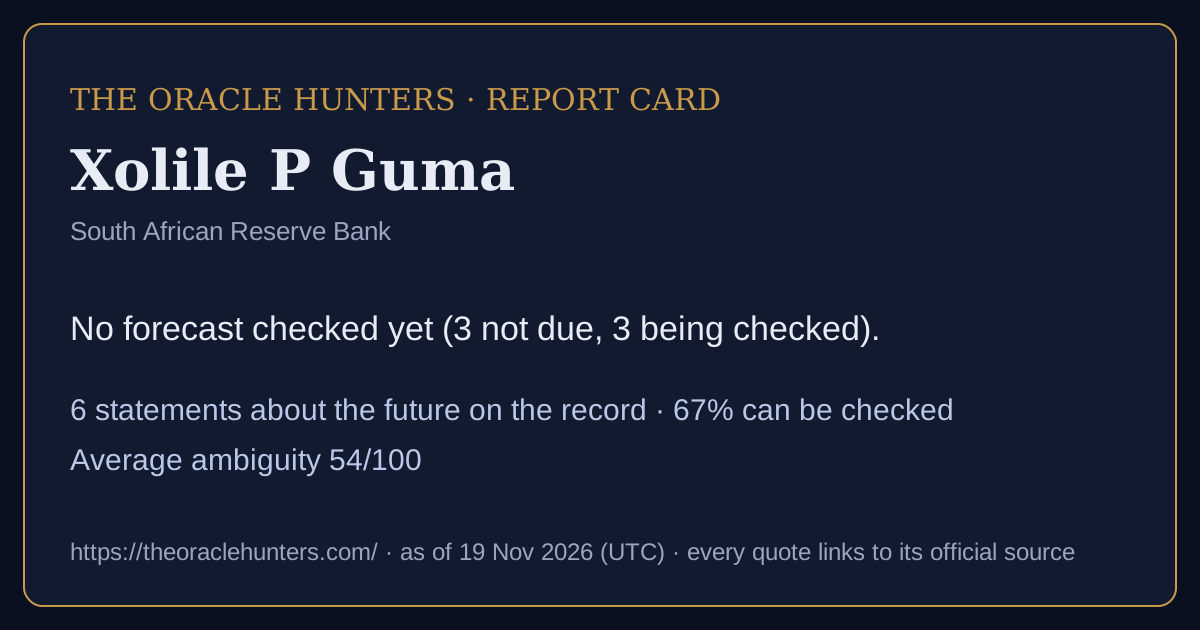
Xolile P Guma
South African Reserve Bank
Track record: No forecast checked yet (3 not due, 3 being checked).
6forecasts & commitments on the record
67%can be checked as stated
54average ambiguity (0-100)
0goalpost moves recorded
0confirmed U-turns
Timeline
came true partly did not not due / being checked / too vague
Calibration score: shown after 10 checked forecasts with a stated likelihood (now 0).
How they speak about the future: based on data 5, stated on authority 1.
Kinds of claim: forecast 4, mixed claim 1, commitment 1. · Download this report card as a picture
In the nine words
πρόγνωσιςInference from evidence4 · 67%μαντείαInspired knowledge1 · 17%προαναγγελίαPublic pre-announcement1 · 17%
How to read this
Each box is one sentence a public figure or institution said about the future, word for word, with a link to the official text. Can be checked means it names what will happen, by when, and how likely - so it can be compared with official figures later. Too vague to check means it does not. Ambiguity (0-100) is how many different ways the sentence can be read. When the date passes, the forecast is compared with official data and marked came true, partly or did not come true. Labels judge the sentence, never the person. Full guide and glossary.On the record (6)
The revised SAA will be implemented later this year, coinciding with the appointment of new external fund managers and/or reappointment of some existing ones.
Over the past few months, gross foreign exchange reserves have increased to levels above USD35 billion, largely due to the successful international bond issue which took place in May this year.
As has been observed elsewhere in this regard, 'take away inflation targeting and we will still have monetary policy, we will still have the same instruments of monetary policy, and the Bank will still have a constitutional mandate to maintain low inflation' 10 , in the interest of balanced and sustainable economic growth in the Republic.
Five of the largest banks account for the greater share of the banking sector assets of R2860.5 billion as at May 2008, a pattern which has been consistent over time.
Clearly, though, there will be a need to re-assess the quantitative dimensions of the desired end-state if severe macro-economic dislocation is to be avoided in the period which is to extend beyond 2012, in terms of the SADC timetable.
Growth in real gross domestic product amounted to 4,5 per cent in 2004, and preliminary anecdotal evidence suggests that this performance may have been exceeded somewhat in 2005.
Also said - not checkable as stated (12 newest)
Remarks about the future with no date, figure or likelihood that could be checked. They are kept on the record and shown here, but not scored.
The financial risks in advanced economies that might impact on the stability of the South African financial system, and which are discussed comprehensively in the Financial Stability Review, are
In many sub-Saharan African countries economic growth has returned to pre-crisis levels, but growth prospects will depend on a sustainable recovery in the global economy.
The rising trend in the growth rate of impaired advances seems to have peaked and indications are that it may start to decline in the near future.
Recent tensions in the Middle East and North Africa countries, the substantial impact on oil prices, and developments in Japan, together with increased prospects of further monetary policy tightening in advanced economies, will be developments of which to take note.
Although household debt to disposable income remained at elevated levels and the profile of credit-active consumers worsened somewhat in the fourth quarter of 2010, the improved outlook for economic growth in 2011 could boost the confidence level of consumers in South Africa.
Job losses, which negatively affect consumers' ability to take up new credit, might have had an impact on prospective homeowners' ability to purchase a residence.
In emerging market economies GDP growth has been robust and incentives for capital inflows are expected to remain strong.
I trust that you will find these interesting, stimulating and relevant to the current environment and invite you to provide comment as part of the important process of ongoing debate on financial stability.
The Financial Stability Department has existed since 2001, its task being to identify possible threats to financial stability and suggest ways in which these could be mitigated.
The financial crisis has demonstrated, in general, that, although microprudential supervision makes a valuable and indispensable contribution to financial stability, it may be insufficient on its own to ensure systemic financial stability.
This could place downward pressure on commodity prices, which could also undermine government revenues and raise public debt to unsustainable levels.
The elevated rate of unemployment continued tight lending conditions and a need to address weaker household balance sheets are expected to continue to impact consumption expenditure negatively.