World Health Organization
Institution - official statements with no named speaker
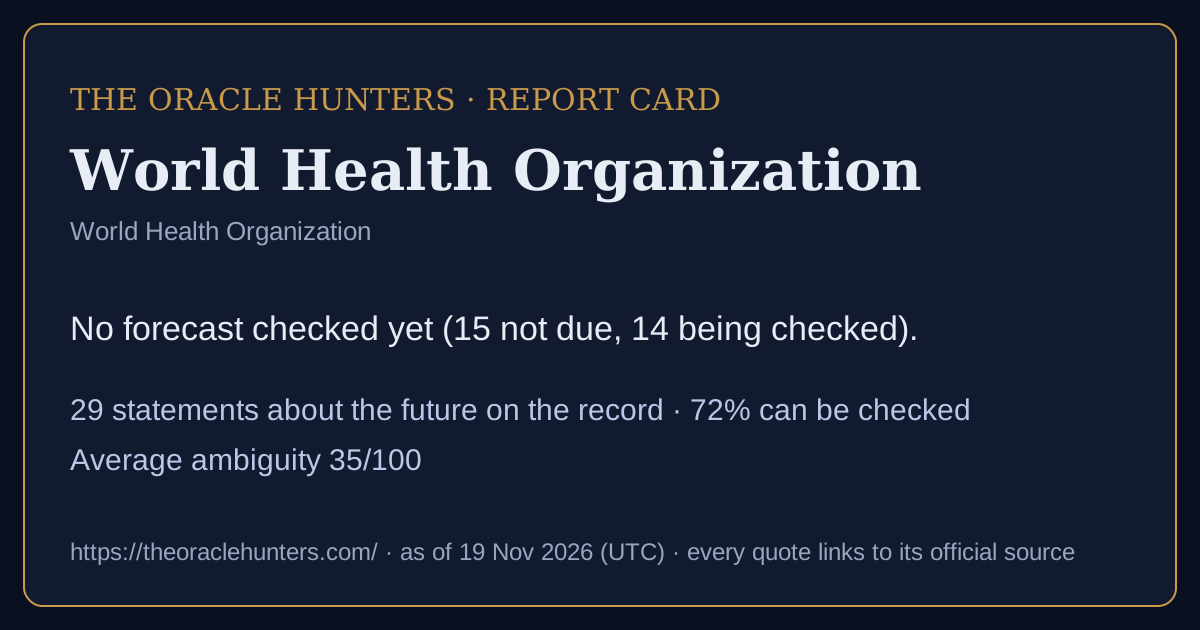
Track record: No forecast checked yet (15 not due, 14 being checked).
29forecasts & commitments on the record
72%can be checked as stated
35average ambiguity (0-100)
0goalpost moves recorded
0confirmed U-turns
Timeline
came true partly did not not due / being checked / too vague
Calibration score: shown after 10 checked forecasts with a stated likelihood (now 0).
How they speak about the future: based on data 27, educated guess 1, stated on authority 1.
Kinds of claim: forecast 25, mixed claim 3, scenario (if… then) 1. · Download this report card as a picture
In the nine words
πρόγνωσιςInference from evidence27 · 93%μαντείαInspired knowledge1 · 3%πρόνοιαPreparing for the future1 · 3%
How to read this
Each box is one sentence a public figure or institution said about the future, word for word, with a link to the official text. Can be checked means it names what will happen, by when, and how likely - so it can be compared with official figures later. Too vague to check means it does not. Ambiguity (0-100) is how many different ways the sentence can be read. When the date passes, the forecast is compared with official data and marked came true, partly or did not come true. Labels judge the sentence, never the person. Full guide and glossary.On the record (29)
The ACT-Accelerator needs US$35 billion to fast-track the development, procurement and distribution of 2 billion vaccine doses, 245 million treatments and 500 million tests over the next year.
A collaboration between Serum Institute of India (SII), Gavi and the Bill & Melinda Gates Foundation announced earlier this month will ensure up to 100 million doses of AstraZeneca or Novavax’s candidate vaccines, if successful, will be available to low- and middle-income economies through the COVAX Facility at just US$ 3 per dose.
Through COVAX our aspiration is to be able to vaccinate the most vulnerable 20% of the population of every country that participates, regardless of income level, by the end of 2021.
Respondents from 82 countries, including 14 with lower than 80 per cent vaccination coverage rates in 2019, reported on disruptions in immunization services due to COVID-19 as of May 2020.
The likelihood that a child born today will be fully vaccinated with all the globally recommended vaccines by the time she reaches the age of 5 is less than 20 per cent.
While it is too soon to assess the full impact of the lockdowns and other containment measures, the report estimates that at a minimum, another 83 million people, and possibly as many as 132 million, may go hungry in 2020 as a result of the economic recession triggered by COVID-19.iii The setback throws into further doubt the achievement of Sustainable …
On current trends, by 2030, Africa will be home to more than half of the world’s chronically hungry.
Across the planet, the report forecasts, the COVID-19 pandemic could tip over 130 million more people into chronic hunger by the end of 2020.
In January 2021, the Executive Board will hold its regular session, where the Panel’s work will be further discussed; and in May of next year, at the World Health Assembly, the panel will present its substantive report.
Through a collaboration of multiple partners, we are likely to see generic versions of dolutegravir for children by early 2021, allowing for a rapid reduction in the cost of this medicine,” said Dr Meg Doherty, Director of the Department of Global HIV, Hepatitis and STI Programmes at WHO.
WHO released its 2020 World malaria report, which provided an overview of the malaria response during the pandemic and outlined that even a disruption in access to treatment of 10% in sub-Saharan Africa was likely to lead to an estimated 19 000 additional deaths in the region.
Due to the pandemic's disruptive effects, nearly half of the world’s 3.3 billion global workforce are at risk of losing their livelihoods, tens of millions of people are at risk of falling into extreme poverty and up to 132 million people could become undernourished.
WHO, the Coalition for Epidemic Preparedness Innovations (CEPI) and Gavi, the Vaccine Alliance, alongside key delivery partner UNICEF, published COVAX’s first interim distribution forecast with information on the availability of vaccines doses in the first half of 2021 to COVAX participants.
Under a worst case scenario, there would be a projected 5.3 million additional chronic HBV infections among children born between 2020 and 2030 and 1 million additional HBV-related deaths among those children later on.
Demonstrating the return on investment provided by the Access to COVID-19 Tools (ACT) Accelerator, the Eurasia Group published an analysis estimating that global equitable access to COVID-19 vaccines will generate economic benefits of at least US$ 153 billion in 2020–21 and US$ 466 billion by 2025, in 10 major economies.
The 2020 edition of the UN’s ‘State of Food Security and Nutrition in the World’ is published, which forecasted that the COVID-19 pandemic could tip over 130 million more people into chronic hunger by the end of the year.
of which 1 billion will be purchased for LMICs, by the end of 2021.
tests to LMIC’s by mid-2021, 245 million courses of treatments to LMICs by mid-2021, and 2 billion vaccine doses, of which 50% will go to LMICs by the end of 2021.
The event will include an interactive Facebook live session in which FAO and WHO experts will discuss the theme of this year’s World Food Safety Day,
At least 80 million children under one at risk of diseases such as diphtheria, measles and polio as COVID-19 disrupts routine vaccination efforts, warn Gavi, WHO and UNICEF
According to data collected by the World Health Organization, UNICEF, Gavi and the Sabin Vaccine Institute, provision of routine immunization services is substantially hindered in at least 68 countries and is likely to affect approximately 80 million
A key aim this year will be to support ongoing efforts to protect some 70 million forcibly displaced people from COVID-19.
On current trends, WHO estimates that this year, 2020, approximately 1 billion people (almost 13 per cent of the global population) will be spending at least 10% of their household budgets on health care.
“A vaccine against HSV infection would not only help to promote and protect the health and well-being of millions of people, particularly women, worldwide – it could also potentially have an impact on slowing the spread of HIV, if developed
This announcement will not have an immediate effect on how the vaccine is accessed or administered in the Democratic Republic of the Congo, as licensing has not yet occurred, and licensed doses will only be available mid-2020.
It warns that if current trends continue, up to 5 billion people will still be unable to access health care in 2030 – the deadline world leaders have set for achieving universal health coverage.
the 2030 targets will not be met without redoubled efforts.
If trends continue, up to 5 billion of the world’s population will not be covered by essential health services in 2030, as highlighted in the
A pilot study in 4 African countries showed that implementing a selection of the new recommendations could result in a 39% reduction in surgical site infections.