World Bank Managing Director
World Bank Group
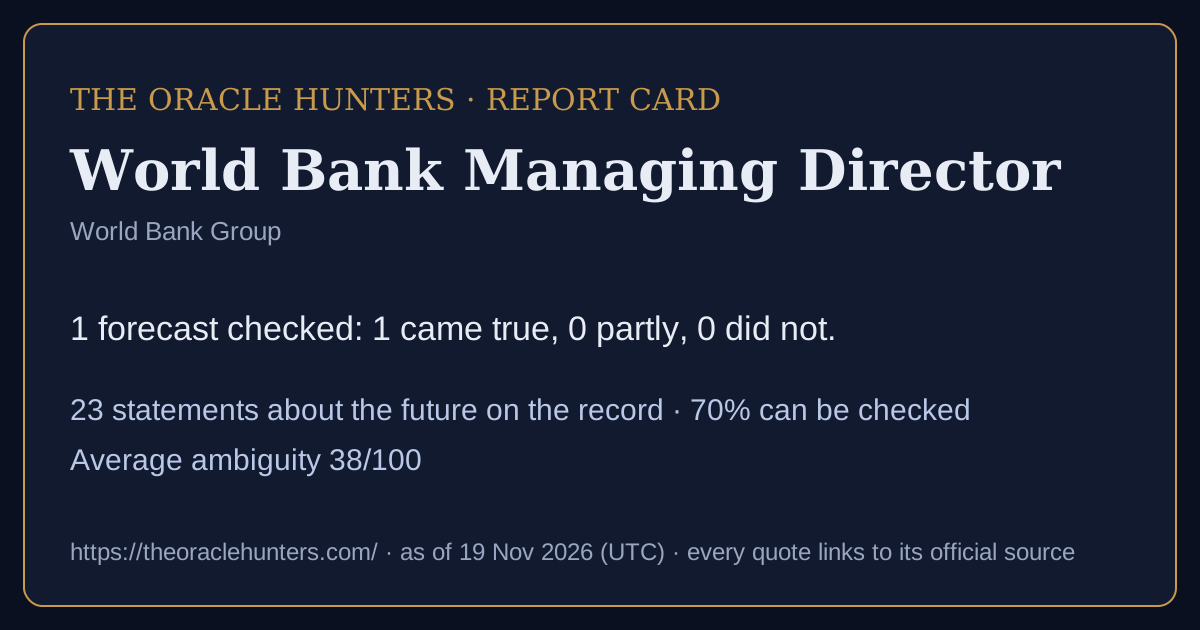
Track record: 1 forecast checked: 1 came true, 0 partly, 0 did not.
23forecasts & commitments on the record
70%can be checked as stated
38average ambiguity (0-100)
0goalpost moves recorded
0confirmed U-turns
Timeline
came true partly did not not due / being checked / too vague
Calibration score: shown after 10 checked forecasts with a stated likelihood (now 0).
How they speak about the future: based on data 20, educated guess 2, stated on authority 1.
Kinds of claim: forecast 20, scenario (if… then) 2, commitment 1. · Download this report card as a picture
In the nine words
πρόγνωσιςInference from evidence19 · 83%πρόνοιαPreparing for the future2 · 9%προαναγγελίαPublic pre-announcement1 · 4%μαντείαInspired knowledge1 · 4%
How to read this
Each box is one sentence a public figure or institution said about the future, word for word, with a link to the official text. Can be checked means it names what will happen, by when, and how likely - so it can be compared with official figures later. Too vague to check means it does not. Ambiguity (0-100) is how many different ways the sentence can be read. When the date passes, the forecast is compared with official data and marked came true, partly or did not come true. Labels judge the sentence, never the person. Full guide and glossary.Checked
New directions for China’s economic course have been in the making for years, and the indicative growth rate of about 7 percent for next year is in line with this trend.
Came true. Said: economic growth around 7% in 2016. Official figure for China: 6.8% (World Bank open data). On target. Off by 0.2 points. official data · checked 14 Nov 2026 · automatic check against official data (rules v3)
On the record (23)
Our first financing arrangement came in 1962, when representatives of Korea and the World Bank signed an agreement for the International Development Association to provide $14 million in financing for railroad projects.
The ERF can mobilize up to $50 million per country during the early stages of an emerging crisis, making use of food security data and forecasts to identify eligible events.
Out of which IDA, our fund for the poorest, will provide $50 billion of that total in grants and highly concessional credit terms.
Looking ahead, we will provide up to $160 billion in financing for the next 15 months.
According to World Bank research unabated warming could create 100 million new poor people.
Demographic trends will demand sustainable health and welfare systems for aging populations and creating 500 million new jobs in developing countries where populations are growing rapidly, as in Africa and South Asia.
Growth in these economies is projected to advance at a meager 0.4% pace this year, a downward revision of 1.2 % from the January outlook.
Ensuring access to adequate, safe, and affordable housing is also part of Sustainable Development Goal #11, which commits the global community to making cities inclusive, safe, resilient and sustainable.By 2030, the global population will reach over 8 billion, with almost 60 percent living in cities.
Third, climate change is an additional threat that could potentially create 100 million new poor people.
In addition, this year we are experiencing the worst El Niño since the late 1990s, which will expose over 10 million people in East and Southern Africa, Central America, and the Caribbean to acute food insecurity.
Putting all of this together, we think that 2016 will continue to be challenging with significant headwinds and broad-based weaknesses.
By 2025, 68 percent of the population is projected to live in urban areas, compared with 52 percent in 2012.
Global growth continues to disappoint - likely to be about 2.5 percent in 2015, and about 3 percent in 2016.
This year is a crucial year for us and our many partners: At the United Nations the international community will define the new Sustainable Development Goals, which will be the next-generation scorecard of our combined efforts to end poverty.
The reduction of administrative burdens on small enterprises, which caused the number of new businesses to jump by 50 percent, is evidence that further improvements in the business climate has much scope to generate growth and jobs in the years ahead.
At the same time, there are currently some 250 million migrants in China’s cities, and tens of millions more will move to the cities in the years to come.
China’s submission to the COP-21 meeting could solidify the country’s commitments to global environmental goals and hold or even reverse greenhouse gas emissions by 2030 or before.
New directions for China’s economic course have been in the making for years, and the indicative growth rate of about 7 percent for next year is in line with this trend.
Came true. Said: economic growth around 7% in 2016. Official figure for China: 6.8% (World Bank open data). On target. Off by 0.2 points. official data · checked 14 Nov 2026 · automatic check against official data (rules v3)
But as World Bank research shows, if inequality starts to affect equity of opportunity, inequality could threaten growth.
We are now only 15 months away from the creation of its economic community, a much anticipated step for further integration A seamless economic space with 600 million people can be a powerful engine of growth for the region and the world.
If current trends prevail, we can expect the importance of emerging economies will only grow.
Almost 80 % of GDP is generated in cities, and it will be difficult for any country to reach middle-income status and beyond without getting urbanization right.
Global consumer spending by women is projected at $28 trillion in 2014, up from $20 trillion in 2009.
Also said - not checkable as stated (12 newest)
Remarks about the future with no date, figure or likelihood that could be checked. They are kept on the record and shown here, but not scored.
Mobilizing private capital at scale will be essential to closing financing gaps, accelerating job creation, and sustaining growth.
We will hear about Korea’s development achievements; then we will hear about the process of development, particularly how Korea’s economic development plans and its international engagement strategy combined to spur development; and finally, we will hear about Korea’s future development strategy.
Most of you will know that the next tier of assistance for countries comes through the International Bank for Reconstruction and Development, or IBRD – the arm of the World Bank focused mainly on providing development finance to middle-income countries.
I am proud that the World Bank could play this meaningful role in Korea’s development story.
Society at large will be stronger as a result, including in situations of fragility, conflict and violence where agribusiness jobs and rural programs can improve social cohesion.
Our response to the current crisis must support better health and human capital development in the long run.
The World Bank will be releasing our Global Economic Prospects forecasts next week, which showed negative growth for a large number of countries, advanced and developing in 2020.
Today’s disruptions in trade and schooling may lead to tomorrow’s unemployment and diminished human capital, especially for women and girls.
This will be used firstly on the shorter-term response which focuses on protecting the poor and vulnerable through social protection programs, such as scalable cash transfer programs which have used digital technology in its delivery; income and food security support; protecting jobs and ensuring the sustainability of firms, especially SMEs.
This could include building of low carbon infrastructure, more resilient health and food safety systems, and elimination of distorting subsidies such as fuel and agriculture subsidies.
As the working-age population and productivity decelerate, growth will be harder to sustain, and the goals of the World Bank - ending poverty and promoting shared prosperity - will be much harder to achieve.
It will become ever more urgent to create jobs, enhance basic human development outcomes – like education and health – empower women, lengthen productive lives, and reduce inequality.