World Bank Group Senior Vice President
World Bank Group
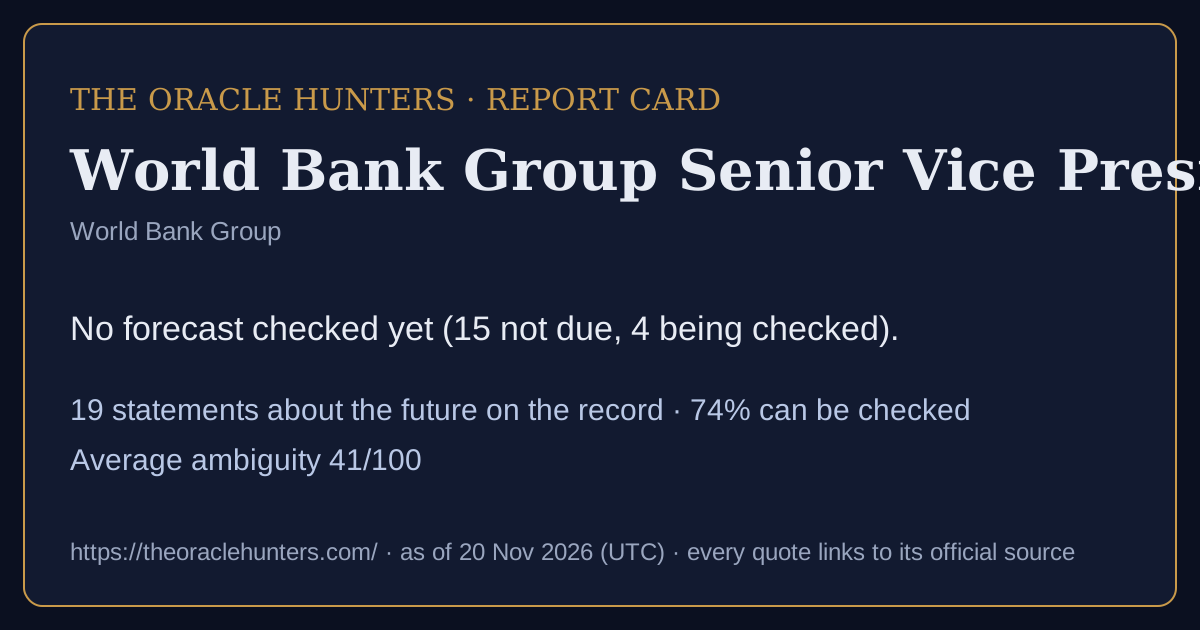
Track record: No forecast checked yet (15 not due, 4 being checked).
19forecasts & commitments on the record
74%can be checked as stated
41average ambiguity (0-100)
0goalpost moves recorded
0confirmed U-turns
Timeline
came true partly did not not due / being checked / too vague
Calibration score: shown after 10 checked forecasts with a stated likelihood (now 0).
How they speak about the future: based on data 17, educated guess 2.
Kinds of claim: forecast 15, mixed claim 2, scenario (if… then) 2. · Download this report card as a picture
In the nine words
How to read this
Each box is one sentence a public figure or institution said about the future, word for word, with a link to the official text. Can be checked means it names what will happen, by when, and how likely - so it can be compared with official figures later. Too vague to check means it does not. Ambiguity (0-100) is how many different ways the sentence can be read. When the date passes, the forecast is compared with official data and marked came true, partly or did not come true. Labels judge the sentence, never the person. Full guide and glossary.On the record (19)
If global experience is a barometer, cities in Africa will have a critical role to play in their countries’ economic growth.
Under the proposed Kenya Urban Support Program (KUSP, US$300 million), considered a follow-on project from KMP, the collaboration between World Bank and the UN-Habitat will continue as KUSP work closely with the national government and county governments on enhancing urban management, urban infrastructure and service delivery.
(2) We are also considering USD 80 million additional financing to our Emergency Health and Nutrition Project to address the worsening health and nutrition status of the vulnerable, particularly children and women.
(3) A Global Agriculture Food Security Program Grant for USD 36 million is expected to target poor households/smallholders, particularly women, returnees, and farmers who lost their livelihood due to the ongoing conflict.
The Bank’s political risk insurance arm, the Multilateral Investment Guarantee Agency (or MIGA), has provided a $427 million-dollar Sharia-compliant investment guarantee for an infrastructure project in Djibouti and $450 million in political risk insurance for a telecommunications investment in Indonesia.
Johannesburg, South Africa, issued Africa’s first municipal green bond in 2014 – over $100 million dollars -- to help finance emissions-reducing projects including bio gas energy, solar power, and sustainable transportation.
Further, the number of light-duty vehicles on the road will significantly increase while adequate public transport remains unaffordable to a large population in many major cities in the world. 70% of fuel energy is lost in engine and driveline inefficiencies.
The world population is expected to reach 8.5 billion by 2030, putting an exponential increase in demand for mobility.
The green bonds market has since developed rapidly and is expected to reach a total volume of $80 to $100 billion dollars by the end of this year.
We also need to boost domestic resource mobilization, which the World Bank Group estimates developing countries could grow up to 2-4 percent of GDP.
If not, they will reject reforms that lead to national growth, and will turn away from the shared sacrifice needed to address global public threats that affect us all.
By 2030, an estimated 62 percent of the global poor will live in fragile and conflict-affected situations, jeopardizing the “leave no one behind” commitment.
The region is forecast to contract by 1.3 percent in 2016 after a 0.7 percent decline in 2015, the first back-to-back years of recession in more than 30 years.
Aggregate growth for emerging market and developing economies (EMDEs) is projected at 3.5 percent for 2016, just above the post-crisis low in 2015.
However, it is projected to begin expanding again in 2017, gradually gaining momentum to around 2 percent in 2018.
Advanced economies are projected to expand by 1.7 percent this year, 0.5 percentage point slower than expected in January.
Statistical capacity building: WBG technical and financial support to improve production of key statisticsRegarding implementation: The SDGs are global, yet the challenges to achieving them are country specific, and hence engagement will have to take place at the country level as the primary means through which one can support the 2030 Agenda.
This underscores the critical priority of pursuing growth-enhancing policies: Global growth this year is projected at 2.4 percent, unchanged from the disappointing pace of 2015, and 0.5 percentage point below January 2016 forecasts.
This fiscal year, the Bank Group has approved $11.6 billion for Africa, spread out among over 100 projects.
Also said - not checkable as stated (12 newest)
Remarks about the future with no date, figure or likelihood that could be checked. They are kept on the record and shown here, but not scored.
We also hope that this event will send a strong message on the importance of independent institutions -- from investigative and prosecutorial bodies to the judiciary -- in the fight against corruption.
If we are to make sustained progress in the pursuit of the World Bank Group’s twin goals -- to end extreme poverty and boost shared prosperity -- we must double our efforts in the fight against corruption.
We know that successful anti-corruption efforts must feature a broad coalition of leaders across borders, as well as partners both inside and outside of government in different countries working together.
For our part, we are committed to contributing to this process through the World Bank/UNODC StAR Initiative.
Adding to this, workers’ high food, housing, and transport costs increase labor costs, thus reducing expected returns on investment.
As Africa’s cities clarify land rights and strengthen land use planning, they will encourage economic growth.
Going forward, the core focus will have to be on leveraging and mobilizing global funds -- especially from the private sector -- through innovative mechanisms to meet the extraordinary financing needs of the region The World Bank Group has three priorities in our efforts to reach our twin goals of ending poverty and boosting shared prosperity, which are fully aligned …
Now global partners will emphasize how stronger health systems, skills building, within a framework of strong institutions and good governance, can lead to better systems of consumption and production, and can help promote stability and peace, and end poverty.
In addition, for the first time in its 56-year history, IDA will leverage its equity by blending donor contributions with internal resources and funds raised through debt markets.
Such large infrastructure investment could have the additional benefit of reigniting global growth.
Each of these priorities require financing and private sector participation: First, we need to accelerate inclusive and sustainable economic growth.
And third, we need to foster resilience to global shocks and threats, from pandemics to climate change.