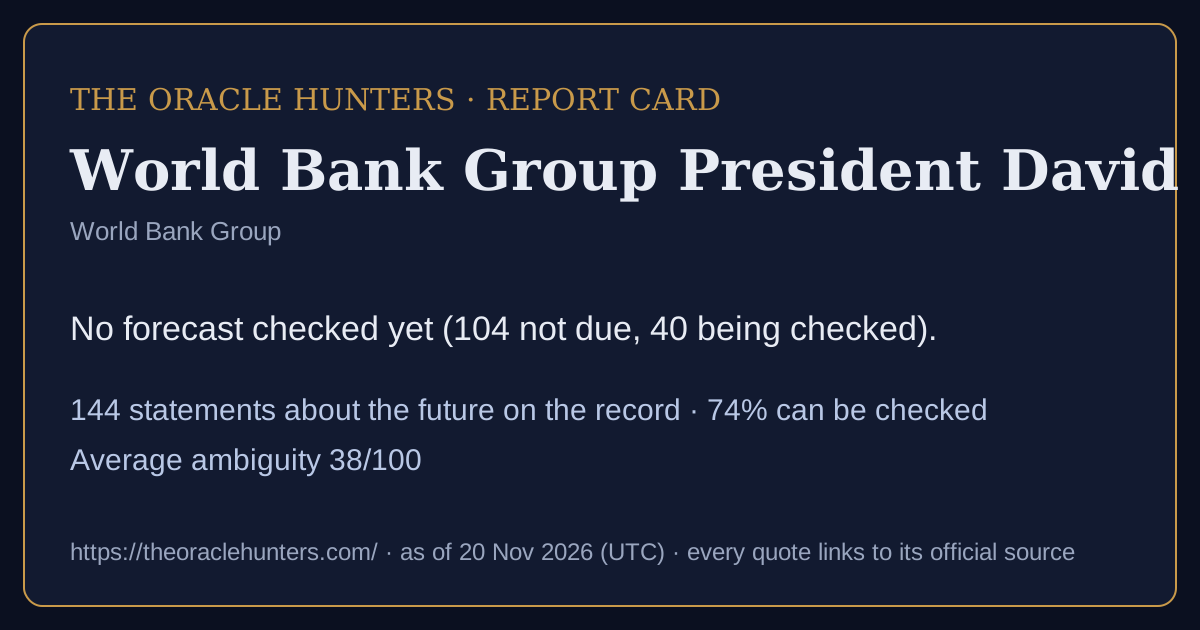
World Bank Group President David Malpass
World Bank Group
Track record: No forecast checked yet (104 not due, 40 being checked).
144forecasts & commitments on the record
74%can be checked as stated
38average ambiguity (0-100)
0goalpost moves recorded
0confirmed U-turns
Timeline
came true partly did not not due / being checked / too vague
Calibration score: shown after 10 checked forecasts with a stated likelihood (now 0).
How they speak about the future: based on data 132, stated on authority 7, educated guess 5.
Kinds of claim: forecast 112, mixed claim 23, commitment 5, scenario (if… then) 4. · Download this report card as a picture
In the nine words
πρόγνωσιςInference from evidence129 · 90%προαναγγελίαPublic pre-announcement5 · 3%πρόνοιαPreparing for the future4 · 3%μαντείαInspired knowledge3 · 2%εἰκασίαConjecture2 · 1%πρόβλεψιςSeeing the signs1 · 1%
How to read this
Each box is one sentence a public figure or institution said about the future, word for word, with a link to the official text. Can be checked means it names what will happen, by when, and how likely - so it can be compared with official figures later. Too vague to check means it does not. Ambiguity (0-100) is how many different ways the sentence can be read. When the date passes, the forecast is compared with official data and marked came true, partly or did not come true. Labels judge the sentence, never the person. Full guide and glossary.On the record (144)
The national debts in the advanced economies have grown by an order of magnitude –in the U.S. from 50% of GDP to a looming 200% of GDP in CBO’s projections – not counting the excessive debt of some state and local governments and their non-transparent public pension liabilities.
This has helped mainstream QII principles in more than $22 billion of World Bank projects.
We are committed to continuing our support to enable the private sector, create new job opportunities, broaden the tax base, strengthen the financial sector, and build the country’s resilience to economic and climate shocks.
As a long-standing partner, we will support Bangladesh as it navigates a challenging global environment on its way to reaching upper-middle-income status by 2031.
In the report, we urged policymakers “to recognize the danger and move countries into safer territory in terms of the quality and quantity of investment and debt—sooner rather than later.” Yet here we are today—with 60 percent of low-income countries either in debt distress or at high risk of it.
We estimate that developing countries will need $2.4 trillion per year for the next seven years to address these global challenges, which could cost poorer countries as much as 8 percent of GDP.
I was there in February and think it will take capital market liberalization for India to achieve their 8% growth goal.
Global growth is expected to be weak this year, slowing to 2% from 3.1% in 2022.
As the World Bank, we have a portfolio of over $24 billion in water investments, and projects in over 70 countries.
To help cope, the World Bank is providing a $30 billion food and nutrition security package, including $12 billion of new projects, which have all been committed ahead of schedule.
In Sub-Saharan Africa, which is home to 60% of the world’s poor, per-capita income growth is expected to average just 1.2% over the next two years—a rate that would cause poverty rates to rise, not fall.
According to our projections, average global growth between 2020-2024 will be less than 2%, the slowest 5-year growth average since 1960.
Their debt service payments on external public and publicly guaranteed debt are expected to surge 35 percent in 2022, to $62B up from $46 billion in 2021.
Many of the impacts will be delayed even into 2024 and 2025 including debt restructurings.
This year, China is expected to account for 66 percent of the debt-service payments these countries will be making on their official bilateral debt.
I note that this is in addition to our current portfolio of energy access operations which amounts to US$8 billion, and when completed, it will provide energy access to 75 million people in Sub-Saharan Africa. · In conclusion, I would like to reiterate the WBG’s commitment to supporting the innovative solutions that SAPP is developing to leverage private and climate …
One important example is our partnership on QII with Japan, and that has helped mainstream QII principles in World Bank projects totaling $22.8 billion.
For 2022, IDA countries, which are the 75 poorest countries in the world, will have to pay $44 billion in debt service to official and commercial creditors.
My deep concern is that these conditions and trends might persist into 2023 and 2024.
The growth rate – we've lowered our 2023 growth forecast from 3 percent to 1.9 percent for global growth.
For example, a $2.3 billion program for Eastern and Southern Africa, which will help 11 African countries increase the resilience of the region’s food systems, the sustainable development of natural resources, and their ability to tackle growing food insecurity.
The world is not going to meet the goal of ending extreme poverty by 2030.
For 2022, the 75 poorest countries in the world will have to pay $44 billion in debt service to their bilateral and private creditors.
Climate change could push up to 132 million people into poverty by 2030 and, without urgent action, it could drive 216 million people to migrate within their own countries by 2050.
The World Bank has mobilized $13 billion in emergency financing from bilateral and development partners, with about $11 billion already disbursed through our projects and trust funds.To combat climate change, the World Bank Group is by far the largest single funder of climate-related finance in the developing world and a leader on climate diagnostics, methane emission reduction, and innovative climate …
The report also shows a 4% decline in global median income, the first decline since our measurements of median income began in 1990.Human Consequence of Overlapping CrisesThe developing world is facing an extremely challenging near-term outlook shaped by sharply higher food, fertilizer, and energy prices, rising interest rates and credit spreads, currency depreciation, and capital outflows.
The weakness of the euro and high inflation increase the likelihood of a European recession and further constrain the eurozone’s longer-term growth outlook.Looking beyond this sharp cyclical downturn, developing countries face the risk that these trends in advanced economies –inflation, slow growth, lower productivity, the drain on global energy supplies, and higher interest rates – persist beyond 2023.
China’s economy has slowed sharply due to COVID-19-related lockdowns, pushing the World Bank’s 2022 forecast for China down to 2.8% from 5% in April.
Moreover, new challenges already loom in the form of demographic pressures: by 2030, according to UN population projections, more than 1 in 4 primary-school-age children will live in Sub-Saharan Africa, the region with the highest learning poverty.
Current projections suggest that Africa’s unmet demand could reach four million metric tons this year, with West Africa facing the most acute challenges this growing season.
The World Bank Group is making around $170 billion in financing available for new and existing projects over the 15 months starting April 2022 to support this crisis response package.
Global growth is expected to slow sharply from 5.7 percent in 2021 to 2.9 percent in 2022, with further slowing likely as more countries fall into recession.
In Uganda, the World Bank supports two health sector projects, totaling $195.5 million.
We're looking at a crisis that, on the production side, will extend into 2023 as the world searches for ways to bring enough capital to bear to increase the production of energy and fertilizer and enable the agricultural system.
Global growth is not expected to rebound in 2023, given energy supply constraints; the long overdue normalization of interest rates and bond yields in the advanced economies; and the misallocation of investments that has pushed much of the world’s savings into bonds, mostly bonds issued by governments and overcapitalized borrowers.
By the end of this fiscal year, the World Bank will have provided nearly $11 billion in vaccine financing benefiting 80 countries.
I also recently announced that our support for the global response to the food security crisis will be up to $30 billion in existing and new projects.
We expect global economic activity to slow to 2.9 percent in 2022.
We will be presenting to our Board in a few weeks a 15-month crisis response envelope of around $170 billion to cover April 2022 through June 2023.
In this latest GEP, forecasts for 2022 growth have been revised down in nearly 70 percent of EMDEs compared to the January release.
If so, on a per capita basis, growth would fall close to zero.In this extraordinary era of overlapping global crises, policymakers need to focus their efforts in five key areas to respond to the crises and improve the outlook for developing countries: First, limit the harm to people directly affected by the war in Ukraine.Second, actively counter the spike in …
In 2022, the level of EMDE per capita income will be nearly 5 percent below its pre-pandemic trend.
Global economic activity is expected to slow to 2.9 percent in 2022 amid surging inflation, rising interest rates, and the war in Ukraine.
If they materialize, we could even see global growth fall to 2.1 percent in 2022 and 1.5 percent in 2023.
The growth forecast for emerging market and developing economies (EMDEs) this year has been lowered to 3.4 percent (from 4.6 percent expected in January 2022).
India is one of the most water-stressed countries in the world, with demand projected to nearly double by 2050.
Climate change could force up to 86 million Africans to migrate within their own countries by 2050.Climate interventions and projects offer large global public good benefits, but many require substantial external funding as well as a comprehensive policy framework.
Our vaccine financing will reach $11 billion by end June, covering 81 countries.
An estimated 100 million people in Sub-Saharan Africa are expected to face food insecurity in the coming months.
Around 60 percent of the world’s poorest countries are now in debt distress or at high risk of it.
Showing the newest 50 - the ledger has all 144.
Also said - not checkable as stated (12 newest)
Remarks about the future with no date, figure or likelihood that could be checked. They are kept on the record and shown here, but not scored.
Thus, while the 1980s were marked by accelerating growth and interest rates that could decline from a very high level, the current environment risks an extended period of dangerously low growth as an increasing portion of global capital flows to governments as interest rates rise to normal.
This will allow risk diversification and can create a robust climate infrastructure asset class.
Climate infrastructure can clearly be an important portion of this asset class, as should be toll roads, electricity transmission assets, electricity distribution, and many types of water-related assets.
We will continue to work with you in providing support to the Rohingya.
As we look forward, several priority reforms can help sustain rapid growth and development: Improving the business environment and simplifying and lowering import tariffs, particularly of intermediate goods, will encourage foreign investment, boost the competitiveness of domestic companies, and facilitate access to new export markets.
Added competitiveness will be increasingly important as Bangladesh approaches its graduation from LDC status.
At the same time, given substantial public investment needs in infrastructure, human capital and climate resilience, mobilizing domestic resources will be critical to complement international development assistance.
We agreed at the April meeting to hold a workshop on Comparability of Treatment in the next few weeks.
Other measures which could facilitate restructurings include limiting creditor recoveries, immunizing sovereign assets from attachment, or introducing a most favored creditor clause.
It is essential in attracting new investment, boosting growth, and breaking the poverty cycle.
We need to tackle two dimensions: (i) enhance debt transparency, and (ii) rebalance the creditor and debtor balance, which heavily favors the creditor during debt restructurings, as we see clearly every day.
Sovereign borrowers seeking restructurings should be able to fully disclose all their debt and debt-like contracts.