World Bank Group MD
World Bank Group
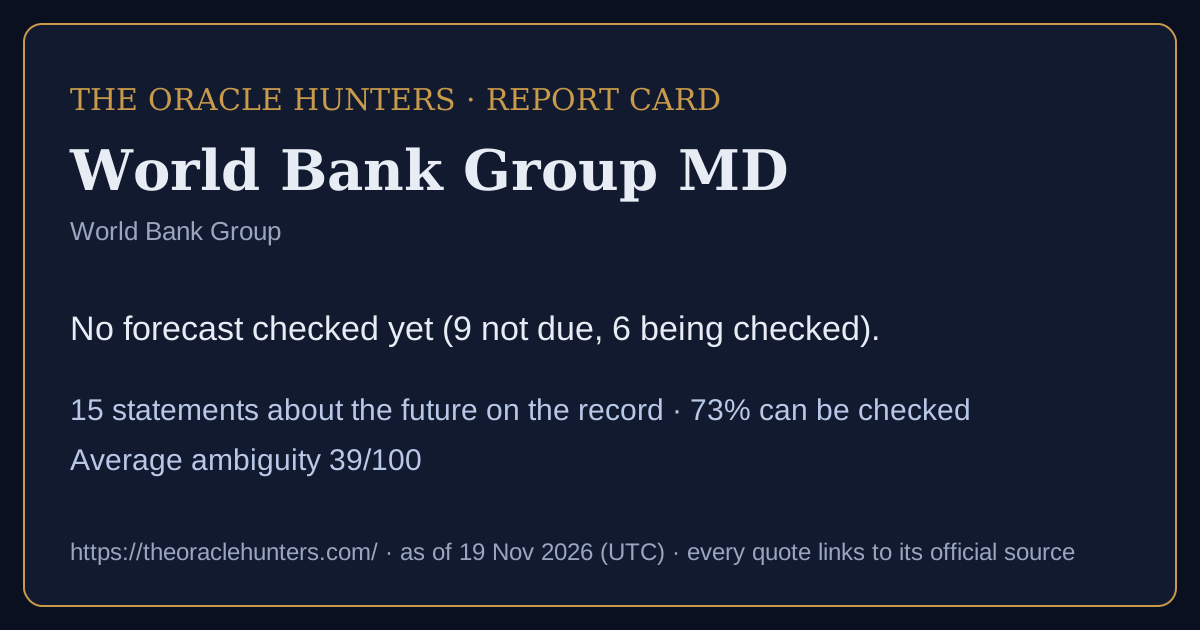
Track record: No forecast checked yet (9 not due, 6 being checked).
15forecasts & commitments on the record
73%can be checked as stated
39average ambiguity (0-100)
0goalpost moves recorded
0confirmed U-turns
Timeline
came true partly did not not due / being checked / too vague
Calibration score: shown after 10 checked forecasts with a stated likelihood (now 0).
How they speak about the future: based on data 11, educated guess 3, stated on authority 1.
Kinds of claim: forecast 9, scenario (if… then) 4, mixed claim 2. · Download this report card as a picture
In the nine words
πρόγνωσιςInference from evidence10 · 67%πρόνοιαPreparing for the future4 · 27%μαντείαInspired knowledge1 · 7%
How to read this
Each box is one sentence a public figure or institution said about the future, word for word, with a link to the official text. Can be checked means it names what will happen, by when, and how likely - so it can be compared with official figures later. Too vague to check means it does not. Ambiguity (0-100) is how many different ways the sentence can be read. When the date passes, the forecast is compared with official data and marked came true, partly or did not come true. Labels judge the sentence, never the person. Full guide and glossary.On the record (15)
With commodity prices gradually recovering, growth among the commodity-exporting countries is projected to average 2.3 percent in 2017 after two consecutive years of near-stagnation.
Growth in EMDEs is expected to accelerate to 4.2 percent in 2017, from 3.4 percent in 2016, but it varies drastically across regions and countries.
Global growth in 2016 had the weakest performance since the global financial crisis—and is expected to pick up only moderately this year, to 2.7 percent.
This will allow to expand IDA’s investing program by 50 percent, reaching US$ 75 billion in the next three years, of which US$ 45 billion are for Africa, a continent that has been deeply affected by the fall in commodity prices and climate events, and is receiving increasing attention from the G20 countries.
By improving the economic outlook and reducing the risks of climate change, it could also lift confidence and increase aggregate demand in the investing countries over the near term, even if building these infrastructure assets and getting an income stream from them will take some time.
For instance, today, in the European Union, four workers support the pension of every person aged 65, but by 2050, there will be just two. This has significant implications for the sustainability of social pension systems, especially if we factor in the low level of real growth.
For instance, if countries pick sustainable, climate-friendly technologies to expand their capacity in energy generation, the whole world will benefit from a slower rise in emissions.
Since then, 190 governments have committed to concrete action to reduce their greenhouse gas emissions. Target allocations amongst the funds with dedicated infrastructure exposure ranged from under 1 percent to over 20 percent of total assets. For example, about 50 percent of infrastructure investment could theoretically be financed on a commercial basis.
We estimate that there are more than $380 billion worth of investment-ready projects in energy generation and renewables by end-February 2017, in a wide range of countries and regions (Reference: Power Point Presentation Chart 4).
In the next year, we expect 40 new projects in over 30 countries.
By 2021, we expect that over half of our programs will be working to improve providers’ financial viability. · We will also soon launch a facility to help countries prepare bankable water projects and secure commercial lenders for resilient development. · Finally, with UNICEF, the World Bank Group will host the next Sanitation and Water for All (SWA) High Level …
And especially so if it incorporates new technologies and arrangements that help developing countries leapfrog into low-carbon economies where services will play an increasing role.
As we conclude this year’s Annual Meetings, let me take the opportunity to look back and reflect on the many discussions I have had over the last few days - and what I have learned from these discussions about how globalization, perhaps in different forms, will remain central to the World Bank’s mission.
If we persist in supporting trade and think creatively about clean infrastructure, we will advance in the fight against climate change and meet our goals for ending extreme poverty and boosting shared prosperity by 2030.
According to the World Bank’s June projections, global growth for 2016 is estimated at 2.4 percent, broadly unchanged from last year, but subject to potential downward revision based on information to mid-September.
Also said - not checkable as stated (12 newest)
Remarks about the future with no date, figure or likelihood that could be checked. They are kept on the record and shown here, but not scored.
Its objective is to (i) incentivize loss reduction, (ii) build resilience, and (iii) enhance disaster risk coverage for poor and vulnerable people and countries. We will move this agenda forward through donor-funded and World Bank-administered technical assistance facilities that will (i) provide data analytics;
That is why we are committed to the IDF and its objectives so that we can identify and address areas where cooperation with industry could be further enhanced.
This is why we see the World Bank’s role—especially in the context of the IDF—as a neutral and strategic adviser to governments that want to build capacity in countries so they will be able to access the market on their own in the future.
From the perspective of the IDF, an important aspect of the London Centre will be the proposed Insurance Development Program for several pilot countries that have enabling conditions for market development.
And we should be mindful that it is likely to require international cooperation, including of prudential regulation where systematic profiles of risk are identified.
This global leadership will include a strong focus on inclusive growth and climate, and ways to channel excessive savings to investments that could create long-term income streams.
I am stressing these issues because, while I am optimistic about the future, this revolution could initially bring less job growth, since the most productive services tend to require highly skilled people and are therefore not as scalable.
Regional leadership is therefore in great demand, and the World Bank will continue to work with governments, partners and the private sector across Asia to address these issues and increase resilience.
This gap will not be filled by public investment alone—even with the help of some extremely important initiatives of public financing from large countries in Asia.
That means that private savings, especially from institutional investors around the globe, can find an important outlet that will also help decrease the environmental footprint of progress in many EMDEs.
These are good news, but should a strong rise in global interest rates interact with deteriorating corporate credit fundamentals in EMDEs countries, it could spill over to the financial sector in the countries with broader implications.
Downside Risks to the Medium-term Growth Outlook In addition to the cyclical adjustment driven by lower commodity prices, I should note that heightened policy uncertainty at global level, protectionist pressures, and the potential for financial market disruptions would create new risks to EMDEs.