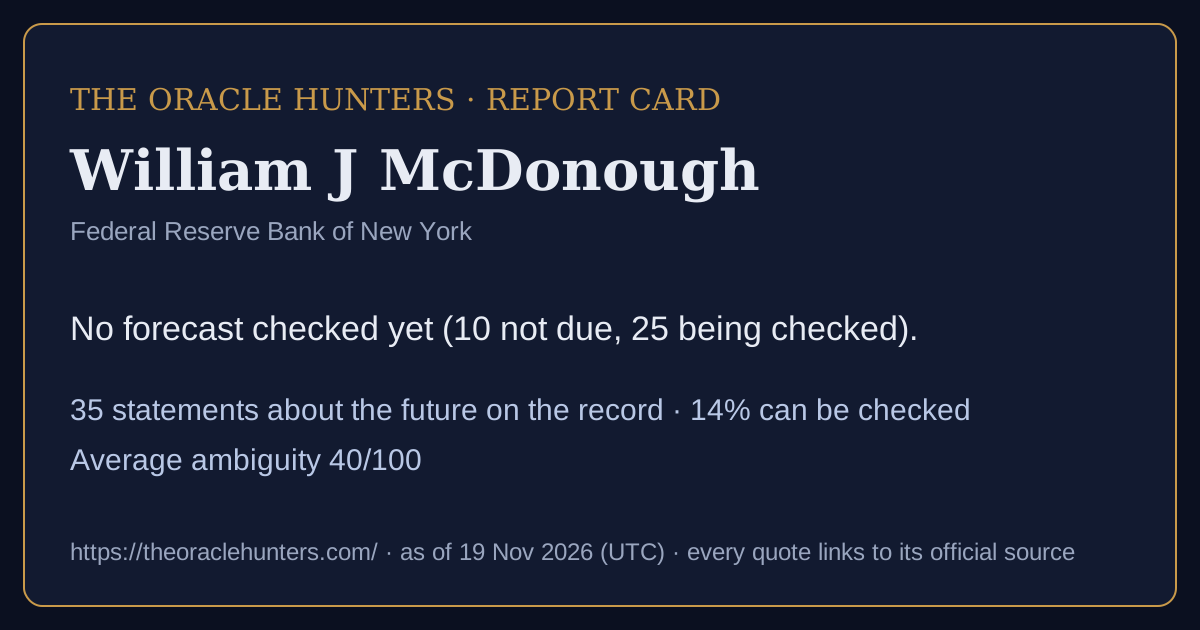
William J McDonough
Federal Reserve Bank of New York
Track record: No forecast checked yet (10 not due, 25 being checked).
35forecasts & commitments on the record
14%can be checked as stated
40average ambiguity (0-100)
0goalpost moves recorded
0confirmed U-turns
Timeline
came true partly did not not due / being checked / too vague
Calibration score: shown after 10 checked forecasts with a stated likelihood (now 0).
How they speak about the future: based on data 18, stated on authority 10, educated guess 7.
Kinds of claim: forecast 24, mixed claim 5, scenario (if… then) 5, commitment 1. · Download this report card as a picture
In the nine words
πρόγνωσιςInference from evidence18 · 51%μαντείαInspired knowledge8 · 23%πρόνοιαPreparing for the future5 · 14%προαναγγελίαPublic pre-announcement1 · 3%φρόνησιςPractical wisdom1 · 3%εἰκασίαConjecture1 · 3%πρόβλεψιςSeeing the signs1 · 3%
How to read this
Each box is one sentence a public figure or institution said about the future, word for word, with a link to the official text. Can be checked means it names what will happen, by when, and how likely - so it can be compared with official figures later. Too vague to check means it does not. Ambiguity (0-100) is how many different ways the sentence can be read. When the date passes, the forecast is compared with official data and marked came true, partly or did not come true. Labels judge the sentence, never the person. Full guide and glossary.On the record (35)
Enhancements in these areas will be important, not just to ensure readiness for IRB, but for further improvement in credit risk management more generally. | expect that there will be further public supervisory guidance on these and other key elements of the IRB approach this year.
- While much work clearly remains to be done over the next three years - including evaluating banks' readiness, training supervisory staff, and working towards consistent implementation across supervisors - in my view, both the journey and the ultimate destination of a New Accord will contribute substantially to a more resilient international financial system.
- The Basel Committee expects that we will achieve our goal of not raising in aggregate the capitalization required of the banking industry, though clearly and appropriately those banks that engage in higher risk businesses may see their requirements rise, and vice versa.
I further believe that the painful experiences of this year will help educate a generation of younger managers about the importance of integrity and sound corporate governance based on independent oversight and strong internal checks and balances.
The "FSI" anticipates that more than half of its 40 seminars and programs in 2003 will concentrate on components of the New Accord.
Assessment of the QIS 3 results will allow us to ascertain the need for adjustments prior to the release of an updated proposal for public comment in the second quarter of 2003.
On the other hand, it seems clear to me that if these conditions are satisfied, then the collateral does offer a bank protection against loss and banks will need to hold less capital against those loans.
It is envisioned that the revised Accord will be implemented in 2004.
With this in mind, I fully expect that we will meet our goal of releasing a new capital adequacy framework by early next year, followed by a short international comment period and then implementation in each of the member countries.
Over the next year, the Risk Management Group will work with the industry to develop an evolutionary framework comprised of approaches of varying sophistication, ranging from a simple to an internal-based method.
Given the progress already achieved, it is my belief that the Committee will be prepared to release a second Consultative Paper early next year.
As I mentioned, we are now evaluating the comments received on the Consultative Paper and aim to publish, by early next year, a comprehensive set of proposals that will be responsive to the industry's input.
The outlook is for continued worsening in the deficit that had already reached a record last year, at about 4% of GDP.
If the system is working properly, those receiving credit will be the most efficient, competitive, and profitable - those most capable of producing the stream of goods and services that will enable the economy to grow and, as a result, for living standards to rise.
And if banks' ability to honor deposit obligations falls into question, if the public's confidence is undermined, households and businesses will likely rush to redeploy their savings, raising the specter of a flight to cash and real assets with all the associated implications for inflation and destabilizing runs on banks.
If that confidence is undermined, society's ability to collect and deploy its savings will be impaired, and the principal means to economic growth and rising living standards - intermediation by banks - will be short-circuited.
We encourage comments on the Committee's proposals from both supervisors and industry participants through 31 March 2000 - which is next week - and plan to publish, hopefully early next year, a comprehensive set of proposals that will be responsive to the comments and input we have received.
This can be achieved through what 'stress tests', where a bank conducts 'what if' analyses of how credit exposures t counterparty could grow under these market conditions.
This can be achieved through wh 'stress tests', where a bank conducts 'what if' analyses of how credit exposures t counterparty could grow under extreme market conditions.
We have already conduct meetings with the major banks to reinforce these messages and our examiners will condu follow-up reviews in the course of this year.
If the supervisory too harsh, the supervisor will exacerbate the stresses on credit and liquidity in the fin Bank supervisors must have the tools and the determination to make steady progress in t recovery or to seek resolution through merger, sale or the winddown of the bank.
Over the course of 1999, the extent of Year 2000 preparations by organizations will become the subject of ever more intensive scrutiny.
In my remarks today, I will provide my perspective on the Year 2000 problem the challenges it poses.
The Basle Committee's Year 2000 Task Force will be developing a contingenc planning document focused on issues relevant for bank supervisors.
Even if banks are successful at tackling thei Year 2000 concerns, they may still face risks from critical services that they re vendors.
As s we will need to be increasingly alert to the possibility of Year 2000 rumors affecting of firms during the latter half of 1999, and should support the disclosure of accurate in response.
We are now in the second phase of our supervisory program for Year 200 During this second phase, which will last through March 1999, we will conduct another r supervisory reviews focused on Year 2000 testing and contingency planning.
Once monetary union is in place for all 15 countries, the openness of Europe's unified economy -- as measured, for example, by the share of exports in relation to GDP -- is likely to be quite similar to that of the U.S. economy, on the order of 10 percent.
For a variety of business and economic reasons, different approaches to correcting Year 2000 problems will be taken by different organizations.
Financial institutions depend on the proper sequencing of events and calculations based on dates, but the logic built into applications to sequence events and perform calculations will not work properly when we hit 2000.
As a bank supervisor, the Federal Reserve Bank of New York will do whatever it can to encourage banks to set up and adhere to programs that deal with Year 2000 problems.
All of this suggests that controlling the cost of Year 2000 projects will be a problem for many institutions as resource prices are bid up.
Not infrequently, we have found that banks have assumed either that vendors will make their products and services Year 2000-compliant, or have sought only general assurances from the vendors, which have been accepted at face value.
Consultants estimate that testing alone will absorb as much as 70 percent of Year 2000 project resources at some institutions.
With this in mind, the CPSS will continue to closely monitor progress over the next year for any signs of slippage.
Also said - not checkable as stated (12 newest)
Remarks about the future with no date, figure or likelihood that could be checked. They are kept on the record and shown here, but not scored.
While it will not be inexpensive to achieve these capabilities, particularly for a very large and diverse organization, | believe that it is essential for the largest and most complex U.S. banking organizations to continue down this path.
The discussions with the industry have also highlighted a number of areas where banks may need to expand their efforts in preparing for implementation.
Accordingly, banks using the IRB approach will need to be able to measure the key statistical drivers of credit risk.
The Basel standards outline the data history banks will need to use the IRB approach.
As implementation of the New Accord approaches, we encourage banks to consider their data needs very seriously and to comprehend fully the techniques they will need to use to derive appropriate estimates of loss based on those data.
We expect many banks will need to make greater investments in their reporting systems with the aim of facilitating the flow of information about a bank's ratings practices to senior management and directors.
To qualify for the IRB approaches, banks will need to adhere to various specific parameters and standards that may not be fully in place as yet.
Our pilot reviews of U.S. bank readiness do indicate that there are a number of areas that both banks and supervisors will need to work on to be ready for full IRB implementation.
Likewise, as banks rely increasingly on their own assessments of credit and operational risk when determining their capital needs, our examiners will have to become well versed in the changing technical aspects of those models.
With the maturation of our organizational approach, | fully expect that we will register further improvements in this dimension.
While enhanced risk management can and will lead to better corporate governance through a more accurate measurement and therefore management of those risks, it must be nimble enough to evolve to address the challenges that are ahead, wherever they may lie.
Along those lines, the Committee recently agreed that banks adopting the "internal ratings based" approach to credit risk will be required to conduct appropriate credit risk stress testing, which should help to contain procyclical behavior.