William Hague
Foreign & Commonwealth Office · GBR
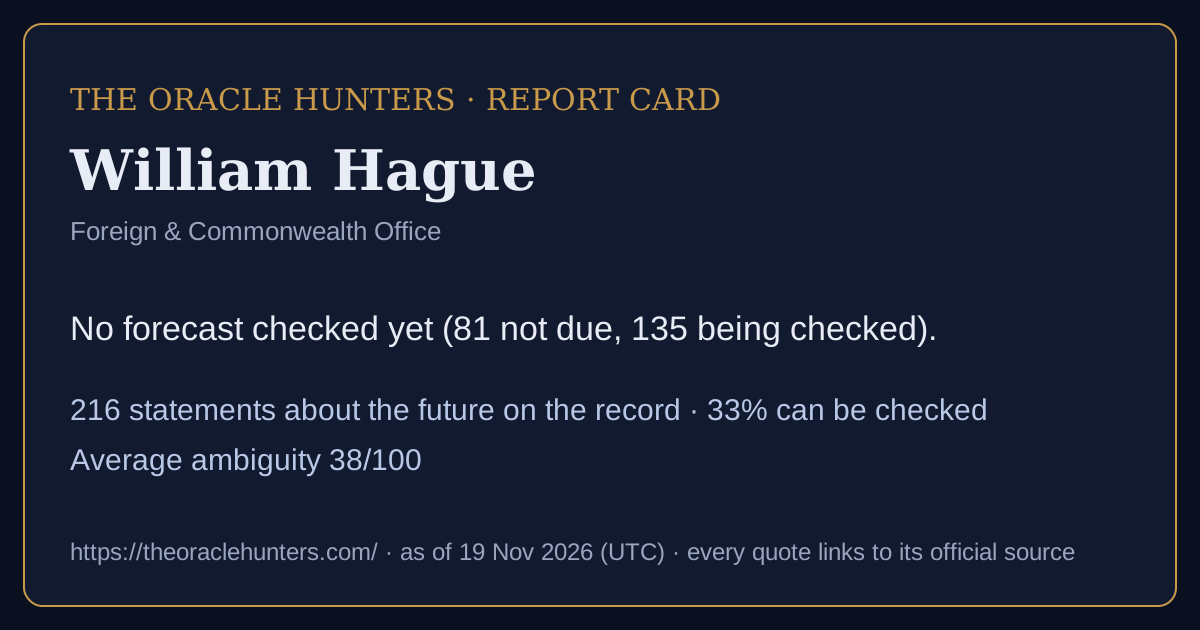
Track record: No forecast checked yet (81 not due, 135 being checked).
216forecasts & commitments on the record
33%can be checked as stated
38average ambiguity (0-100)
0goalpost moves recorded
0confirmed U-turns
Timeline
came true partly did not not due / being checked / too vague
Calibration score: shown after 10 checked forecasts with a stated likelihood (now 0).
How they speak about the future: based on data 130, stated on authority 79, educated guess 7.
Kinds of claim: forecast 107, mixed claim 62, commitment 43, scenario (if… then) 4. · Download this report card as a picture
In the nine words
πρόγνωσιςInference from evidence116 · 54%μαντείαInspired knowledge48 · 22%προαναγγελίαPublic pre-announcement43 · 20%εἰκασίαConjecture4 · 2%πρόνοιαPreparing for the future4 · 2%πρόβλεψιςSeeing the signs1 · 0%
How to read this
Each box is one sentence a public figure or institution said about the future, word for word, with a link to the official text. Can be checked means it names what will happen, by when, and how likely - so it can be compared with official figures later. Too vague to check means it does not. Ambiguity (0-100) is how many different ways the sentence can be read. When the date passes, the forecast is compared with official data and marked came true, partly or did not come true. Labels judge the sentence, never the person. Full guide and glossary.On the record (216)
And this autumn, we will celebrate the huge contribution made to our national life by the 1.5m British Indians, at the first ever Pravasi Bharatiya Divas event in the UK.
But not only that, we will also expand our programme of GREAT Awards, adding 130 new grants so that next year 500 Indian students can access generous support to take degrees in the UK.
Last year we awarded fifty scholarships; next year we will offer 150, making this our largest Chevening scholarship programme anywhere in the world.
This year, the centenary of the start of WWI, we will be honouring the 1.2 million Indians who served to defend Europe’s freedom so that their courage and sacrifice are not forgotten;
If we are successful in this task, we will be making an important contribution to tackling corruption and to supporting the Ukrainian people in their desire to build a better, more prosperous and stable future.
The NATO Summit, which we will be proud to host in Wales in September, will be even more strongly committed to strengthen capabilities and guarantee our common defence.
We will ask all the countries present at the summit to make real practical commitments: to revise their military doctrines and training; to commit new support for local organisations and human rights defenders; to launch new partnerships and to prioritise this effort in their foreign policy; and to endorse and implement the new International Protocol which will help to increase …
In four months time we will convene a global summit in London in June this year, which we intend to be the largest ever staged on this issue.
I hope we will all sign up to concerted action to strengthen law enforcement and the capacity of criminal justice systems; including stronger border controls and much more cooperation so that we clamp down on trafficking.
A stable, secure and prosperous Asia-Pacific will only be achieved in the long-term if countries in this region are able to change, to innovate, to stay competitive through strengthening free trade, individual liberty and the rule of law.
The EU-US free trade agreement negotiations launched during our G8 Presidency will be worth £100 billion a year to the EU economy, £80 billion to the US, and as much as £85 billion to the rest of the world.
You may be surprised to know that the British nomination for this year’s Foreign Language Film at the Oscars was a film made here in the Philippines by a British director with Filipino actors.
It gives the security of belonging to a nation of 63 million people; with one of the fastest growing economies in the developed world; and a tried and tested defence and security network which is the envy of many other nations and will help to keep the Commonwealth Games secure this summer.
That’s one of the reasons why I launched the Preventing Sexual Violence Initiative and why the UK will host this year an unprecedented global summit designed to ask nations to confront the horrors of warzone rape once and for all.
With changes coming in on voting rules later this year, larger states will have relatively more weight in EU decision-making – and smaller states less.
We agreed that Jordan and the Arab League have an important role to play in supporting the process in the coming months, and that our two countries would stay in close contact on this issue.
As such, Jordan will be a very important and valuable addition to the Security Council over the next two years and we look forward to working closely together in New York.
If current trends continue, over 4 million Syrian people could be refugees by the end of next year.
In the UK, this includes the establishment of the Global Cyber Security Capacity Centre which will open in Oxford next month and help other countries to build their own resilience and security.
With my full support our security and intelligence agencies will continue to address threats in cyberspace and to help our allies and partners to do the same – and the UK will remain at the centre of the debate on how we tackle those threats more effectively.
We will host a conference in London on 12th & 13th February next year, at the highest levels of government.
To that end, I will convene a major global conference in London in the first half of next year, aimed at building on what we have achieved today.
It is why we will also succeed in opening up to 20 new British diplomatic posts overseas by 2015.
The reasons for this wide support are compelling, and they underline why it is so vital that this agreement remains ambitious in scope, removing the remaining trade barriers could add an estimated £80 billion to the US and £10 billion to the British economies, leading to much needed growth and securing millions of jobs on both sides of the Atlantic.
Over the next year we will continue our discussion with business so that we understand the challenges you face and can reflect those challenges in the EU negotiating position, getting the best possible deal for our companies.
We do this in part to facilitate the export of British goods and services, because it is only through the growth of trade that we will lift up the world economy.
Our Embassy in Washington has undertaken a study in partnership with the Atlantic Council and Bertelsmann on the potential benefits across the US, and our early findings show that a deal of the kind I’m talking about would increase Californian exports to the EU by over 25 percent and could create 65,000 new service sector jobs.
First of all, removing the remaining trade barriers could add $280 billion a year to our economies, and secure millions of jobs on both sides of the Atlantic.
The Transatlantic Trade and Investment Partnership between the EU and the US could be worth £10 billion to the UK economy, or £380 per family, every year.
I have no doubt that Glasgow and its people will make just as favourable impression on those who come to the Commonwealth Games next year.
Since 2010, we have opened seven new diplomatic posts, we expect to open three more this year, and we are well on the way to opening or upgrading 20 new Embassies, consulates and trade offices by 2015 – in places as diverse as Kyrgyzstan, Laos, Brazil, Paraguay – and are making sure that we are in all the vital markets …
Full implementation of the Services Directive could add 2.6% to EU GDP.
The size of the global middle class is projected to increase by three billion by 2030.
Development of a digital single market by 2020 could result in a four percent increase in EU GDP.
By 2030, some forecasts suggest that Europe’s share of nominal global GDP could halve, as the world’s emerging economies continue to surge forward.
With the European e-commerce market forecast to double in size to 625 billion euros by the end of 2016, we need to start by strengthening cross-border e-commerce.
The UK is deeply concerned that the UN relief effort is critically under-funded, and that only 34% of the $1.5 billion humanitarian appeal has so far been provided, even though the need will become far worse if the conflict continues.
Our team of over 70 experts including doctors, forensic scientists, police and gender experts has already deployed to Bosnia, the Syria border and Libya, and will carry out further deployments this year to those three countries as well as South Sudan, Mali and the Democratic Republic of Congo.
We will continue with the twin track approach of sanctions and negotiations, but the G8 were clear that the window for diplomacy will not remain open forever.
We have opened a new Embassy in El Salvador and a Consulate-General in Recife; and will be opening new Embassies shortly in Paraguay and Haiti later this year.
A comprehensive trade agreement between the EU and the US could boost the European economy by more than £75bn, which is more than any of the other trade deals currently underway.
And while long term forecasts are often wrong, as we all know, in a generation, China’s middle class is on course to be over three times the size of Western Europe’s, and by 2030, on current trends Central and Latin America’s middle class will be as big as North America’s.
Of the $20 trillion of growth that the IMF forecasts in the world economy over the next five years, almost $13 trillion will be in emerging markets.
By dealing decisively with our debt problem, we will increase overseas confidence in the UK economy and attract greater foreign investment to our shores.
We are determined to use our Presidency of the G8 this year and our voice in the EU to secure an ambitious deal that will help break down the remaining trade barriers and bring benefits for businesses on both sides of the Atlantic, as well as boosting growth around the world.
By 2015 we will have opened up to 20 new Embassies, consulates and trade offices, and deployed 300 extra staff in more than 20 countries, particularly in Asia, Latin America and parts of Africa, so that Britain is linked up to the world’s fastest growing economies.
On top of this, the new UK team of experts in preventing sexual violence will deploy to at least six countries this year: the Syrian border, Libya South Sudan, the Eastern DRC, Bosnia-Herzegovina, and – as I announced two weeks ago – to Mali as part of the EU military training mission that has now been established there.
Because we are determined to support the UN’s efforts, we have provided £1 million in funding to her office, which will help bolster efforts to build local capacity, facilitate legal reform, and secure political support for national governments.
We will also deploy the Team of Experts to at least four other countries this year:
We will expand this work this year, deploying a team again, in larger numbers, to help Syrian refugees and those working with them.
Showing the newest 50 - the ledger has all 216.
Also said - not checkable as stated (12 newest)
Remarks about the future with no date, figure or likelihood that could be checked. They are kept on the record and shown here, but not scored.
Standing at those windows, as he contemplated the catastrophe about to engulf the world, he famously said “the lamps are going out all over Europe; we shall not see them lit again in our lifetime”.
Our optimism and faith in human nature will always have to contend with this harsh truth, at the same time as being essential to overcoming such evils.
But that will never be enough by itself, so we also have to retain the ambition to influence not just the resolutions that are passed and the treaties that are signed, but the beliefs in the world about what is acceptable and what is not.
While of course our goal is always to prevent conflict, we cannot simply consign millions of women, men and boys to the suffering of rape while we seek a way to put an end to all conflict, since as I have argued that this goal is one we should always strive for but may often not attain.
As these proposals were discussed at the negotiating table, he is said to have remarked with some passion that one could sooner talk of “humanising hell” than of “humanising war”.
But in fact addressing these issues is crucial to overcoming crises now and in the future – and it will be an increasingly important part of our moral authority and standing in the world that we are seen to do this.
As the United Kingdom we will continue to do our utmost, using our global diplomatic network, our world-class armed forces and our membership of NATO and the European Union.
In this the 30th anniversary year of the Chevening Scholarship programme, I am delighted to announce that the UK will quadruple the budget for young people with leadership potential to study at world-class British universities, and mid-career professionals to take specialist courses.
But we will not relent, we will not rest at any time in the coming months to make sure we now turn into practical implementation the many commitments and the tremendous support that we have seen from all over the globe here in London this week.
And now we have done so much this week, we must go on to do even more, and accelerate our work over the coming months and years.
We need to be absolutely clear across the world that the stigma attached to victims is not only unjust, it is utterly misplaced and could not be further from the truth, obscuring not only the humanity we share but the immense contribution survivors can and should be allowed to make to their societies.
We will be consulting you all on how we go about this, drawing on the many powerful ideas that have come out of this Summit.