Wes Streeting
Department of Health and Social Care · GBR
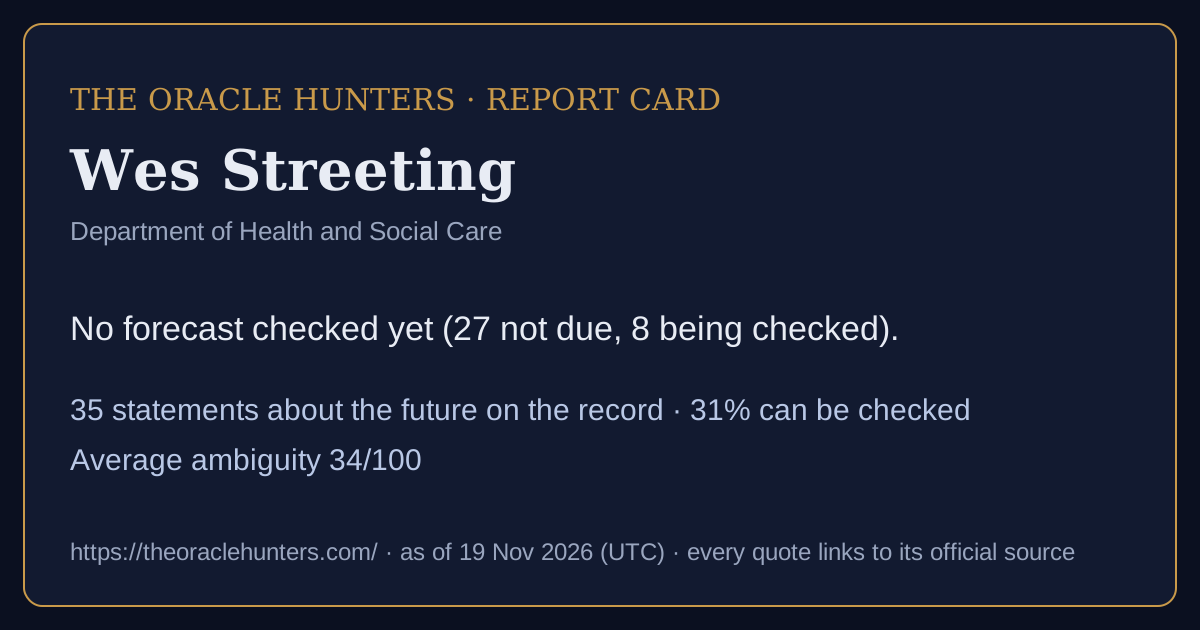
Track record: No forecast checked yet (27 not due, 8 being checked).
35forecasts & commitments on the record
31%can be checked as stated
34average ambiguity (0-100)
0goalpost moves recorded
0confirmed U-turns
Timeline
came true partly did not not due / being checked / too vague
Calibration score: shown after 10 checked forecasts with a stated likelihood (now 0).
How they speak about the future: based on data 19, stated on authority 12, educated guess 4.
Kinds of claim: forecast 16, mixed claim 14, scenario (if… then) 3, commitment 2. · Download this report card as a picture
In the nine words
πρόγνωσιςInference from evidence19 · 54%μαντείαInspired knowledge10 · 29%πρόνοιαPreparing for the future3 · 9%προαναγγελίαPublic pre-announcement2 · 6%εἰκασίαConjecture1 · 3%
How to read this
Each box is one sentence a public figure or institution said about the future, word for word, with a link to the official text. Can be checked means it names what will happen, by when, and how likely - so it can be compared with official figures later. Too vague to check means it does not. Ambiguity (0-100) is how many different ways the sentence can be read. When the date passes, the forecast is compared with official data and marked came true, partly or did not come true. Labels judge the sentence, never the person. Full guide and glossary.On the record (35)
We will meet our NATO commitment to spend 3.5% of GDP on core defence by 2035 – and hit 3% in 2030 along the way.
So investment in defence will only command lasting public support if people can see not only how that investment strengthens our national defence, but also if they can see how it improves their lives, how it makes sure that we have a Britain that is worth fighting for.
Gun Hall will also support the next generation of equipment for the British Army, helping to deliver the firepower that will make us warfighting ready by 2030.
But if aggression is rewarded, if borders can be redrawn by force, if the sovereignty of nations becomes negotiable, the consequences will not remain confined to Ukraine or to my continent.
We will meet our NATO target to spend 3.5% of GDP on defence by 2035.
Globally, the CCA sector is projected to be valued at more than £125 billion to 2050.
This is how we make ourselves fit to face the future, how we will continue to be a strong, dependable ally to our friends abroad, and how we will be an engine of growth and jobs here at home.
And as well as investing an additional £26 billion into the NHS, we’re investing an extra £4.6 billion into social care by the end of this Parliament.
And over the next year, I’m also going to enlist patients in my drive for a better quality service.
And as the Prime Minister announced at his speech in Liverpool, NHS Online will launch next year with the aim of delivering 8.5 million appointments in its first 3 years.
By 2035, the NHS App will bring together genomic and lifestyle data with the single patient record to advise every patient according to their risk.
And so we will roll out the Lung Cancer Screening programme nationally by 2030.
It’s an ambitious plan to save 320,000 more lives by 2035 – the fastest rate of improvement this century – and a promise that we will meet all three national cancer waiting time standards by the end of this Parliament:
Next year, patients will be able to see a specialist online for conditions including prostate cancer, cataracts and endometriosis through NHS Online, rather than traipsing across town to a hospital.
It’s only with the combination of modernisation to make the NHS more efficient, and tough action to improve our nation’s health, that we will keep the costs of healthcare down, and with them the need for tax rises.
It’s not going to be easy to stay on track for the rest of this year, especially with the double whammy of strikes and winter to come.
If strikes do go ahead, this will cost around £240 million and we will not be able to afford the same offer again, so my message to BMA is simple: postpone the strikes, trust your members and give resident doctors a say.
I’m not saying that everything’s been fixed in a year, and I’m certainly not promising that everything will be fixed by this time next year.
GPs: you set out 6 demands, with probably more to follow on issues ranging from funding envelopes for 2026 to 2027 to GMS contract renewal and investment, to GP under and unemployment.
Top trusts who run services will be able to reinvest them in new kit and buildings, and they’ll be first in line for the new wave of foundation trusts from next year.
Look instead at the 100% of the budget the NHS will receive next year, £205 billion and ask, what if we spend it where it makes the biggest difference for patients?
Thanks to the reforms we’ve made to bear down on wasteful spending, the fund will not go to trusts which run deficits this year.
This year, we will require regions to begin drawing up plans for failing providers and begin the process of turnaround.
But if instead we look at 100% of the budget the NHS will receive next year, totalling £205 billion, and ask ‘what if we spent that funding where it would make the biggest difference to patients’, then the opportunities before us seem enormous.
We will always defend our NHS as a publicly funded, public service, free at the point of use, so that when you fall ill you never have to worry about the bill.
We will only succeed if this is a team effort, from the Prime Minister to the 1.5 million people who work in the health service.
We will always defend the NHS as a public service, free at the point of use, so that when you fall ill, you never have to worry about the bill.
We will only succeed if this is a team effort, from the Prime Minister to the 1.5 million people who work in the National Health Service.
Movember being Movember, said to me straight after the general election campaign, I think - “Do you think that health strategy we talked about in opposition, you could be committed to and launched as a complete strategy in Movember this year?”
And I’m really delighted to announce today here during Movember that we will be publishing a men’s health strategy next year to tackle these problems.
They will be at the heart of the 10-year plan next year, their priorities will be reflected in a new NHS mandate shortly and when the elective recovery plan is published in the coming weeks you’ll see that greater choice and control is at the heart of it.
And NHS England will hold ICBs and trusts to account if they fail to act.
And we’ve begun to fix the front door to the NHS, with an additional 1,000 GPs hired by the end of the year, beginning to reverse the decline in primary care of the past 14 years.
We will publish a 10-year plan early next year that will set out how we deliver 3 big shifts in the focus of the NHS:
It will be the mission of my department, every member of this government, and the 1.4 million people who work in the NHS to turn our health service around.
Also said - not checkable as stated (12 newest)
Remarks about the future with no date, figure or likelihood that could be checked. They are kept on the record and shown here, but not scored.
Which is why we will stand with Ukraine for as long as it takes.
Even if it could, Ukraine shows how quickly warfare is changing – including in the maritime domain.
Not because war is inevitable but because the more ready we are to fight and win, the less likely war becomes.
But when you invest in defence, you not only have the peace of mind that a conventional insurance policy provides, you make it the worse less likely to happen.
We must constantly push the frontier of defence innovation and mobilise industry to match the demands of a more dangerous world.
As we’ve heard, their production will create one hundred jobs here and hundreds more across the supply chain right across the country.
Almost seventy percent of defence investment is already spent outside London and the South East, and we’re setting out shortly how people and communities in every nation and region of the UK will feel benefits and do feel benefits from the defence dividend.
To make sure we can deter and, if necessary, defeat, our adversaries, Britain must have the capacity to manufacture critical defence components at home and in sufficient quantities.
We must have robust supply chains to back them up, and we must have the wider industrial resilience to sustain our armed forces through prolonged conflict.
We can still do all these things – and we will.
I also enjoyed your characterisation of my experience in government, depending on how you look it – I might well understand fiscal pressures in government from the two departments that I’ve now led.
After the Second World War, President Truman and General Marshall understood that the security of the United States could not be separated from the security of Europe.