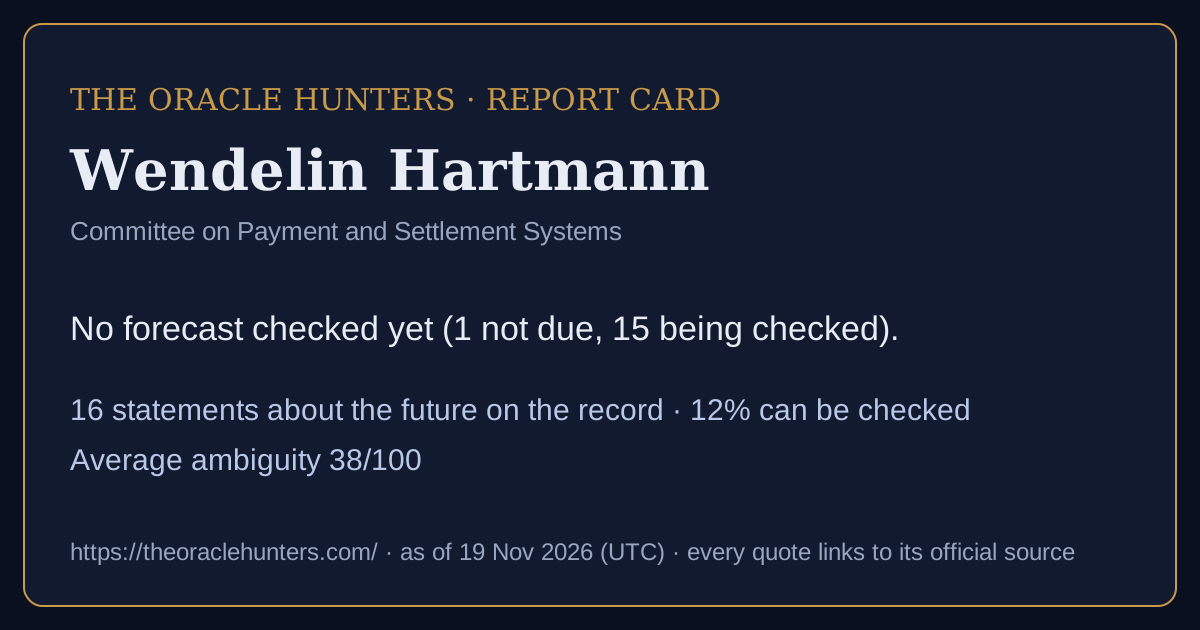
Wendelin Hartmann
Committee on Payment and Settlement Systems
Track record: No forecast checked yet (1 not due, 15 being checked).
16forecasts & commitments on the record
12%can be checked as stated
38average ambiguity (0-100)
0goalpost moves recorded
0confirmed U-turns
Timeline
came true partly did not not due / being checked / too vague
Calibration score: shown after 10 checked forecasts with a stated likelihood (now 0).
How they speak about the future: based on data 14, stated on authority 2.
Kinds of claim: forecast 13, mixed claim 3. · Download this report card as a picture
In the nine words
How to read this
Each box is one sentence a public figure or institution said about the future, word for word, with a link to the official text. Can be checked means it names what will happen, by when, and how likely - so it can be compared with official figures later. Too vague to check means it does not. Ambiguity (0-100) is how many different ways the sentence can be read. When the date passes, the forecast is compared with official data and marked came true, partly or did not come true. Labels judge the sentence, never the person. Full guide and glossary.On the record (16)
From 2002, when the national banknotes and coins will be replaced by the new currency, this discrepancy will become even more obvious.
In summary, it can be said that, in the time which remains, the Bundesbank, being aware of its special position and duties, will take all the measures that are needed to ensure that its systems undergo a smooth transition from 1999 to 2000.
The information channels that have already been set up will be used for the changeover from 1999 to 2000.
The Federal Banking Supervisory Office has announced just recently that the present stage of Year 2000 readiness achieved by the German credit institutions meets the expectations of the banking supervisory authorities and that, according to the information currently available, there is no reason to fear that the transition from 1999 to 2000 will cause any major disruptions in institutions' operations.
This measure will enhance the security of the changeover to the Year 2000 since, as a result, all end-of-day and end-of-year work can be performed for all systems on that date and the backing-up of data can be concluded before midnight.
It will also ensure that its data-processing procedures are robust enou individual customer systems fail to operate in a year-2000-compatible manner.
By that date, all computer-infrastructure (systems and networks) and data-processing application procedures will be available i year 2000-proof versions.
Ferguson Jr, Member of the Board of Directors, Washington, and I are going to present the Year 2000 problem and its implications for t financial markets via all media to a - hopefully - broad public.
As you all know, the Bundesbank is responsible for monetary policy in Germ till the end of this year, but will also continue to form part of the banking supervi after the start of Stage Three of European monetary union.
As you know, our latest Joint Year 2000 Council Bulletin also fo this matter, and I hope that we will have an opportunity to attract public attention i at the forthcoming press conference.
For financial market participants, the Year 2000 problem is especially acute financial institutions rely heavily on automation to manage information, it will be even impossible to conduct business if automated applications fail to work properly. number and complexity of the date-dependent computerprograms in use, the remediation e will often have to be colossal.
The 'out' central banks may gr maximum intraday credit of 1 billion euros per bank to credit institutions in their systems against the deposit of appropriate collateral.
Furthermore, the EBA that the volume will increase by 15% to 20% by the year 2004.
According to a 1996 estima EBA, a daily volume of between 318,000 and 473,000 crossborder commercial and financial payments in euros is to be expected from the start of next year.
However pressing and topical the centennial project of EMU may be, the exam of the year-2000 problem makes us realise - if we have not done so already - that coop the field of payments must not stop at Europe's borders.
Taking an overall view of payment systems at the beginning of next year, TARG will not be the only European scheme; there will also be several net settlement systems.
Also said - not checkable as stated (12 newest)
Remarks about the future with no date, figure or likelihood that could be checked. They are kept on the record and shown here, but not scored.
Owing to the enormous potential of this new form of money, the ECB has to ensure from the outset that its monetary policy responsibility will not be jeopardized by developments outside its sphere of influence.
Why should the central banks and the banking industry not be able to master this agenda 2000 together to the benefit of all those involved?
The early standardisation and centralisation of retail payments in Belgium offers many advantages from the point of view of cost and efficiency and might well act as a model for solving the many different problems in cross-border payments in Europe.
The free negotiation of prices between the customer and the bank certainly represents one of the key areas of free competition, but if the result is out of proportion to the service provided, then - as past experience has shown - new operators or procedures tend to emerge - in Europe possibly in the form of cross-border cash transports or …
Although the development of network money is currently still at an early stage, the increasing importance of the Internet and thus of electronic commerce will undoubtedly contribute to a rapid spread of those products in the future.
But doing this involves the risk of undermining macroeconomic policy: looser monetary policy will finally cause inflation and ongoing asset price bubbles.
concerns about counterparty risk, or technical shortcomings in the payments infrastructure, could pose further threats to international financial stability if they lead to a sudden loss of liquidity in important markets or an inability to settle transactions.
At the other extreme are central banks that both own and operate the payment systems, and who may therefore be tempted to impose a solution on the market.
The central bank will usually have certain overriding interests (such as avoiding systemic risk) that are likely to be a lower priority for the market itself.
So the central bank will typically have to set the objectives of the reform.
And ultimately the central bank may have to override the wishes of the market in some areas.
In saying that, however, the Global Street Test was only one milestone - albeit a very important and highly visible one - in our entire Year 2000 project.