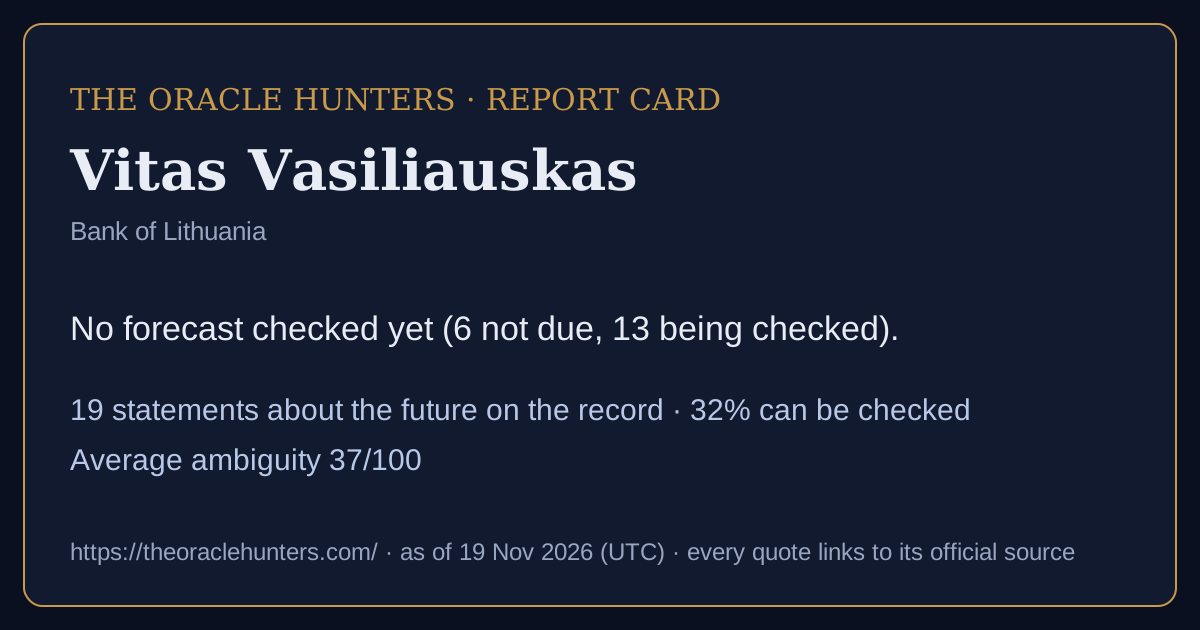
Vitas Vasiliauskas
Bank of Lithuania
Track record: No forecast checked yet (6 not due, 13 being checked).
19forecasts & commitments on the record
32%can be checked as stated
37average ambiguity (0-100)
0goalpost moves recorded
0confirmed U-turns
Timeline
came true partly did not not due / being checked / too vague
Calibration score: shown after 10 checked forecasts with a stated likelihood (now 0).
How they speak about the future: stated on authority 10, based on data 7, educated guess 2.
Kinds of claim: forecast 14, scenario (if… then) 2, mixed claim 2, commitment 1. · Download this report card as a picture
In the nine words
μαντείαInspired knowledge9 · 47%πρόγνωσιςInference from evidence7 · 37%πρόνοιαPreparing for the future2 · 11%προαναγγελίαPublic pre-announcement1 · 5%
How to read this
Each box is one sentence a public figure or institution said about the future, word for word, with a link to the official text. Can be checked means it names what will happen, by when, and how likely - so it can be compared with official figures later. Too vague to check means it does not. Ambiguity (0-100) is how many different ways the sentence can be read. When the date passes, the forecast is compared with official data and marked came true, partly or did not come true. Labels judge the sentence, never the person. Full guide and glossary.On the record (19)
According to the latest data, Lithuania's GDP decreased by 1.3% in 2020, beating the previous forecasts made both by the Bank of Lithuania and international institutions.
The US, meanwhile, is likely to make up for the lost ground already this year, whereas China's output has not only fully bounced back - it has already returned to its prepandemic trend.
Accordingly, GDP in the euro area is now projected to recover to the pre-pandemic level only towards the end of 2022.
For instance, the vacancy rate of office space in Vilnius is projected to increase substantially next year, which will certainly be mostly determined by the shift to remote work.
We also hope that next year, along with the transposition of the updated Capital Requirements Directive, our arsenal will be complemented by the possibility to impose additional sectoral capital requirements for commercial banks.
This year, however, it has become apparent: the country's population is growing for the second consecutive year, and this trend is likely to continue, which is in turn a substantial impetus for the housing market growth.
Lithuania's debt will reach record highs this year.
The pandemic forces businesses to shelve investment decisions: for instance, we estimate that private sector investment will decrease by more than 13% in Lithuania this year.
This will help prevent premature fiscal tightening in Europe beyond the end of this year.
We will unwind the programme after the pandemic-related downward pressure on the economy is over and the projected path of euro area-wide inflation shifts upward.
According to the OECD calculations , medium risk of job automation in Lithuania amounts to more than 50%.
This is how I would describe it: convergence will not be sustainable nor long-lasting if we do not overcome the growing challenges of the labour market.
If no significant changes occur, there will be fewer than 1.5 million working-age people in 2030, and just over a million in 2060 . 1
It is important to note here that this year we will be able to mark the net migration rate in green rather than red, meaning that more people are coming to Lithuania than leaving it.
This might increase credit risk for the central banks, especially if it becomes necessary to widen collateral eligibility.
For example, currently, the ECB's forward guidance is that interest rates are expected to remain unchanged at least through the end of this year.
In fact, it is estimated that by 2024 the global peerto-peer market will be worth nearly 900 billion US dollars, growing by roughly 50% annually.
It is estimated that by 2024 the global peer-topeer market will be worth nearly USD 900 billion - growing by around 50% annually.
As of next year, indexation of pensions is to come into effect, meaning that pension payments will be linked to the average annual change in the economy-wide wage level.
Also said - not checkable as stated (12 newest)
Remarks about the future with no date, figure or likelihood that could be checked. They are kept on the record and shown here, but not scored.
It is a knowledge-sharing mission that will contribute to Ukraine in fulfilling its European aspirations.
I am confident that the Twinning project will represent a qualitatively new stage in cooperation between our central banks, bringing about concrete results in the areas that it covers.
We should focus on bringing in higher value-added activities, so that we could provide a strong impetus to the growth of labour productivity and, consequently, the potential output.
Our investment strategies will have to accommodate these trends.
We need to attract foreign direct investment that could help us enhance our participation in the recalibrated value chains.
We could even consider novel ways of applying macroprudential tools - such as the application of borrower-based measures during the cycle, e.g. relaxing the loan-to-value or debt-service-to-income requirements in times of crisis.
If regional housing market imbalances emerge, we will not hesitate to take additional steps in implementing the Bank of Lithuania's macroprudential mandate.
Expectations of the real estate industry have also taken a turn for the worse: our surveys show that the majority of commercial banks have started to expect a fall in real estate prices, particularly in the segment of commercial real estate.
In this case, it also cannot be ruled out that the current health emergency may give an impetus to the housing market in some respect.
However, even in such circumstances, it would be unwise not to reflect on the post-pandemic world, which will be different - and we will have to adapt to it.
If we want to attract more foreign investment, we need to consider one important fact - a likely wave of deglobalisation in the post-pandemic world.
If we manage to do this, we will pay our debts back without much pain.