Virginijus Sinkevičius
European Commission · EU
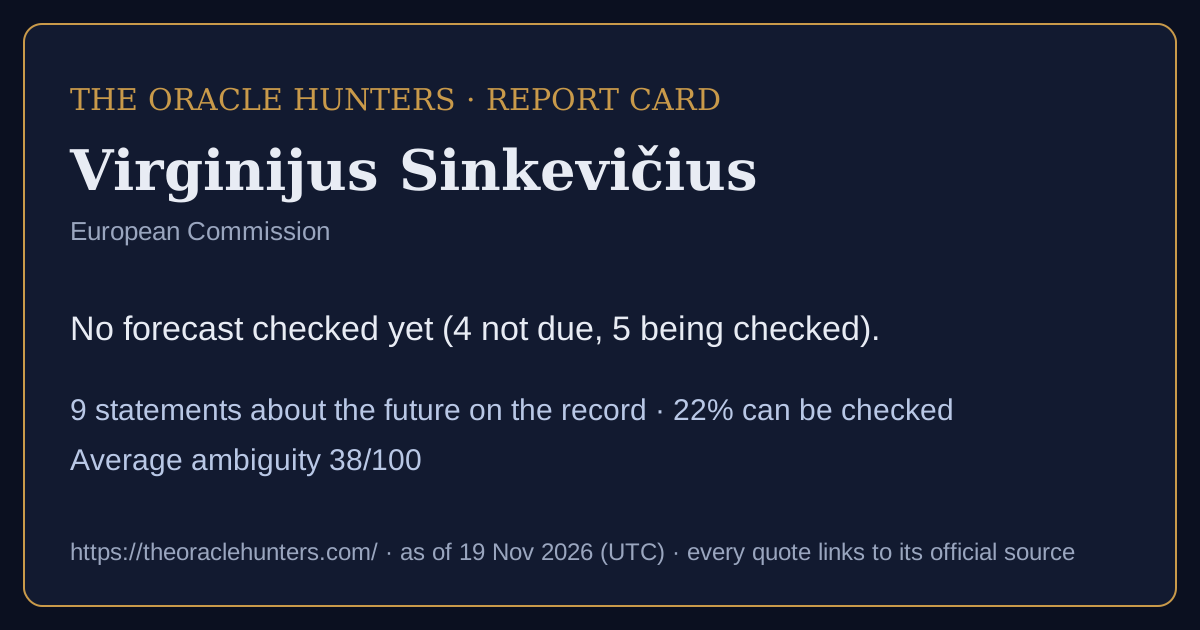
Track record: No forecast checked yet (4 not due, 5 being checked).
9forecasts & commitments on the record
22%can be checked as stated
38average ambiguity (0-100)
0goalpost moves recorded
0confirmed U-turns
Timeline
came true partly did not not due / being checked / too vague
Calibration score: shown after 10 checked forecasts with a stated likelihood (now 0).
How they speak about the future: based on data 5, stated on authority 4.
Kinds of claim: forecast 6, mixed claim 2, scenario (if… then) 1. · Download this report card as a picture
In the nine words
πρόγνωσιςInference from evidence4 · 44%μαντείαInspired knowledge4 · 44%πρόνοιαPreparing for the future1 · 11%
How to read this
Each box is one sentence a public figure or institution said about the future, word for word, with a link to the official text. Can be checked means it names what will happen, by when, and how likely - so it can be compared with official figures later. Too vague to check means it does not. Ambiguity (0-100) is how many different ways the sentence can be read. When the date passes, the forecast is compared with official data and marked came true, partly or did not come true. Labels judge the sentence, never the person. Full guide and glossary.On the record (9)
It will help us deliver on the promise and commitments of the EU Biodiversity Strategy for 2030 and of the historic agreement reached only two months ago at COP15 in Montreal on a new global biodiversity framework.
Next year will fill more gaps with initiatives on microplastics, and nutrients in relation to soil health.
The Commission proposal could reduce premature deaths up to 70% by 2030, while also significantly reducing ammonia too, provided that the proposal we made for revised Industrial Emissions Directive maintains a sound level of ambition for livestock farming.
If we want to reduce the number of premature deaths caused by air pollution by 55 percent, the share of people chronically disturbed by transport noise by 30 percent, or if we want to reach any other target proposed in the plan, concrete actions at every level will be necessary.
That would allow this vital piece of legislation to come into force in time to influence the major increase in battery production expected in 2023.
To this end, we will launch, still this year, a broad stakeholder consultation.
We will therefore launch a new initiative next year on ocean observation and we are going to extend the Copernicus marine service.
Most of the measures will be covered in Soil Strategy which will be put forward later this year.
The Commission has proposed that 35% of Horizon Europe, the EU's €100 billion research and innovation programme, will take up to the fight against climate change.
Also said - not checkable as stated (12 newest)
Remarks about the future with no date, figure or likelihood that could be checked. They are kept on the record and shown here, but not scored.
They will thus strengthen the sector's socio-economic resilience and sustainability, and we will fully support it in this transformation.
The actions we propose will help us reduce the sector's impact on marine ecosystems and on the climate, promote the use of cleaner energy sources, and move us away from dependence on fossil fuels.
The measures we propose will support energy efficiency in the short to medium-term and will foster the development and adoption of additional renewable and low-carbon energy sources in the medium to long-term.
In this spirit, today we are looking at two areas and two challenges that we have to address: The dependency of the fisheries sector on a healthy marine environment, and its own environmental and climate impact.
And its dependency on fossil fuels and the need to move towards cleaner energy sources.
We have to avoid that scenario, and the New Deal for pollinators adopted today aims at reversing their decline by the year 2030.
We will do that with specific conservation plans for species under threat.
We will be supporting them very closely, in their efforts to get to grips with the causes of the problem.
This will also include a new initiative called buzz lines – a blueprint for a network of ecological corridors for pollinators.
There will also be a new push to enhance pollinator habitats in urban areas.
We know that pesticide use is a significant factor in pollinator decline, so we need to mitigate the impact of pesticide use.
Beyond air, the Outlook report shows that we're not on track to achieve the 2030 targets for noise, nutrients, waste, and plastics in the oceans.