Villy Bergström
Sveriges Riksbank
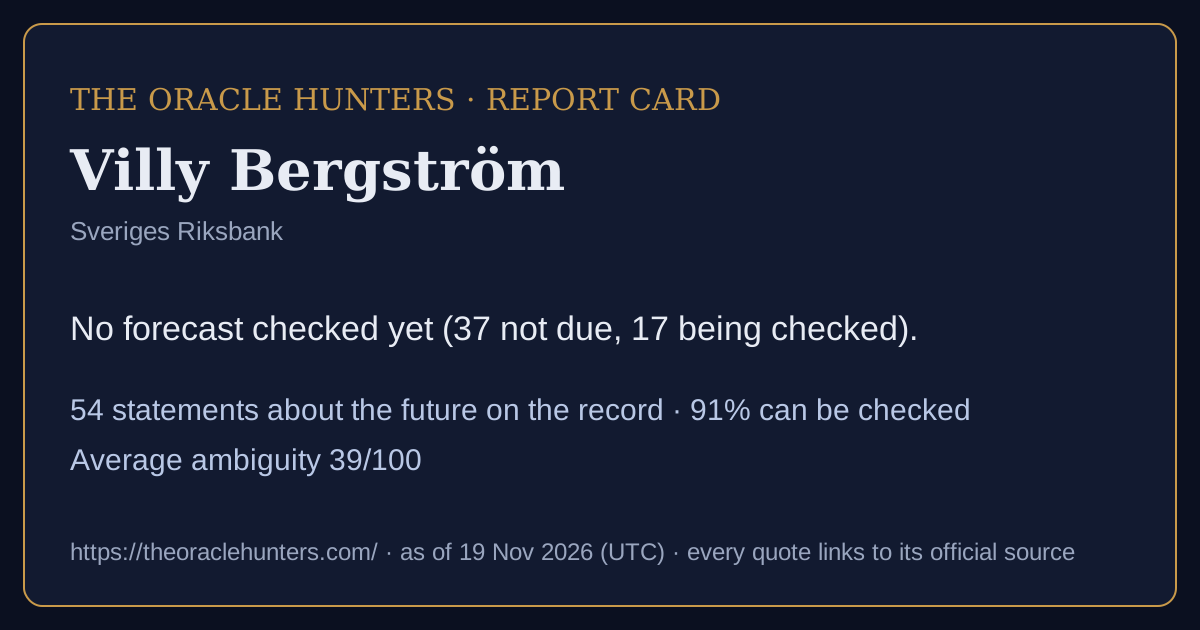
Track record: No forecast checked yet (37 not due, 17 being checked).
54forecasts & commitments on the record
91%can be checked as stated
39average ambiguity (0-100)
0goalpost moves recorded
0confirmed U-turns
Timeline
came true partly did not not due / being checked / too vague
Calibration score: shown after 10 checked forecasts with a stated likelihood (now 0).
How they speak about the future: based on data 33, educated guess 18, stated on authority 3.
Kinds of claim: forecast 31, scenario (if… then) 15, commitment 4, mixed claim 4. · Download this report card as a picture
In the nine words
πρόγνωσιςInference from evidence33 · 61%πρόνοιαPreparing for the future15 · 28%προαναγγελίαPublic pre-announcement4 · 7%εἰκασίαConjecture2 · 4%
How to read this
Each box is one sentence a public figure or institution said about the future, word for word, with a link to the official text. Can be checked means it names what will happen, by when, and how likely - so it can be compared with official figures later. Too vague to check means it does not. Ambiguity (0-100) is how many different ways the sentence can be read. When the date passes, the forecast is compared with official data and marked came true, partly or did not come true. Labels judge the sentence, never the person. Full guide and glossary.On the record (54)
If the inflation target were lower, a relative increase for some might necessitate lower nominal wages for others.
Given that no agreements are cancelled prematurely, 2007 will be a very busy agreement year, since the majority of the collective bargaining agreements concluded in the business sector and the central government sector in 2004, as well as the municipal sector from 2005, will be due for renegotiation. 4
This year, approximately 70 collective bargaining agreements will be signed for just over 1.3 million employees.
If these negative risks are realised in full, it could be more difficult for domestic demand to relieve the export-driven growth of recent years.
The most likely scenario is that over the coming years we will see a more subdued growth in productivity, rising employment and an increase in resource utilisation, despite the pressure for change in the economy.
If we assume this, there is a risk that we will not be sufficiently willing to make changes and then unemployment will rise.
In November last year the Board estimated that Swedish economic growth would be 1.4 per cent in 2003 and 1.9 per cent this year, while unemployment was forecast to be 5.1 per cent this year.
In my opinion, encouraging a further increase in indebtedness through a rate cut of 0.5 percentage points could lead to problems once rates rise.
We will have better information regarding the durability of the rise in productivity when the business cycle matures and employment picks up.
During periods of large deficits and burgeoning government debt there is always a risk from a lender's point of view that the government will attempt to reduce the real burden of the debt by eroding its real value through increased inflation.
The relatively strong rate of growth means that the economy will approach full resource utilisation in spring 2006, according to our forecasts in the Inflation Report.
By 2030, this is forecast to have risen to 0.42.
The whole increase in the dependency burden is due to the retirement of large numbers from specific generations, the 1940s generation in the years 2005-2015 and the 1960s generation in the years around 2030, at the same time as average life expectancy is expected to increase.
By 2030, it is forecast that each person of working age will have to support 0.84 people, which represents a rise in the dependency burden of 20 per cent.
For instance, the population trend means that the proportion of people that are 65 years or older will increase from 17 per cent today to 23 per cent in 2030.
Between 2012 and 2030, this group will increase by around 1.3 per cent per year.
For example, growth in the number of hours worked could be 0.4 percentage points higher per year up to 2008 if the Government's target of halving sick leave were to be attained.
However, if other groups were also to demand higher wages, the inflation target might be threatened.
It is therefore estimated that payroll expense could increase by an average of just over 4 per cent a year during the forecast period without any threat to the inflation target.
If imported inflation, which comprises approximately onethird of CPI, develops weakly as a result of a stronger krona or lower international price pressure, domestic prices may rise more rapidly than 2 per cent over a period of time without causing a threat to the inflation target.
The population increase that Sweden has experienced during the 1990s will gradually decline and with effect from 2010 growth in the working population will be negative. 13 The large population growth among the younger and older age categories risks reducing labour force participation, as these age groups generally have a lower participation than average.
The baby boom of the 1990s means that the shortage of teachers will increase and peak in 2005, when there will be a shortage of 23 000 teachers - the greatest need is for upper secondary school teachers. 11 There may be a need for relative wage changes to encourage more people to train as teachers and to remain in …
Our assessment of wage developments in the coming two years is around 4 per cent, i.e. a level that is not compatible with the inflation target, unless productivity develops better than expected.
If the krona continues to develop along the path estimated by the Riksbank and many other analysts, and continues to strengthen in 2002 and 2003, it will help ensure that the economic upturn does not grow into overheating.
This year households' disposable incomes are expected to increase by almost 5 per cent, almost 80 per cent of which comes from increased transfers and lower taxes and charges.
To sum up, we can conclude with the aid of this slide ( OH 1 The Riksbank's forecasts for GDP 1999-2003 ) that the year 2001 entailed constant downward adjustments in the growth forecasts.
That is to say, they trust that the Riksbank will on average deliver an inflation rate of around 2 per cent.
An inflation target of 2 per cent shall act as a kind of nominal anchor for expectations regarding the future development of inflation and thereby affect pricing, rates and wage-setting.
If this adjustment is dramatic, the effect could be an economic downturn, with rising unemployment and a slowdown in prices.
Since then the stock exchanges have fallen, Nasdaq by 70 per cent, and the fall on the stock exchange risks pulling the USA down into a recession that could have been avoided.
It should be possible, at least in the case of major deviations from fundamental economic conditions, to detect imbalances on the asset markets, exaggerated valuations that could potentially give rise to monetary policy measures being necessary, even if the target for consumer prices is being followed fairly well.
At the same time, there is a risk that import prices will rise if importers take compensation for the weaker krona exchange rate.
If, in such a situation, we wait to increase the interest rate and thus comply with the main rule, we could subsequently end up in a situation where we were forced to increase the interest rate very sharply to avoid inflation expectations accelerating and persisting when inflation rises
The thinking underlying this is that inflation will be stabilised if the increase in output is in accord with the long-term growth track.
It is expected to fall to approximately 60% of GDP this year.
GDP has increased on average by 3% for the past three years and, in the Riksbank's most recent assessment, it will continue to grow at between 3 and 4% in the coming two years.
An interest rate decision of this kind could probably also be motivated by the risk of strongly falling inflation if the risk scenario is realised.
Purely hypothetically it is conceivable that the Riksbank would increase interest rates even if we regard it as most probable that the inflation target would not be
If the international investors also expect that productivity and the return will increase more quickly in Sweden than in the surrounding world, the exchange rate can, however, strengthen and also dampen inflation.
If households and businesses base their consumption and investment decisions on the expectations reflected in asset prices, demand will probably increase more rapidly than the actual growth of the economy.
The employment ratio has increased, however, from 72 to 74% during the past year and employment is expected to increase greatly during the coming years.
In 1999, GDP increased by 3.8% and during the coming three years, growth is expected to average almost 3.5%.
It is expected that open employment will fall to 3.7% in 2002.
Central government finances are in surplus for the second year running and despite a planned tax reduction of over SEK10 billion this year, the surplus in the central government budget is expected to total at least 2% of GDP.
If, for instance, monetary policy is made more stringent too late, there is a risk that inflation expectations will rise and gain a hold.
The Swedish upswing has now begun in earnest and GDP growth is estimated at around 3.5% per year during the next few years.
There are still no signs that we will see a productivity growth such as in the USA.
This year and next year pay negotiations are to take place for 2.3 million employees and the mode of functioning of the labour market will then be seriously put to the test.
If this type of imbalance cannot be dealt with by the union organisations and employers without a general scramble for pay increases, the Riksbank will be confronted by the unpleasant task of constraining the economy in order to prevent excessively high wage increases having an impact on inflation.
However, experience shows that if inflation is allowed to rise, there is a great risk that the higher inflation will persist and that inflation expectations will be driven up.
Showing the newest 50 - the ledger has all 54.
Also said - not checkable as stated (12 newest)
Remarks about the future with no date, figure or likelihood that could be checked. They are kept on the record and shown here, but not scored.
Wage-earners do not have to worry that their wage increases will be eroded by excessively fast price rises, while it is easier for employers to determine their scope for wage costs.
The inflation target should be the basis for wage negotiations, rent agreements, tax increases, etc. Thus, it is necessary that the target is credible, that people trust that it will be met.
Separate prices and wages have to be able to grow at different rates if it is to be possible to allocate resources such as labour to their correct use.
Speech by Mr Villy Bergström, Deputy Governor of Sveriges Riksbank, at the annual meeting of the Swedish Association of Independent Savings Bank, Vadstena, 30 May 2005.
The inflation figures registered today are thus largely due to interest rate decisions made one to two years ago, and the decisions we make now will not have their real effect until one or two years from now.
Import prices were slightly lower than we had expected, partly due to an unexpectedly high increase in the percentage of total imports from low-wage countries such as China and Poland.
Instead, high growth may reflect rapid change and high productivity growth, and that more jobs are disappearing in some parts of the economy at the same time as new jobs need to be created in other areas.
This makes it tempting to criticise the Riksbank and to expect us to be able to solve the employment problems through a looser, more inflation-tolerant monetary policy.
During the first decades of the post-war era, one of the fundamental theses of Keynes' legacy was that there was a direct trade-off between unemployment and inflation, implying that decision-makers could secure lower unemployment by allowing inflation to rise.
According to the prevalent view, higher unemployment could always be explained by insufficient demand.
It was generally accepted among professional economists and the public that the government could fine-tune the economy with the aid of fiscal policy - expenditures, tax receipts and tax structures.
The advantage of such an approach, given that the central banks should succeed, would be stabler real developments thanks to the fact that household consumption and business investment would be stabler if bubbles in the equity and property markets could be avoided.