Victoria Cleland
Central bank (via BIS) · GBR
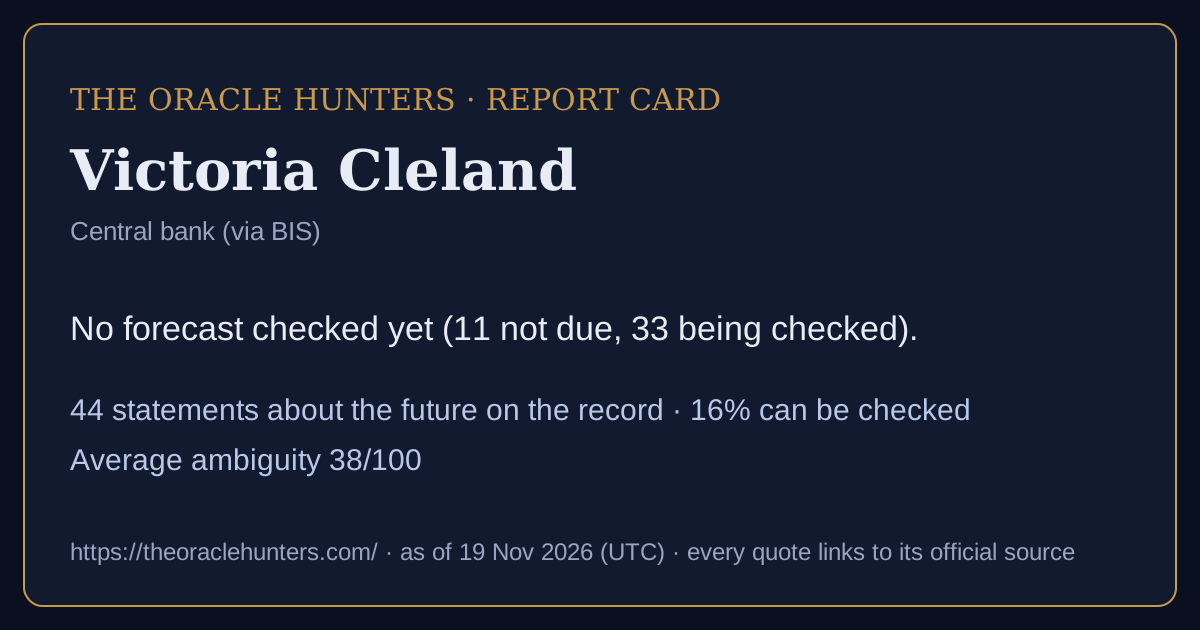
Track record: No forecast checked yet (11 not due, 33 being checked).
44forecasts & commitments on the record
16%can be checked as stated
38average ambiguity (0-100)
0goalpost moves recorded
0confirmed U-turns
Timeline
came true partly did not not due / being checked / too vague
Calibration score: shown after 10 checked forecasts with a stated likelihood (now 0).
How they speak about the future: based on data 36, stated on authority 8.
Kinds of claim: forecast 30, mixed claim 11, commitment 3. · Download this report card as a picture
In the nine words
πρόγνωσιςInference from evidence36 · 82%μαντείαInspired knowledge5 · 11%προαναγγελίαPublic pre-announcement3 · 7%
How to read this
Each box is one sentence a public figure or institution said about the future, word for word, with a link to the official text. Can be checked means it names what will happen, by when, and how likely - so it can be compared with official figures later. Too vague to check means it does not. Ambiguity (0-100) is how many different ways the sentence can be read. When the date passes, the forecast is compared with official data and marked came true, partly or did not come true. Labels judge the sentence, never the person. Full guide and glossary.On the record (44)
The Blueprint will then be handed over to the Delivery Company in Spring 2027, so that they can take forward detailed design, procurement, build and implementation.
Surveys commissioned by the Bank found that 14% of people choose cash as their first-choice payment method, and a quarter of UK adults could not go more than a week without using it.
At the Bank, we will always produce banknotes to meet demand, and we are committed to ensuring that physical cash will remain available to any and all who want to use it.
And next year our core RTGS settlement engine will become fully ISO 20022-native for all services and account holders.
To support the necessary up-take, the Bank will mandate the LEI for payments between financial institutions from November 2024.
The Bank will mandate the inclusion of a purpose code for property payments and payments between financial institutions from November 2024.
Whilst the current CHAPS ISO 20022 message usage guidelines that control the technical specification of CHAPS payment messages already support the vast majority of the data requirements set out in the publication, we will make some adjustments by end-2025 to ensure full compatibility, as part of a regular process for updating message guidelines.
Beyond 2024, we will continue to enhance RTGS, and are already working closely with industry on our ambitious, , exploring Roadmap of future payment innovations 1 innovative enhancements such as synchronised settlement.
Next year we will introduce a new core settlement engine, supporting broadened access for more and for different types of participants.
And furthermore, many of these features will also play an important role in helping us meet the ambitious G20 targets 3 for enhancing cross-border payments, many by 2027.
In addition, in line with our commitments under the G20 roadmap on cross-border payments, we will publish around the end of the year an external review of our access polices for non-banks, Financial Market Infrastructures (FMIs) and foreign banks to ensure that processes for these firms do not pose unnecessary barriers to access to RTGS.
These enhancements could reduce barriers to trade: cutting transaction costs on international trade just by one percentage point would save firms $13bn in Africa alone.
And we are considering longer operating hours as part of our forward looking RTGS roadmap beyond 2024 : again benefiting from the framework published by the CPMI. Longer and better aligned hours of operation could speed up cross-border payments, reduce settlement risk and simplify liquidity management, and the Bank's renewed service will have the capability to offer longer hours.
Along with a number of other central banks, this year we are undertaking a further review of our access approach, benefitting from the CPMI self-assessment framework. The review will help the Bank to determine whether the current direct access requirements remain proportionate in light of our objectives and new trends in the payments landscape.
In February 2023 the FSB published a set of priority actions that will be taken forward to meet the cross-border payments targets by 2027.
The value of cross-border payments is forecast to increase from almost $150 trillion in 2017 to over $250 trillion by 2027 1 .
The consultation closes on 30 June 2022 and we expect to issue a response document around the end of this year.
There are two key milestones approaching: CHAPS payments will migrate to enhanced ISO 20022 messaging in April 2023, followed by the switchover of the core settlement engine in Spring 2024.
We are currently consulting industry on a menu of features which could be introduced to RTGS beyond 2024. This includes assessing demand for a number of features, including synchronised payments that seek to bring not only domestic benefits, but help to improve crossborder payments.
In October 2021, following a public consultation, the FSB announced clear quantitative global targets to address the 4 challenges of cross-border payments - cost, speed, access and transparency across 3 market segments - wholesale, retail and remittances - the majority of which will come into effect in 2027. Work is underway to assess how to measure progress against the targets.
It is estimated that this year the global cross-border payment market will settle $156 trillion. And it is not just the wholesale markets that are impacted: cross-border payments are crucial to businesses, consumers and remittances.
In April 2023 CHAPS will move to the common international language for payments.
The Bank of England and HM Treasury will consult later this year on the assessment of the case for a retail CBDC in the UK, including scope for further work.
In the next few weeks we will consult the industry not just the current users of RTGS on proposals for continued evolution of the new platform beyond 2024.
We will then introduce in spring 2024 a new RTGS core settlement platform, offering greater resilience and enhanced user functionality.
Therefore the Bank will mandate the sending of enhanced data in due course, starting with Purpose Codes and Legal Entity Identifiers (LEIs) within certain CHAPS messages from Spring 2024.
In addition, starting in late 2022 SWIFT's correspondent banking network will retire the use of the existing MT standard by November 2025 and mandate ISO 20022.
June next year will be the first step in the UK's migration to ISO 20022.
It is predicted that by 2028 just 9% of all payments will be made by cash.
These ideas have been developed in conjunction with industry, and we will be consulting later this year to help to prioritise the enhancements.
We will transition to enhanced ISO 20022 messaging in February 2023.
The schema for the enhanced messages will be published towards the end of 2020, aiming to cut over to the ISO messages in the first half of 2022.
First, we plan next year to enhance the Security Requirements in the CRM to align to the globally recognised National Institute of Standards and Technology (NIST) Cybersecurity Framework. 8 The new requirements would align with NIST's principles of Identify, Protect, Detect, Respond and Recover, and will be more outcome focused, balanced with prescriptive requirements when necessary.
SIMEX16 focused on a multi-day outage to RTGS and SIMEX18 focused on a protracted operational outage of a Global Systemically Important Bank; a summary report of SIMEX18 was published last month. 15 Next month, we will participate in a desktop exercise to explore the impact of large scale rerouting of payments between CHAPS and Faster Payments.
Additional functionality will be delivered in 2024, to further drive innovation and change.
We plan to enter the contract with the Technology Delivery Partner in May 2020.
Final specifications for the implementation phase of the ISO 20022 migration will be available by the end of 2019 - allowing firms to kick start their planning and preparations for ISO 20022 implementation in CHAPS.
We will harness leading edge technology to deliver this, coupled with changes to our policies to support growth and resilience.
This dialogue - along with detailed analysis of the potential benefits and impacts for monetary and financial stability - will feed into a consultation paper in 2020.
Third, we will consult in 2020 on the appropriate level of access for payments service providers to the Bank's infrastructure and balance sheet, including necessary safeguards.
Later this year we will provide an update on our August 2018 call for interest on this topic.
The Bank is committed to strengthening the UK's payments services, and we will continue to work closely with the industry to ensure we create services not just for existing users but for prospective participants too, including those with innovative business models such as Distributed Ledger Technology.
There will be an update on next steps and how the Bank will structure future ISO engagement towards the end of the year.
The results of the POC were published on the Bank of England's website in June this year. 3 The results were encouraging and demonstrated that participants using alternative technology, such as DLT, could connect and settle.
Also said - not checkable as stated (12 newest)
Remarks about the future with no date, figure or likelihood that could be checked. They are kept on the record and shown here, but not scored.
While some features will be included in layers above the core, it is essential that the new infrastructure can support and enable effective controls across the ecosystem.
And extensibility will be key as the new infrastructure will need to be able to scale as payment volumes grow.
As we reflect on these responses, we will be considering that there was a preference for a relatively thin core, footnote that is the element that will be common to all products.
Planning the transition will be crucial and will need to draw on the input from many players, but it can only be planned once we have a clearer idea of what is being built and hence what is being transitioned to.
Product and scheme arrangements, payment services providers, consumer protection, liability, merchant acceptance, commercial incentives, financial inclusion and access will all need to develop alongside the core.
The public need to trust that banknotes will be available when required.
I will now dive deeper into the Bank’s work to ensure this essential trust in our banknotes through availability, secure design and public engagement.
Images of wildlife will also support resilience, enabling us to incorporate intuitive movements into the security features which are engaging and easy for the public to recognise and distinguish.
This helps to promote trust and security, as familiar imagery which resonates with the public will mean they look more closely at their banknotes.
We also collaborated with influencers to help us reach young people and audiences who may not have engaged with the Bank’s work in the past.
There will now be a quieter period in our communications about the next series, while our design work continues in the background, with security at its heart.
This must be a collective endeavour; we are engaging with industry, experts, and end users on an ongoing basis and will soon be launching our first consultation on the design of the future infrastructure.