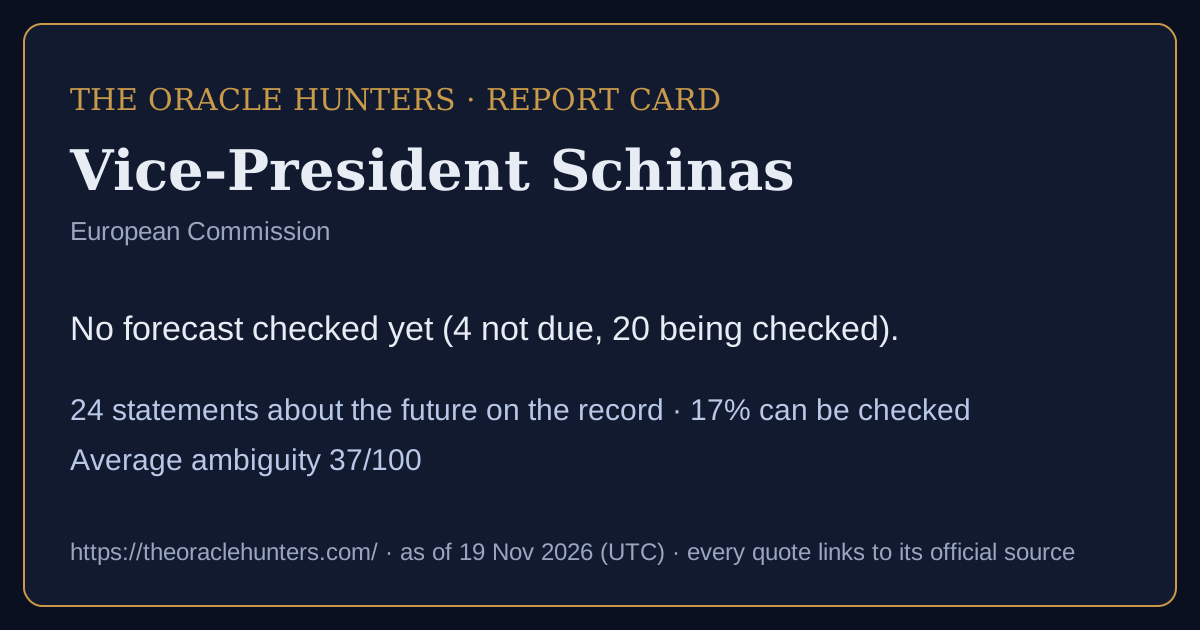
Vice-President Schinas
European Commission · EU
Track record: No forecast checked yet (4 not due, 20 being checked).
24forecasts & commitments on the record
17%can be checked as stated
37average ambiguity (0-100)
0goalpost moves recorded
0confirmed U-turns
Timeline
came true partly did not not due / being checked / too vague
Calibration score: shown after 10 checked forecasts with a stated likelihood (now 0).
How they speak about the future: stated on authority 14, based on data 10.
Kinds of claim: mixed claim 11, forecast 11, commitment 2. · Download this report card as a picture
In the nine words
μαντείαInspired knowledge14 · 58%πρόγνωσιςInference from evidence8 · 33%προαναγγελίαPublic pre-announcement2 · 8%
How to read this
Each box is one sentence a public figure or institution said about the future, word for word, with a link to the official text. Can be checked means it names what will happen, by when, and how likely - so it can be compared with official figures later. Too vague to check means it does not. Ambiguity (0-100) is how many different ways the sentence can be read. When the date passes, the forecast is compared with official data and marked came true, partly or did not come true. Labels judge the sentence, never the person. Full guide and glossary.On the record (24)
And the Commission will be there every step of the way to accompany Member States over the next two years and beyond – putting all the operational and financial resources and expertise needed at the disposition of Member States.
The mid-term review of the MFF will give an additional 1.6 billion for MFF and AMIF, which is the Asylum, Migration and Integration Fund, and this is money that had to be spent before 2027 that has not been allocated yet.
And some elements, the Commission will already take forward as of now – we will for instance inaugurate the first solidarity cycle already next year.
Before the summer, we will produce a full, step-by-step implementation plan and support Member States every step of the way – with technical and operational assistance and significant EU funding, including EUR 2 billion earmarked from the MFF review.
In 2024, we will help build a child and youth mental health network and develop a prevention toolkit, showing how important it is for mental and physical health to go hand in hand.
This Act will be presented by the end of 2022, but you can already contribute to its success by participating in the online public consultation, which was launched last week.
And I will come next year to the Munich Security Conference, with results, to show that our commitments are being delivered on the ground.
We have already supported the creation of the European Holocaust Research Infrastructure with 25 million euros since 2010 but now we will propose the creation of a European research hub on contemporary antisemitism and Jewish life to strengthen multidisciplinary research across the EU.
The next call for proposals will be published next year for an amount to 24 million euros.
Later this year we will come with a separate proposal on theSchengen Borders Code.
As announced in the Pact, by the end of this year, the Commission will present a ‘Skills and Talent package'.
We will also by next year propose a way forward to allow for a lawful access to encrypted information in the context of criminal investigations and prosecutions that would also protect privacy and security and the confidentiality of communications.
First, the increasing deployment of key enabling technologies, such as 5G or internet of things devices: these devices are expected to reach 25 billion by 2025 with a quarter of them to be located in Europe.
In 2022, we will launch a European Cancer Imaging Initiative to support the development of new computer-aided tools to improve personalised medicine and innovative solutions.
Still this year we will create a Knowledge Centre on Cancer to facilitate the coordination of scientific and technical cancer-related initiatives at EU level.
By 2025, we will develop a new EU Cancer Screening Scheme to ensure that 90% of the target population is offered breast, cervical and colorectal cancer screening.
Today's package is yet another important building block of our Health Union: it also adds to the unprecedented work we are currently carrying out on vaccines, the new Health for All programme for the next budget and will be followed by the EU Cancer Plan early next year.
We shall be presenting concrete proposals and flagship initiatives in the next two years and throughout the mandate.
By the end of the year we will have a first group of EU countries finally adopting and presenting national strategies on combating antisemitism.
Which is why we have today launched a public consultation to gather views on this topic and will come with proposals next year.
Of course, it was natural that other political priorities had to take centre stage this year (pandemic, MFF/recovery) but these proposals remain eagerly anticipated and the devastating fires in Moria this month have added a renewed sense of urgency to put this crucial topic back on top of the agenda.
We will next year present a strategy on the future of Schengen, which will include initiatives for a stronger and more complete Schengen.
The cost of cybercrime is expected to reach EUR 5.5. trillion by the end of this year.
And we will work with our Agency, ENISA, to build on its recently renewed mandate to do much more and better, and that will happen by the end of the year.
Also said - not checkable as stated (12 newest)
Remarks about the future with no date, figure or likelihood that could be checked. They are kept on the record and shown here, but not scored.
Not all are starting from the same place – for example, some Member States already have experience with advanced screening procedures at the borders, others will need to work to put the necessary structures in place.
Others still have a strong track record of streamlined workflows for processing asylum claims, but all will need to adjust to the new requirements, timelines and safeguards of the law.
For example reception, because with a well-functioning situation at the borders, with all the things we are doing to close the loopholes for secondary movements, we will have less pressure on the reception facilities which is important.
I confess it is quite an emotional thing to do, at this point when the current political cycle is ending and a new chapter will open in the next few weeks.
Five years ago, it was virtually unthinkable that a European Health Union could be anything more than a vision on paper.
The European Health Data Space will bring our health systems into the digital age.
Citizens will fully control their own health data and be able to use it to seek treatment across EU borders if they are traveling.
But more importantly it has also raised the bar in what citizens expect from us.
And the Covid-19 pandemic underscored in the most emphatic way the urgent need to prioritise EU in health.
But we will manage migration in an orderly way, and on our terms.
What is the most important part that we will achieve with the Pact is on the legislative files - a lot - it's a really comprehensive one.
Second, we also have a streamlining of the return decision together with an asylum decision so we will have swifter returns.