Vice-President Rehn
European Commission · EU
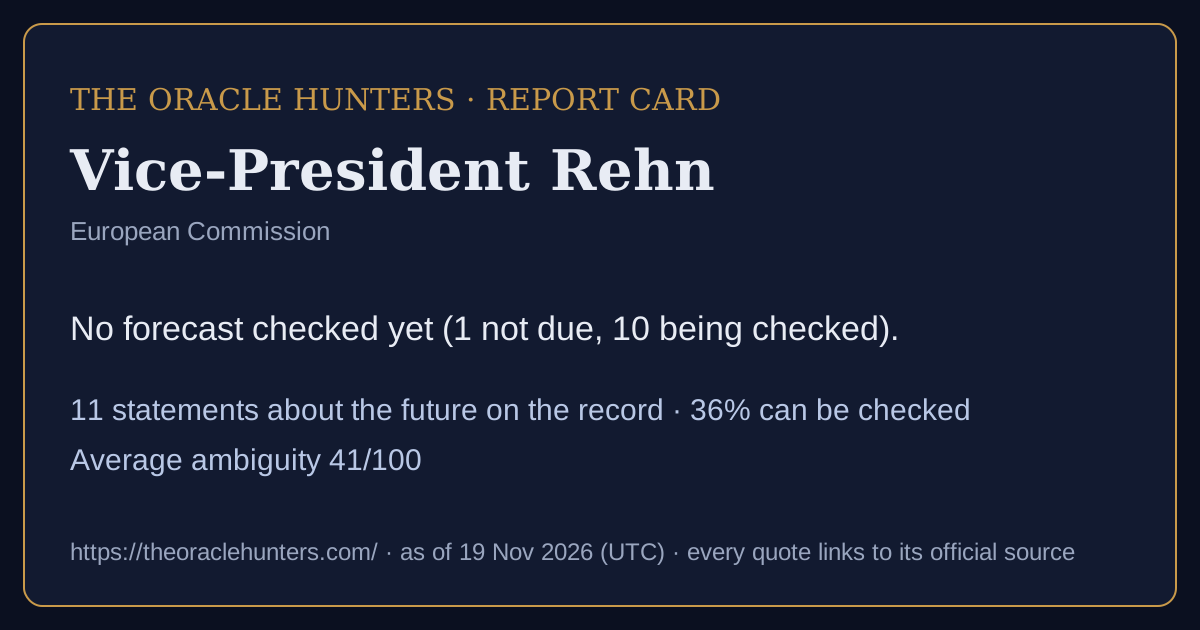
Track record: No forecast checked yet (1 not due, 10 being checked).
11forecasts & commitments on the record
36%can be checked as stated
41average ambiguity (0-100)
0goalpost moves recorded
0confirmed U-turns
Timeline
came true partly did not not due / being checked / too vague
Calibration score: shown after 10 checked forecasts with a stated likelihood (now 0).
How they speak about the future: based on data 5, stated on authority 5, educated guess 1.
Kinds of claim: forecast 6, mixed claim 4, scenario (if… then) 1. · Download this report card as a picture
In the nine words
μαντείαInspired knowledge5 · 45%πρόγνωσιςInference from evidence5 · 45%πρόνοιαPreparing for the future1 · 9%
How to read this
Each box is one sentence a public figure or institution said about the future, word for word, with a link to the official text. Can be checked means it names what will happen, by when, and how likely - so it can be compared with official figures later. Too vague to check means it does not. Ambiguity (0-100) is how many different ways the sentence can be read. When the date passes, the forecast is compared with official data and marked came true, partly or did not come true. Labels judge the sentence, never the person. Full guide and glossary.On the record (11)
Regarding non-resident banking, close monitoring of financial stability risks, readiness to adopt regulatory measures if needed, and determined implementation of anti-money laundering rules will remain key.
Rigorous asset-quality reviews and stress tests scheduled for next year are a crucial ingredient in our overall growth strategy.
A gradual recovery is underway, and we expect it to grow firmer in the coming months and to speed up over the course of next year.
In parallel, the Commission will continue to work intensively to facilitate a decision on a programme, which we envisage can be taken next month.
Today, this morning, we have put in place an essential building block of the banking union, which next year we will build upon with a proposal for a Single Resolution Mechanism, and with further steps to reinforce our Economic and Monetary Union.
Moreover, in the healthcare sector, measures to control over-prescriptions and fraud mean that public expenditure will have fallen by €1 billion (or around 25%) this year, and should fall by a further €800 million over the next two years.
By the end of this year, all of the competitiveness loss experienced by Greece between 2001 and 2009, relative to the rest of the euro area, will have been recouped.
And this margin will increase further with the implementation of the additional measures foreseen for 2013 and 2014.
They are indeed very substantial programmes of both fiscal consolidation and restoring competitiveness and we broadly welcome these and will come back to these programmes later on in the course of this year.
On fiscal consolidation, the improvement in Greece's structural budget balance has already exceeded the 10 percentage points required at the start of the first programme in May 2010 for the period from 2009 to 2014.
First, in the healthcare sector, measures to control over-prescriptions and fraud mean that public expenditure will have fallen by €1 billion (or around 25%) this year, and should fall by a further €800 million over the next two years.
Also said - not checkable as stated (12 newest)
Remarks about the future with no date, figure or likelihood that could be checked. They are kept on the record and shown here, but not scored.
Looking ahead, it is essential that sustainable convergence is not jeopardised by another round of re-emerging imbalances assuming that real interest rates may remain for a while lower in Latvia than in the euro area on average.
Of course, in order to realise the full economic benefits of monetary union and minimise risks to sustainable convergence in the long run, it will be essential to continue with sound macroeconomic and structural policies, which should be fully geared towards a smooth performance within the euro area.
At macro level, Latvia will benefit from the ECB's monetary policy that ensures price stability.
Euro area membership is likely to foster trade integration and attract investment, thereby supporting medium-term growth prospects.
Latvia needs to proceed implementing structural reforms in line with the Country Specific Recommendations to further enhance competitiveness, reduce the grey economy and strengthen the functioning of product and labour markets.
We will assess the planned service tax from this perspective once the details have been agreed.
If a Member State breaches the reference values of the Treaty [deficit and/or debt], the Commission will have to take the necessary steps and open an excessive deficit procedure.
The procedure is closed, but Italy will need to live up to its commitments – as the Italian government has repeatedly stated that it will.
By 15 October, all euro area Member States must present their draft budgets for 2014 to the Commission and to the Eurogroup.
Now it will be essential to maintain the tempo of reform in the coming months in Greece.
The disbursement agreed today will allow for liquidity to begin to flow back into the Greek economy via a recapitalised and reformed banking system.
It will pave the way for a return to growth, enhanced by the reforms that are transforming Greece's competitiveness and rendering its labour market both more dynamic and more inclusive.