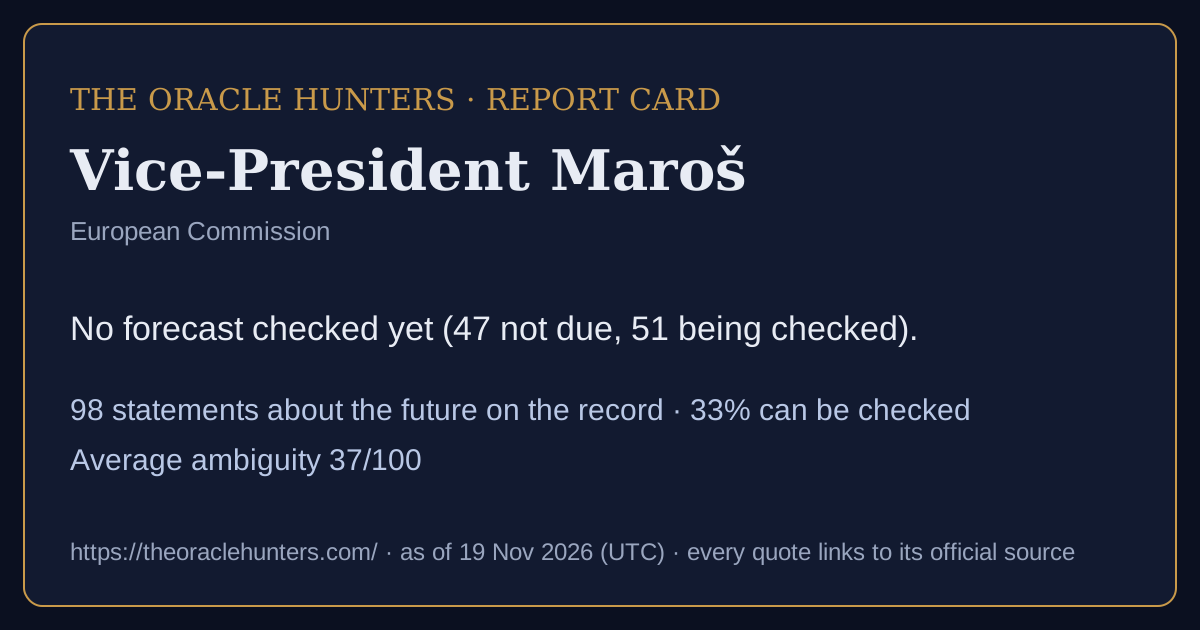
Vice-President Maroš
European Commission · EU
Track record: No forecast checked yet (47 not due, 51 being checked).
98forecasts & commitments on the record
33%can be checked as stated
37average ambiguity (0-100)
0goalpost moves recorded
0confirmed U-turns
Timeline
came true partly did not not due / being checked / too vague
Calibration score: shown after 10 checked forecasts with a stated likelihood (now 0).
How they speak about the future: based on data 74, stated on authority 24.
Kinds of claim: forecast 71, mixed claim 21, commitment 6. · Download this report card as a picture
In the nine words
πρόγνωσιςInference from evidence69 · 70%μαντείαInspired knowledge22 · 22%προαναγγελίαPublic pre-announcement6 · 6%πρόβλεψιςSeeing the signs1 · 1%
How to read this
Each box is one sentence a public figure or institution said about the future, word for word, with a link to the official text. Can be checked means it names what will happen, by when, and how likely - so it can be compared with official figures later. Too vague to check means it does not. Ambiguity (0-100) is how many different ways the sentence can be read. When the date passes, the forecast is compared with official data and marked came true, partly or did not come true. Labels judge the sentence, never the person. Full guide and glossary.On the record (98)
In this case, we could expect the EU's adjusted GDP to increase by 15.5% by 2040, higher than that of countries such as the US, China or India.
Demand for batteries is expected to continue to increase drastically in the coming years for both mobility and storage [just for lithium-ion batteries: from 550 GWh by 2025 to 1000 GWh in 2030].
Last but not least, we have invested in supporting research and innovation, for example, through the 925 million-euro Battery Partnership with industry under our Horizon Europe programme, and we will continue to do so.
And this is part of our ongoing reflection for the 2023 Strategic Foresight Report, which will be published early next month.
We need to be honest with ourselves: technologies existing today can help us reach our 2030 climate targets, but to achieve our 2050 ambitions, we will need new technologies that are currently only at the experimental, demonstration or prototype phase.
With sales soaring, demand for lithium needed for the batteries which power them is expected to be 12 times greater by 2030 and 21 times higher by 2050.
Looking ahead, our efforts to implement the roadmap will continue in the coming months, including by beginning the work of identifying potential joint projects, increasing the resilience of the raw materials, battery and renewable hydrogen supply chains in Kazakhstan, and exchanging experience and best practices.
And we will continue with this effort: Together with the UK and Ireland, the European Commission has agreed to co-fund the new €1.15 billion PEACE PLUS programme, expected to start shortly.
This is the question we started asking ourselves in our 2021 Strategic Foresight Report, when considering the fact that India is projected to surpass Europe in terms of nominal GDP by 2050.
This first tendering round is open until the 15th of May, and it covers gas deliveries from June 2023 until May 2024.
My hope is that we could conclude the negotiations by the summer of 2024, making the best use of the political cycles on both sides.
And the battery industry is expected to require an extra 800,000 skilled workers by 2025.
The solar panel industry will need 1 million skilled workers by 2030.
Some studies expect that some 50% of jobs today will see automation by 2025.
As green and digital transitions move into higher gear, we are expected to face a global shortage of key raw materials by 2030.
In the same vein, 14 projects identified across the rare earths value chain by the European Raw Materials Alliance could meet 20% of the EU's needs by 2030, as compared to close to zero today.
For example, if all 11 potentially viable lithium projects in the EU become operational, they could produce some 38% of the expected lithium demand by 2030.
Our Gigafactories are expected to supply 90% of batteries needed in the EU's economy by 2030.
Furthermore, in order to produce the expected 30 million electric vehicles by 2030, we will need 10,000 tons of permanent magnets, requiring 3,000 tons of rare earths – the vast majority of which is imported from China.
The actions outlined in today's report will feed into the Commission Work Programme for next year, in line with our overarching objective – to mainstream foresight across our major policy initiatives so that the long-term perspective is reflected in our immediate decision-making.
According to industry, however, if Europe fixes its shortcomings, recycling could become a major source of metals and minerals, crucial for new technologies, by 2040.
Technologies available today may get us through to 2030.
In the report, we note that the EU's use of lithium, a key component for electric mobility, is projected to increase by 3,500% by 2050.
The ICT sector is already responsible for up to 9% of global electricity use and more than 2% of greenhouse gas emissions – figures which could triple by 2025.
However, according to industry, if Europe fixes its shortcomings, recycling could become a major source of metals and minerals, crucial for new technologies, by 2040.
Just imagine: the EU's use of lithium, a key component for electric mobility, is projected to increase by 3,500% by 2050.
The first set of new proposals will be announced in President von der Leyen's State of the Union address in September – and will then feed into the 2023 Commission Work Programme.
The battery industry alone is telling us some 800,000 workers will need to be re-skilled and up-skilled by 2025.
This crucial role is why we will put them at the centre of our next Foresight report which we will publish next month.
However, the technological limits of current transistor architecture will be reached by 2030.
The World Economic Forum has estimated that, by 2027, 10 percent of global GDP could be stored on blockchain technology.
As outlined in the recently proposed Defence package, we will strengthen our defence industrial base, especially by reducing strategic dependencies, supporting research and innovation, encouraging joint procurement of defence capabilities, and enhancing the defence dimension of space at EU level.
Finally, I also informed Ministers that next month – in the context of the upcoming EU-African Union Summit – the Commission would put forward a Team Europe Vaccination support package to accelerate the vaccine rollout and uptake in Africa.
And we have also agreed that the EU-UK Joint Committee on the Withdrawal Agreement will take place in the course of next month.
With this in mind, the theme of our 2022 Strategic Foresight Report will be the twinning of the green and digital transitions.
However, the limits of physics for current transistor architecture will be reached by 2030.
President Macron, meanwhile, has just announced France 2030, and we are currently discussing with Paris how to strengthen our foresight cooperation during the upcoming French presidency, when the next ministerial meeting will be taking place.
Demand will be fuelled by a number of trends, including an exponential increase in Internet of Things connections – with up to 200 billion connected devices expected by 2030 – the continuing electrification and automation of cars, artificial intelligence, 5G and quantum computing.
And third, a Just Transition Fund that will provide grants and loans for both the private and public sectors in the context of territorial just transition plans, as we move towards a climate-neutral Europe by 2050.
This trend will continue into 2022, as in the second quarter of 2021, the share of renewables in the EU's electricity supply reached 42 percent, with 32 percent from fossil fuels.
By 2025, the EU's battery market is set to be worth 250 billion euros and will sustain up to four million jobs of all different skill levels.
Rather, it will keep generating demand for low- and medium-skilled roles in the energy sector, with 75 percent of employees expected to be manual workers and technicians in 2050.
For example, 50 percent of today's jobs could be automated by 2050.
The bigger part of this funding – 262 million euros under NextGenerationEU – must be committed by 2023, with the projects completed by 2026.
We will therefore continue to support the PEACE+ programme, together with the UK and the Irish government, to the tune of around 1 billion euros.
For Ukraine that could mean embarking on a society-wide “Ukraine 2050” project – to build a modern, sustainable and digital economy.
The EU will continue to stand by your side in solidarity and with unwavering commitment to support Ukraine across all critical areas, including its territorial integrity, the rule of law, reforms, and sustainable economic growth.
In the preparation of next year's work programme, we are paying close attention from the early planning stages to whether the envisaged measures are likely to add burdens or not - and for which stakeholders.
The full implementation of the ‘One-In-One-Out' approach will also begin with next year's Commission work programme.
For the 2022 Commission work programme, managing the exit from the pandemic and the recovery are likely to remain centre stage, and making sure that we turn this crisis into an opportunity to achieve a fairer, greener and more digital society.
Showing the newest 50 - the ledger has all 98.
Also said - not checkable as stated (12 newest)
Remarks about the future with no date, figure or likelihood that could be checked. They are kept on the record and shown here, but not scored.
This is why the European Investment Bank, the largest public bank in the world, should provide stronger support for strategic investments relevant for the green and digital transitions in key areas such as raw materials, green tech and biotechnology, especially for cutting-edge projects.
In times of rising insecurity and with open conflict on Europe's border, strategic foresight enables us to better prepare for an uncertain future and anticipate developments which might impact on us.
As an example, we looked at what GDP might look like after taking into account life expectancy as a measure of health.
Tenders will be published today, and international gas suppliers will be able to send their bids until 10 July.
Looking at the wider picture, I believe the impact of the Platform will go beyond the energy sector.
Changes in the climate, digital technologies and geopolitics are having a profound effect on the lives of Europeans, and therefore need to be well-integrated into public policies.
So I truly believe that we should consider using the EU Energy Platform as a blueprint for other sectors such as hydrogen and critical raw materials.
So we must now turn the joint purchasing of gas into a permanent instrument, and extend it to other commodities.
We will also soon set up structured dialogues on counter-terrorism and cyber-security.
We will continue our joint efforts on this implementation work.
And we will continue to work to ensure the full protection of citizens' rights under the Withdrawal Agreement.
And, crucially, it will preserve the hard-earned gains of the peace process by avoiding a hard border on the island of Ireland.