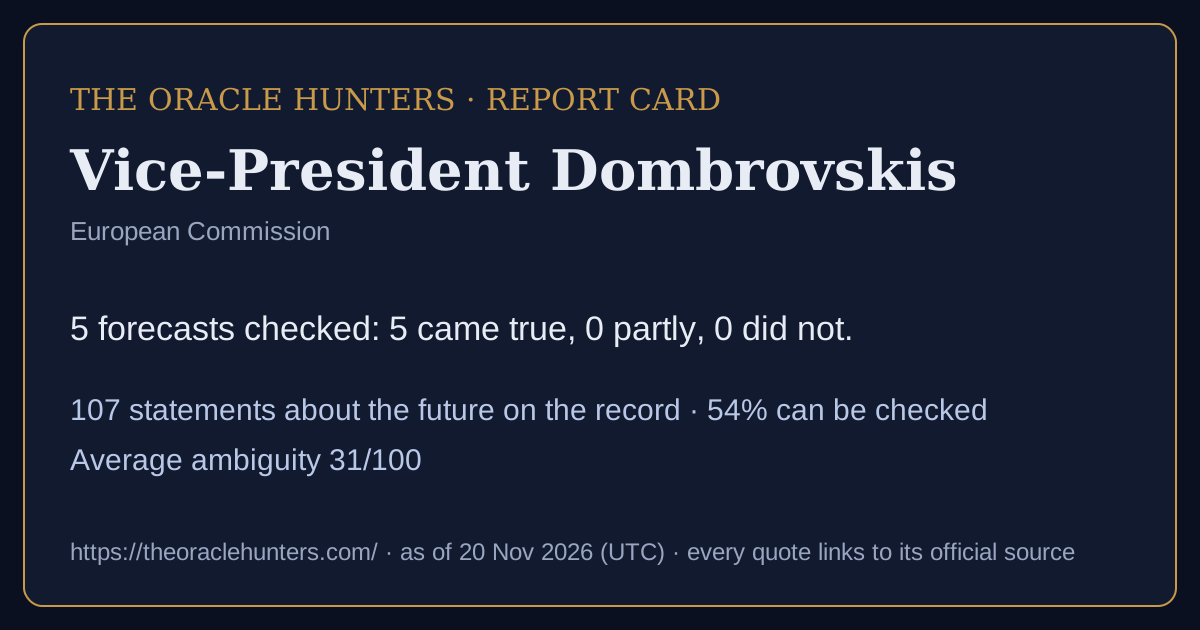
Vice-President Dombrovskis
European Commission · EU
Track record: 5 forecasts checked: 5 came true, 0 partly, 0 did not.
107forecasts & commitments on the record
54%can be checked as stated
31average ambiguity (0-100)
0goalpost moves recorded
0confirmed U-turns
Timeline
came true partly did not not due / being checked / too vague
Calibration score: shown after 10 checked forecasts with a stated likelihood (now 5).
How they speak about the future: based on data 77, stated on authority 29, educated guess 1.
Kinds of claim: forecast 80, mixed claim 18, commitment 6, scenario (if… then) 3. · Download this report card as a picture
In the nine words
πρόγνωσιςInference from evidence74 · 69%μαντείαInspired knowledge24 · 22%προαναγγελίαPublic pre-announcement6 · 6%πρόνοιαPreparing for the future3 · 3%
How to read this
Each box is one sentence a public figure or institution said about the future, word for word, with a link to the official text. Can be checked means it names what will happen, by when, and how likely - so it can be compared with official figures later. Too vague to check means it does not. Ambiguity (0-100) is how many different ways the sentence can be read. When the date passes, the forecast is compared with official data and marked came true, partly or did not come true. Labels judge the sentence, never the person. Full guide and glossary.Checked
The Greek economy expands – real GDP growth in 2017 was 1.4% and it is projected to be about 2% this year.
Came true. Said: economic growth around 2% in 2018. Official figure for Greece: 2.1% (World Bank open data). On target. Off by 0.1 points. official data · checked 14 Nov 2026 · automatic check against official data (rules v3)
Average budget deficit in the Euro area is continuing to decline and is expected to reach 1.7% of GDP next year.
Came true. Said: government budget deficit around 1.7% of GDP in 2016. Official figure for Euro area: 1.5% of GDP (Eurostat - government deficit and debt). On target. Off by 0.2 points. official data · checked 17 Nov 2026 · automatic check against official data (rules v4)
Economic growth in the EU is expected to strengthen slightly, from 1.9% this year to 2.0% next year.
Came true. Said: economic growth around 2% in 2016. Official figure for European Union: 1.9% (World Bank open data). On target. Off by 0.1 points. official data · checked 14 Nov 2026 · automatic check against official data (rules v3)
Real GDP growth in the Euro area is projected to strengthen from 1.6% this year to 1.8% in 2016.
Came true. Said: economic growth around 1.8% in 2016. Official figure for Euro area: 1.8% (World Bank open data). On target. Off by 0.0 points. official data · checked 14 Nov 2026 · automatic check against official data (rules v3)
Recovery in the euro area is progressing: GDP growth is projected at 1.3% this year and 1.9% for next year.
Came true. Said: economic growth around 1.9% in 2016. Official figure for Euro area: 1.8% (World Bank open data). On target. Off by 0.1 points. official data · checked 14 Nov 2026 · automatic check against official data (rules v3)
On the record (107)
This will translate into approximatively €3.3 billion in lost export revenue for Russia;
Of the other four countries at risk of non-compliance, Slovakia and Finland have debt-to-GDP ratios below 60% and Portugal and Slovenia are expected to meet the debt rule.
We invite all Members States that are at risk of non-compliance with the Stability and Growth Pact "to take the necessary measures within the national budgetary process to ensure that the 2020 budget will be compliant with the Stability and Growth Pact".
Romania is expected to breach the 3% of GDP reference value of the Treaty already this year, with rapidly growing deficits over the following years.
Slovenia has a nominal surplus [0.5% of GDP] and given the high uncertainty surrounding its output gap estimates, it may well be that it is closer to its medium-term budgetary objective in 2020.
Its size will be determined in the context of the next Multiannual Financial Framework 2021 – 2027.
We now expect the Italian debt ratio to rise in both 2019 and 2020, up to 135% of GDP due to the gap between interest rates and growth, so called “snowball” effect, but also due to declining primary surplus and underachieved privatisation proceeds.
For example, 21% of the overall proposed budget for 2020 will go to tackle climate change.
It is crucial that Leaders reach a meaningful agreement this week and that the co-legislators agree on pending proposals before the European Parliament elections in May 2019.
As for the revised Draft Budgetary Plan, our analysis shows that Italy's structural deficit would see an increase by about 1% of GDP next year.
We ask those 5 Member States to take the necessary measures within the national budgetary process to ensure that the 2019 budget will be compliant with the Pact.
Ten euro area Member States are expected to have a budget surplus in 2019.
Italy's debt is forecast to remain at around 131% over the next two years.
This year and next, no euro area country is forecast to have a deficit above the 3% of GDP reference value.
According to our estimate, we will need about €180bn in additional annual investment over the next decade to meet these goals.
Many Member States today supported the need for such mapping, so we expect to conclude this assessment later this year.
Already last year, ICOs helped raise over 6 billion dollars in funding and this year this figure will be substantially bigger.
Our number one goal here is for the Parliament and the Council to adopt as many pending legislative files as possible before the European elections in May next year.
Afterwards, these are expected to decline to a steady state of at least 2% of GDP.
Greece also ranks first in the European Union in terms of total expected investment under the European Fund for Strategic Investments, compared to its GDP - €2.6 billion under EFSI is set to trigger €10 billion in additional investments.
Greece will continue to benefit strongly from the EU budget, for example, through a substantially increased cohesion allocation.
The Greek economy expands – real GDP growth in 2017 was 1.4% and it is projected to be about 2% this year.
Came true. Said: economic growth around 2% in 2018. Official figure for Greece: 2.1% (World Bank open data). On target. Off by 0.1 points. official data · checked 14 Nov 2026 · automatic check against official data (rules v3)
These rules will come into force in 2020 and will provide more transparency on the role of intermediaries who sell products and tax structures that can potentially help clients to avoid tax.
By next year, we will propose to revise these guidelines.
And it will help reduce borrowing costs for bank loans, with up to €1.9 billion in potential annual savings for EU borrowers.
Early next year, we will report on best practices for regulatory sandboxes.
Over the next decade, we will need around €180 billion a year in additional low-carbon investments to meet our Paris commitments.
Before 2020, this system could be tested in a pilot phase, by offering Member States the choice to draw from the performance reserve of the European Structural and Investment Funds.
For after 2020, we will propose to do it via a dedicated convergence facility.
But we hope that work will continue in 2018 to deliver stronger defensive measures.
Romania should now undertake a structural adjustment of 0.8% of GDP in 2018, which could also ease our concerns over Romania's fiscal sustainability in mid-term.
We ask all Members States that are at risk of non-compliance with the SGP to take the necessary measures within the national budgetary process to ensure that the 2018 budget will be compliant with the Pact.
Next month we will come with new proposals to reinforce the EMU further.
We stress that the adoption of the 2018 budget with no watering down of its key provisions will be crucial, as will its subsequent strict implementation to deliver a structural effort of at least 0.3% of GDP.
Our autumn forecast projects that the headline deficit will be below 3% of GDP in 2018, but it does not meet the deficit target set to Spain.
To illustrate, this year Sputnik, a pro-Kremlin news platform operating in 30 languages, published stories claiming that French Presidential candidate Macron could be a US agent;
Given the success of the initiative, the European Commission has decided to extend the EFSI from its initial €315 to €500 billion by end 2020.
And the results are clear: the country has stabilised its financial sector, returned to economic growth last year and is expected to grow - at about 2% this year.
We will actually update our forecasts next month.
So early next year, the Commission will present a comprehensive strategy for sustainable and green finance in the EU.
The new mechanism will apply for any disputes related to tax issues on income as of January next year.
We will work together with the ECB and the EBA to develop, by the end of the year, a European blueprint for national Asset Management Companies (AMCs).
As regards the preventive arm, there are 8 countries - Germany, Luxembourg, Malta, the Netherlands, Bulgaria, Czech Republic, Denmark, and Sweden – that are projected to be at or above their medium-term budgetary objectives both this year and next and correspondingly they receive no fiscal recommendations.
Growth is expected to be 1.9% this year and next.
At the level of the Commission, we will continue with our actions in different fields - both internally and towards the outside world - to support the dismantling of barriers and to promote sustainable economic growth.
Today we have positive news for Croatia and Portugal – we recommend the Council to abrogate the Excessive Deficit Procedures for the two countries as they have brought their budget deficits below the 3% of GDP and this for the whole forecast horizon.
As regards the preventive arm, there are 8 countries - Germany, Luxembourg, Malta, the Netherlands, Bulgaria, Czech Republic, Denmark, Sweden – that are projected to be at or above their medium-term budgetary objectives both in 2017 and 2018.
GDP growth, for the EU as a whole, is expected to be at 1.9% both this year and the next.
If however we were to tackle NPLs, the capital relief could support lending by up to EUR 500 bn over the next years, in particular in the Member States which need it most.
According to some estimates, the development of EU capital markets could unlock € 2 trillion of assets to invest in the EU economy and could lead to more than € 50 billion a year in additional financing for companies.
Showing the newest 50 - the ledger has all 107.
Also said - not checkable as stated (12 newest)
Remarks about the future with no date, figure or likelihood that could be checked. They are kept on the record and shown here, but not scored.
And we must be vigilant in respect of any possible actions by China that could undermine our sanctions.
First, we have to avoid panic-driven reactions, which could lead to export bans on key commodities such as wheat and other cereals.
Our path is clear: if Russia persists in its aggression, more sanctions will follow.
EU imports from Russia decline by about 10% or USD 18 billion, a figure which would be five times higher should oil and gas products be covered by EU import restrictions.
Companies are struggling to insure cargos going to and from Russia because of high risks and new customs requirements.
Slovakia has taken additional measures after the submission of its draft budgetary plan, which allowed it to avoid the risk of significant deviation in 2020.
So, the risk of significant deviation is manifest when the years 2019 and 2020 are taken together, due to fiscal slippages this year.
We will propose to reinsert certain aspects of Real Driving Emissions testing into legislation to be adopted by the European Parliament and Council.
Our focus is now on the preparations for next week's European Council, and we will do a gradual roll-out on those preparations for you over next few days:
Finally, we will welcome today the Members of the European Court of Auditors for our regular annual meeting.
The budget instrument will be aligned with the European Semester.
Contributions from the EU budget could be complemented by additional financing, for example, via external assigned revenues on the basis of an intergovernmental agreement.