Vice-President Ansip
European Commission · EU
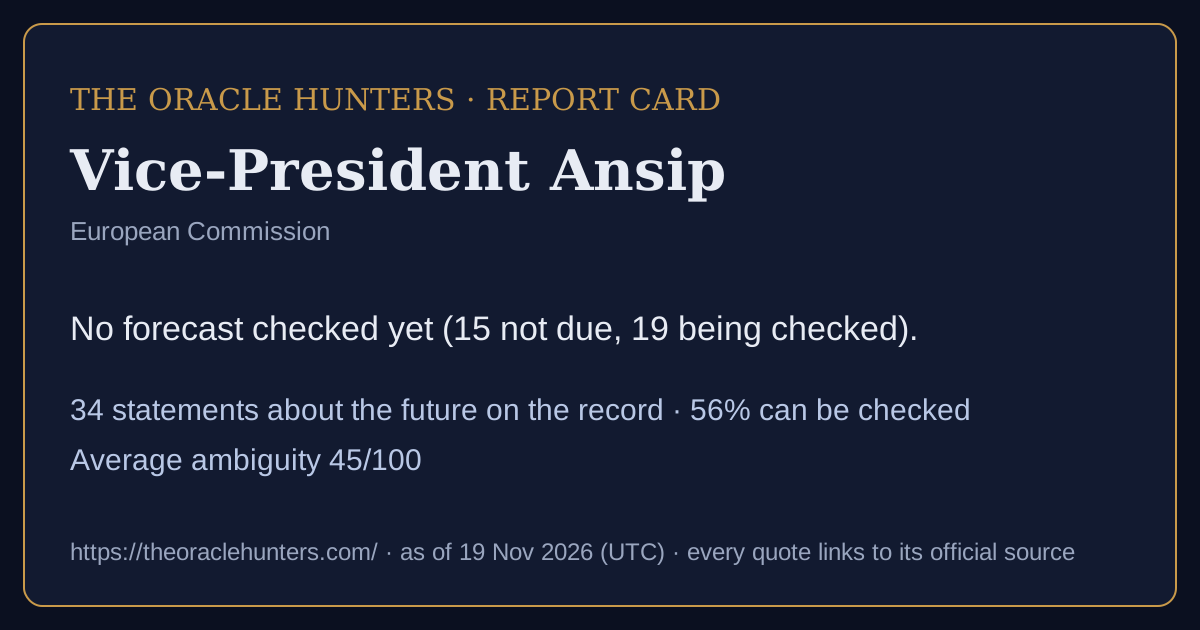
Track record: No forecast checked yet (15 not due, 19 being checked).
34forecasts & commitments on the record
56%can be checked as stated
45average ambiguity (0-100)
0goalpost moves recorded
0confirmed U-turns
Timeline
came true partly did not not due / being checked / too vague
Calibration score: shown after 10 checked forecasts with a stated likelihood (now 0).
How they speak about the future: based on data 26, stated on authority 7, educated guess 1.
Kinds of claim: forecast 25, commitment 5, scenario (if… then) 4. · Download this report card as a picture
In the nine words
πρόγνωσιςInference from evidence21 · 62%προαναγγελίαPublic pre-announcement5 · 15%μαντείαInspired knowledge4 · 12%πρόνοιαPreparing for the future4 · 12%
How to read this
Each box is one sentence a public figure or institution said about the future, word for word, with a link to the official text. Can be checked means it names what will happen, by when, and how likely - so it can be compared with official figures later. Too vague to check means it does not. Ambiguity (0-100) is how many different ways the sentence can be read. When the date passes, the forecast is compared with official data and marked came true, partly or did not come true. Labels judge the sentence, never the person. Full guide and glossary.On the record (34)
As you probably know, the EU's GDPR enters into full force next month:
A few weeks ago in France, President Macron presented a national plan to spend €1.5 billion over five years to support AI, and joint projects with Germany.
I have already mentioned AI – and for this we will also need increased funding for supercomputers.
I say that because: without removing barriers that prevent digital growth; without the right legal environment; without adequate investment - Europe will not have much of a digital future.
This year, I will again ask countries to commit to Europe's digital and data-based future – with a focus on artificial intelligence (AI), digital healthcare and blockchain technologies.
Tanzania's GDP growth is projected at 7.2%, with five other countries in the 6-7% range: Côte d'Ivoire, Senegal, Ghana, Burkina Faso and Rwanda.
Its GDP is projected to grow by 8.3%, against a global growth forecast of 2.7%.
By 2035, according to the IMF, sub-Saharan Africa will have more working-age people than the rest of the world's regions combined.
We will need €500 billion in investment to build the infrastructure capable of sustaining high-speed networks.
If it does not, the growth potential of our digital economy will be limited.
Some experts estimate that the value of personal data in Europe could grow to nearly €1 trillion annually by 2020.
But if data does not flow freely across the EU, then the growth potential of the digital economy in Europe will be limited.
By the end of this year, the European Commission will have presented all major initiatives outlined in our Digital Single Market vision paper from May 2015.
By 2020, it will be more than two zettabytes.
By 2020, 70 percent of people will have one.
Cisco estimates that 50 billion devices and objects will be connected to the internet by 2020 – vastly more than today.
Smartphone subscriptions will almost double by 2021.
In itself, that could save some €5 billion per year by 2017.
By 2020, at least 26 billion devices will be hooked up to the internet; 70 percent of people will own a smartphone.
Reforming Europe's copyright rules will be a major initiative in the DSM strategy and is expected to be one of the first that we propose, later this year.
Take the EU app economy: in 2013, it generated revenues of €17.5 billion, a figure expected to rise to some €60 billion by 2018.
Once fully in place and working, the Digital Single Market could contribute €415 billion per year to our economy and generate hundreds of thousands of new jobs.
And we will prepare for the future: to maximise the growth potential of the digital economy, with a firm focus on all aspects of data and areas of new growth, such as cloud computing and the Internet of Things.
People could save €11.7 billion per year if they could choose from a full range of EU goods and services when they shop online.
Lastly, we will build a solid foundation for long-term growth.
A plan for this will be presented later this year.
It will play a major part in getting the EU to meet its target of increasing industry's economic value from 15% to 20% of GDP.
Later this year, the Commission will open an in-depth analysis of the role of platforms.
Full use of the 'once only' principle across the EU could save a net €5 billion a year by 2017 for people and businesses.
Consumers could save €11.7 billion per year if they could choose from a range of goods and services from across the EU's 28 countries when they shop online.
Despite rapid growth in the ICT sector, creating some 120,000 new jobs a year, Europe could face a shortage of more than 800,000 skilled ICT workers by 2020.
- putting the 'once only' principle into effect EU-wide could save some €5 billion per year by 2017.
This is expected to rise to 4.8 million by 2018 – 3 million more jobs in a few years.
In 2015, the Commission will present its strategy and prepare corresponding measures based on a clear assessment of the most urgent obstacles to be removed.
Also said - not checkable as stated (12 newest)
Remarks about the future with no date, figure or likelihood that could be checked. They are kept on the record and shown here, but not scored.
But to do so, we will have to work together and work for compromise.
We will probably have to do less, be more focused on the things that matter and do things more efficiently.
This will allow major projects to become a reality – such as the synchronisation of the Baltic countries' electricity systems, or the Baltic Connector gas pipeline between Finland and Estonia.
This will be especially important when it comes to implementing the Tallinn Declaration on e-government.
- and it is practical: companies will no longer have to follow 28 different country laws: just one for all of Europe.
If both sides could agree on common security standards for the IoT, this would set a global standard.
Transatlantic cooperation on cybersecurity will help to maintain secure and open data flows between the United States and Europe: they are the world's highest, after all.
To me, it is why the EU-US partnership needs to stay strong: for security and prosperity of both sides of the Atlantic.
These issues concern us all, which is why we should lay down some common principles on how AI is developed and deployed.
In the coming weeks, EU countries should agree on a new telecoms policy that will help 5G to become a reality for millions of people and businesses.
But first, I think we should recall what our Digital Single Market project has achieved so far.
The Commission's copyright proposal helps authors and performers to obtain fair pay when negotiating with producers and publishers, who will have to be transparent about the revenues they make from particular works.