Vice Chairman Stanley Fischer
Federal Reserve · USA
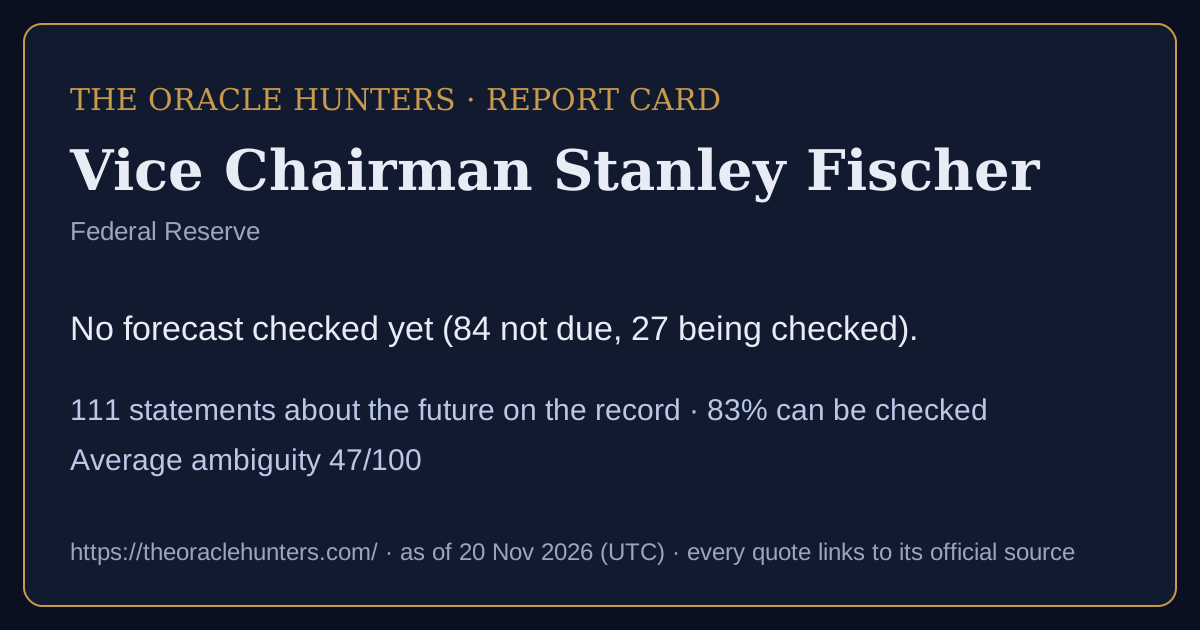
Track record: No forecast checked yet (84 not due, 27 being checked).
111forecasts & commitments on the record
83%can be checked as stated
47average ambiguity (0-100)
0goalpost moves recorded
0confirmed U-turns
Timeline
came true partly did not not due / being checked / too vague
Calibration score: shown after 10 checked forecasts with a stated likelihood (now 0).
How they speak about the future: based on data 89, educated guess 15, stated on authority 7.
Kinds of claim: forecast 77, scenario (if… then) 19, mixed claim 12, commitment 3. · Download this report card as a picture
In the nine words
πρόγνωσιςInference from evidence82 · 74%πρόνοιαPreparing for the future18 · 16%μαντείαInspired knowledge6 · 5%προαναγγελίαPublic pre-announcement3 · 3%εἰκασίαConjecture1 · 1%φρόνησιςPractical wisdom1 · 1%
How to read this
Each box is one sentence a public figure or institution said about the future, word for word, with a link to the official text. Can be checked means it names what will happen, by when, and how likely - so it can be compared with official figures later. Too vague to check means it does not. Ambiguity (0-100) is how many different ways the sentence can be read. When the date passes, the forecast is compared with official data and marked came true, partly or did not come true. Labels judge the sentence, never the person. Full guide and glossary.On the record (111)
Certainly, if the United States had maintained its previous deficit, interest rates would likely be higher around the world.
Federal Reserve economists, in one study, estimate that higher saving by near-retirement households could be pushing down the longer-run equilibrium federal funds rate relative to its level in the 1980s by as much as 75 basis points.9
If labor productivity grows an average of 1 percent per year, the difference is dramatic: Living standards will take two generations to double.16
If labor productivity grows an average of 2 percent per year, average living standards for our children's generation will be twice what we experienced.
Reasonable people can disagree about the right way forward, but if we as a society are to succeed, we need to follow policies that will support and advance productivity growth.
As Bob Solow famously said, just before the increase in productivity growth of 1996-2003, "the computer is everywhere except in the growth data." And there are serious researchers who have made serious arguments that we will soon be seeing more rapid growth in the productivity data.
For example, Friedman's rule would likely perform poorly in an environment in which the trend rate of growth of monetary velocity underwent a major shift, while the Taylor rule could perform unsatisfactorily if the assumption about potential-output behavior embedded in the rule proved to be badly mistaken.
However, even if monetary policy divergence remains substantial, there is good reason to think that spillovers to foreign economies will be manageable.
To highlight some results from the March 2017 surveys, as shown in figure 3, the primary dealers' median projection for the level of the target federal funds rate when the FOMC first announces a change in its reinvestment policy was reported to be 1.63 percent.
"Fed Could Promptly Begin Shedding Bonds This Year: Dudley," U.S. News, March 31, http://money.usnews.com/investing/news/articles/2017-03-31/fed-could-begin-trimming-bond-portfolio-this-year-dudley.
Of note, Federal Reserve Bank of New York President William Dudley's comments on March 31, mentioning "sometime later this year or sometime in 2018" (as quoted in Spicer (2017), paragraph 2)) for the timing of a reinvestment policy change, may also have been a factor behind the muted market reaction to the March FOMC minutes.
Third, the general-equilibrium structure of the model is also important: It is helpful to be able to understand, for example, if a hypothetical appreciation of the dollar might have something to do with an increase in equity share values or whether an independent causal force is at work.
At the time of the August meeting, total PCE price inflation on a 12-month basis was running above the Committee's 2 percent objective, boosted by transitory factors that were expected to dissipate; the staff forecast was for inflation to slow to 1.5 percent in 2012.
First, it means that their forecasts will tend to converge over time to the Committee's 2 percent inflation objective and to each individual's interpretation of maximum employment.
Job gains have been robust in recent years, and the unemployment rate has declined to 4.9 percent, likely close to its long-run sustainable level.
If a decline in bond prices leads to sizable fund withdrawals, the first-mover advantage could accelerate redemptions and second-round price declines.
The median assessment of FOMC participants in the September 2016 Summary of Economic Projections puts the longer-run level of the nominal federal funds rate at a bit under 3 percent.
But other economies might be hurt as a weaker currency could lead to balance sheet deterioration and rising risk spreads, especially if their central banks were called on to tighten monetary policy to keep inflation at bay.
For example, the Bank of England's threshold strategy announced in the summer of 2013--promising to keep policy rates extraordinarily low at least until unemployment fell below 7 percent--lowered the expected path of policy rates significantly by pushing back expectations of liftoff.
If labor force participation was to remain flat, job gains in the range of 125,000 to 175,000 would likely be needed to prevent unemployment from creeping up.
As the transitory effects of the earlier fall in oil prices and rise in the dollar fade, PCE inflation can be expected to rise further toward our 2 percent target, supported by higher core PCE inflation, which ran at a 1.7 percent pace in September.
If we assumed a downward trend in participation of about 0.3 percentage point per year, in line with estimates of the likely drag from demographics, job gains in the range of 65,000 to 115,000 would likely be sufficient to maintain full employment.
The rise in participation may reflect the effects of the modest pickup in wages we are now seeing, with the rate of increase in the employment cost index having risen from an annual rate of about 2 percent last year to 2-1/4 percent so far this year.
Those simulations suggest that the slowdown to the 1-3/4 percent pace anticipated in the Summary of Economic Projections would eventually trim about 120 basis points from the longer-run equilibrium federal funds rate.8
This view is consistent with the most recent Summary of Economic Projections of the FOMC, in which the median value for the rate of growth in real gross domestic product (GDP) in the longer run is just 1-3/4 percent, compared with an average growth rate from 1990 to 2005 of around 3 percent.7
Over the years, many economists--some of them textbook authors--have noted that expansionary fiscal policy could raise equilibrium interest rates.13 To illustrate this possibility, the next two bars on the slide show the estimated effect on interest rates of two possible expansionary fiscal policies, one that boosts government spending by 1 percent of GDP and another that cuts taxes by a …
According to some estimates, the effects of this population aging will trim about 1/4 percentage point from labor force growth in coming years.6
But, of course, Fed interest rates are kept very low at the moment because of the need to maintain aggregate demand at levels that will support the attainment of our dual policy goals of maximum sustainable employment and price stability, defined as the rate of inflation in the price level of personal consumption expenditures (or PCE) being at our target …
And while inflation remains low, we expect it to rise to our 2 percent objective over time.
As we noted in the statement, the recent pickup in economic growth and continued progress in the labor market have strengthened the case for an increase in the federal funds rate.3 Indeed, in our individual economic projections prepared in advance of the September meeting, nearly all FOMC participants anticipated an increase in the target range for the federal funds rate …
While improving labor market conditions have led to higher household incomes in recent years, the key to improved living standards over the long haul will be a revival in productivity growth--at least to more normal levels, possibly in the range of 1-1/2 percent per annum.
It is likely that this correction has by now run its course, and most analysts are expecting inventories to make a positive contribution to demand over the second half of the year and for GDP to increase in the neighborhood of 2-3/4 percent.2
This view is consistent with the projections of appropriate monetary policy prepared by FOMC participants in connection with our September meeting.4 The median projection for the federal funds rate rises only gradually to 1.1 percent at the end of next year, 1.9 percent at the end of 2018, and 2.6 percent by the end of 2019.
As oil prices and the dollar stabilize, the drag on consumer price inflation from these sources ought to dissipate, and inflation will likely move closer to 2 percent.
Given that he believed that the sole function of monetary policy should be to pursue price stability, a modern interpretation of Wicksell's rule would suggest that the central bank should raise the interest rate if inflation is above target and reduce the interest rate if inflation is below target.3 When inflation stabilized, the central bank would know that the interest …
If some of the forces behind these shifts prove to be quite persistent, then we could be stuck in a new longer-run equilibrium characterized by sluggish growth and recurrent reliance on unconventional monetary policy.
In their model, as in Wicksell's framework, inflation generally will rise if the interest rate is low relative to the natural rate and fall if the interest rate is high relative to the natural rate.
The agencies also identified less-severe shortcomings in the plans of all eight GSIBs, which the GSIBs are expected to address in their next round of resolution plan submissions, due in July 2017.
In May of this year, the Board issued another proposal to make GSIBs more resolvable.
If, on the other hand, the rate of interest is maintained no matter how little above the current level of the natural rate, prices will fall continuously and without limit.
If, for any reason whatever, the average rate of interest is set and maintained below this normal level, no matter how small the gap, prices will rise and will go on rising; or if they were already in process of falling, they will fall more slowly and eventually begin to rise.
If such an explicit criterion made it clear that short-term interest rates will not immediately be increased as soon as a Taylor rule descriptive of past behavior would justify a funds rate above 25 basis points, this would provide a reason for market participants to expect easier future monetary and financial conditions than they may currently be anticipating ...
At this stage, we simply do not know what will happen to productivity growth.Robert Gordon of Northwestern University has just published an extremely interesting and pessimistic book that argues we will have to accept the fact that productivity will not grow in future at anything like the rates of the period before 1973.
If the recent financial market developments lead to a sustained tightening of financial conditions, they could signal a slowing in the global economy that could affect growth and inflation in the United States.
Our decision in December was based on the substantial improvement in the labor market and the Committee's confidence that inflation would return to our 2 percent goal over the medium term.
And the second reason is that with inflation currently well below 2 percent, a modest overshoot could actually be helpful in moving inflation back to 2 percent more rapidly.
The actual rate of unemployment is now slightly below 5 percent, and the median view of the members of the FOMC is that it will decline further, perhaps even to the vicinity of 4.7 percent.
However--and there is frequently a "however" in our business--further declines in oil prices suggest that total inflation will likely remain low for somewhat longer than had been previously expected before moving back to 2 percent.
Once these oil and import prices stop falling and level out, their effects on inflation will dissipate, which is the main reason we expect that inflation will rise to 2 percent over the medium term, supported by a further strengthening in labor market conditions.
In my view, even if inflation was expected to return to 2 percent over time, persistent deviations from our goal in either direction could cause economic harm and could ultimately unmoor longer-term inflation expectations.
Showing the newest 50 - the ledger has all 111.
Also said - not checkable as stated (12 newest)
Remarks about the future with no date, figure or likelihood that could be checked. They are kept on the record and shown here, but not scored.
Perhaps reflecting this judgment, the FPC meets on a quarterly basis, which contrasts with the MPC's eight meetings a year.34 The lower frequency of meetings may also reflect the desirability of a relatively stable regulatory structure; financial tools likely should not be as continuously data dependent as monetary policy tools.
A bank that has instrument independence is free to choose the means by which it seeks to achieve its goals."3 In May 1997, the Bank of England achieved instrument independence--something the Federal Reserve had already long had.4
For example, in a country that has committed its central bank to enforce an exchange rate band (with the exchange rate free to move within the band), the central bank will not be fully instrument independent, though it may have a substantial amount of independence with respect to the precise settings of the policy interest rate and other monetary tools.
Around the world, the fear of the central bank losing its ability to meet its price stability goal may well have been the prime reason for governments to implement instrument independence.11
Central banks have over the years--in some cases over a few centuries--amassed an expertise and developed a character that makes them the natural candidates to perform the functions expected of such institutions.
From the beginning, the Inflation Report was intended to increase transparency about the U.K. monetary policy reaction function--that is, the connection between policy instruments and economic variables, including the goal variables.17 After independence, the Inflation Report presented the MPC's inflation forecast.
Do [the job] in a way that shows you care, but in a way that shows you will serenely pursue your goals"--excellent advice, which is easier said than done;
Longer-term interest rates reflect market participants' expectations of future inflation as well as the expected path of real, or inflation-adjusted, interest rates.
And while lower realized inflation and credible central back inflation targets have likely stabilized expected inflation at relatively low levels compared with much of the 20th century, inflation-adjusted yields have also notably decreased.
Knut Wicksell, in his 1898 treatise Interest and Prices, wrote, "There is a certain level of the average rate of interest which is such that the general level of prices has no tendency to move either upwards or downwards."2 In recent years, the coincidence of low inflation and low interest rates suggests that the natural rate of interest is likely …
To a first approximation, one could assume that the rate of bias is constant, and does not account for the estimated decline in productivity growth and that we should not dismiss the slowdown as an artifact of measurement difficulties3 That is the conclusion most researchers reach, but the data issue is not settled.
Clearly, a key question for economic forecasters, and even more so for U.S. citizens, and indeed for the entire global economy, is whether we should anticipate a return of the more rapid productivity gains experienced in the IT boom and for the quarter century after the end of World War II, or should instead resign ourselves to tepid economic growth …