The public record of what the powerful say about the futureAll times UTCYour time ATHENA News Room is liveSealed daily · anchored in BitcoinΕλληνικά A Tekmerion product
THE ORACLE HUNTERS • EVERY PROPHECY ON THE RECORD •AAAWgmp1bWIAAAAeanVtZGMycGEAEQAQgAAAqgA4m3EDYzJwYQAAABZcanVtYgAAAEdqdW1kYzJtYQARABCAAACqADibcQN1cm46YzJwYTo4MTk5ZDlhYi0zYzIzLTQwZDYtYTc1NS04MTM5NWJhODhjMTYAAAADl2p1bWIAAAApanVtZGMyYXMAEQAQgAAAqgA4m3EDYzJwYS5hc3NlcnRpb25zAAAAALxqdW1iAAAARGp1bWRjYm9yABEAEIAAAKoAOJtxE2MycGEuaW5ncmVkaWVudC52MwAAAAAYYzJzaIxn7Lz8d2kiZVLVmLMqjH8AAABwY2JvcqNpZGM6Zm9ybWF0bWltYWdlL3N2Zyt4bWxqaW5zdGFuY2VJRHgseG1wOmlpZDpjNjQzY2M2MC03NmU5LTRkODUtODAzNi04Y2U2YmUwZDA0MzRscmVsYXRpb25zaGlwaHBhcmVudE9mAAAB4mp1bWIAAABBanVtZGNib3IAEQAQgAAAqgA4m3ETYzJwYS5hY3Rpb25zLnYyAAAAABhjMnNoYoNKEfN7QooyLxBggQwrRAAAAZljYm9yomdhY3Rpb25zgqJmYWN0aW9ua2MycGEub3BlbmVkanBhcmFtZXRlcnOha2luZ3JlZGllbnRzgaJjdXJseC1zZWxmI2p1bWJmPWMycGEuYXNzZXJ0aW9ucy9jMnBhLmluZ3JlZGllbnQudjNkaGFzaFggGR++KIZKhTpFlfMpaeP4xKARvK6IpGRCm/JKHJsg8z+kZmFjdGlvbngdY29tLmFudGhyb3BpYy5jbGF1ZGUucHJvdmlkZWRqcGFyYW1ldGVyc6F4H2NvbS5hbnRocm9waWMub3JpZ2luLWNvbmZpZGVuY2VndW5rbm93bmtkZXNjcmlwdGlvbnhmQ2xhdWRlIHByb3ZpZGVkIHRoaXMgZmlsZSBhdCB0aGUgcmVxdWVzdCBvZiBhIHVzZXIgYW5kIG1heSBoYXZlIGNyZWF0ZWQgb3IgbW9kaWZpZWQgdGhlIGZpbGUgY29udGVudHMubXNvZnR3YXJlQWdlbnShZG5hbWVmQ2xhdWRlcmFsbEFjdGlvbnNJbmNsdWRlZPUAAADIanVtYgAAAEBqdW1kY2JvcgARABCAAACqADibcRNjMnBhLmhhc2guZGF0YQAAAAAYYzJzaLTPAMahVK/46OuJ/Q+uuA8AAACAY2JvcqVjYWxnZnNoYTI1NmNwYWRMAAAAAAAAAAAAAAAAZGhhc2hYII7HF9R24wInyRZy4rI4Fw0mI4Rb/ZNxjfxeO7PO35j2ZG5hbWVuanVtYmYgbWFuaWZlc3RqZXhjbHVzaW9uc4GiZXN0YXJ0GQiaZmxlbmd0aBkeBAAAAj5qdW1iAAAAJ2p1bWRjMmNsABEAEIAAAKoAOJtxA2MycGEuY2xhaW0udjIAAAACD2Nib3KlY2FsZ2ZzaGEyNTZpc2lnbmF0dXJleE1zZWxmI2p1bWJmPS9jMnBhL3VybjpjMnBhOjgxOTlkOWFiLTNjMjMtNDBkNi1hNzU1LTgxMzk1YmE4OGMxNi9jMnBhLnNpZ25hdHVyZWppbnN0YW5jZUlEeCx4bXA6aWlkOjljYzUwMDc4LTgzMDctNDI0ZS04NjE4LTVmYTQzMmE1MWJmNHJjcmVhdGVkX2Fzc2VydGlvbnODomN1cmx4LXNlbGYjanVtYmY9YzJwYS5hc3NlcnRpb25zL2MycGEuaW5ncmVkaWVudC52M2RoYXNoWCAZH74ohkqFOkWV8ylp4/jEoBG8roikZEKb8kocmyDzP6JjdXJseCpzZWxmI2p1bWJmPWMycGEuYXNzZXJ0aW9ucy9jMnBhLmFjdGlvbnMudjJkaGFzaFggjvXIkXvJ7aXB5IwuH8TLLMTeq4OAYClzgZHySVCatNCiY3VybHgpc2VsZiNqdW1iZj1jMnBhLmFzc2VydGlvbnMvYzJwYS5oYXNoLmRhdGFkaGFzaFggIhTKhum+9R2LsXAUkQyOeb6aKanhapGjq6FRT3EaJ9V0Y2xhaW1fZ2VuZXJhdG9yX2luZm+jZG5hbWVvQW50aHJvcGljIEZpbGVzZ3ZlcnNpb25lMS4wLjBrc3BlY1ZlcnNpb25lMi40LjAAABA4anVtYgAAAChqdW1kYzJjcwARABCAAACqADibcQNjMnBhLnNpZ25hdHVyZQAAABAIY2JvctKEWQISogEmGCFZAgowggIGMIIBjaADAgECAhRA5aAK7sI50L64g/oGQgU9Z1UTADAKBggqhkjOPQQDAzBJMRcwFQYDVQQKEw5BbnRocm9waWMsIFBCQzEuMCwGA1UEAxMlQW50aHJvcGljIENvbnRlbnQgQ3JlZGVudGlhbHMgUm9vdCBDQTAeFw0yNjA4MDcxODQzNTZaFw0yODA4MDYxOTQzNTZaMEQxFzAVBgNVBAoTDkFudGhyb3BpYywgUEJDMSkwJwYDVQQDEyBBbnRocm9waWMgQ2xhdWRlIENvbnRlbnQgU2lnbmluZzBZMBMGByqGSM49AgEGCCqGSM49AwEHA0IABJh6CmvLUBgFFNU0vUKlOVtE6djd17L5SuwX0LemFisBM3dkd/3cyjxFA3Qo5S46fX0/ihY0VZ7mfb9KF703t5OjWDBWMA4GA1UdDwEB/wQEAwIHgDAVBgNVHSUEDjAMBgorBgEEAYPoXgIBMAwGA1UdEwEB/wQCMAAwHwYDVR0jBBgwFoAUzlHiBIFOZFsj+OPEz5o+nMHXXMIwCgYIKoZIzj0EAwMDZwAwZAIwMXMdFJ4BetLLVY7ORuE9noqbbAZOZn/aArXyTwFAZfKrPzxF2vPoJNf1+UCdg1XGAjBwX1zd9WGqYkqmL5SFqw1QySjr1zJfpJM9+1rdDwSPLMOPOjKuiXjoU/pUUeG9RwmhY3BhZFkNngAAAAAAAAAAAAAAAAAAAAAAAAAAAAAAAAAAAAAAAAAAAAAAAAAAAAAAAAAAAAAAAAAAAAAAAAAAAAAAAAAAAAAAAAAAAAAAAAAAAAAAAAAAAAAAAAAAAAAAAAAAAAAAAAAAAAAAAAAAAAAAAAAAAAAAAAAAAAAAAAAAAAAAAAAAAAAAAAAAAAAAAAAAAAAAAAAAAAAAAAAAAAAAAAAAAAAAAAAAAAAAAAAAAAAAAAAAAAAAAAAAAAAAAAAAAAAAAAAAAAAAAAAAAAAAAAAAAAAAAAAAAAAAAAAAAAAAAAAAAAAAAAAAAAAAAAAAAAAAAAAAAAAAAAAAAAAAAAAAAAAAAAAAAAAAAAAAAAAAAAAAAAAAAAAAAAAAAAAAAAAAAAAAAAAAAAAAAAAAAAAAAAAAAAAAAAAAAAAAAAAAAAAAAAAAAAAAAAAAAAAAAAAAAAAAAAAAAAAAAAAAAAAAAAAAAAAAAAAAAAAAAAAAAAAAAAAAAAAAAAAAAAAAAAAAAAAAAAAAAAAAAAAAAAAAAAAAAAAAAAAAAAAAAAAAAAAAAAAAAAAAAAAAAAAAAAAAAAAAAAAAAAAAAAAAAAAAAAAAAAAAAAAAAAAAAAAAAAAAAAAAAAAAAAAAAAAAAAAAAAAAAAAAAAAAAAAAAAAAAAAAAAAAAAAAAAAAAAAAAAAAAAAAAAAAAAAAAAAAAAAAAAAAAAAAAAAAAAAAAAAAAAAAAAAAAAAAAAAAAAAAAAAAAAAAAAAAAAAAAAAAAAAAAAAAAAAAAAAAAAAAAAAAAAAAAAAAAAAAAAAAAAAAAAAAAAAAAAAAAAAAAAAAAAAAAAAAAAAAAAAAAAAAAAAAAAAAAAAAAAAAAAAAAAAAAAAAAAAAAAAAAAAAAAAAAAAAAAAAAAAAAAAAAAAAAAAAAAAAAAAAAAAAAAAAAAAAAAAAAAAAAAAAAAAAAAAAAAAAAAAAAAAAAAAAAAAAAAAAAAAAAAAAAAAAAAAAAAAAAAAAAAAAAAAAAAAAAAAAAAAAAAAAAAAAAAAAAAAAAAAAAAAAAAAAAAAAAAAAAAAAAAAAAAAAAAAAAAAAAAAAAAAAAAAAAAAAAAAAAAAAAAAAAAAAAAAAAAAAAAAAAAAAAAAAAAAAAAAAAAAAAAAAAAAAAAAAAAAAAAAAAAAAAAAAAAAAAAAAAAAAAAAAAAAAAAAAAAAAAAAAAAAAAAAAAAAAAAAAAAAAAAAAAAAAAAAAAAAAAAAAAAAAAAAAAAAAAAAAAAAAAAAAAAAAAAAAAAAAAAAAAAAAAAAAAAAAAAAAAAAAAAAAAAAAAAAAAAAAAAAAAAAAAAAAAAAAAAAAAAAAAAAAAAAAAAAAAAAAAAAAAAAAAAAAAAAAAAAAAAAAAAAAAAAAAAAAAAAAAAAAAAAAAAAAAAAAAAAAAAAAAAAAAAAAAAAAAAAAAAAAAAAAAAAAAAAAAAAAAAAAAAAAAAAAAAAAAAAAAAAAAAAAAAAAAAAAAAAAAAAAAAAAAAAAAAAAAAAAAAAAAAAAAAAAAAAAAAAAAAAAAAAAAAAAAAAAAAAAAAAAAAAAAAAAAAAAAAAAAAAAAAAAAAAAAAAAAAAAAAAAAAAAAAAAAAAAAAAAAAAAAAAAAAAAAAAAAAAAAAAAAAAAAAAAAAAAAAAAAAAAAAAAAAAAAAAAAAAAAAAAAAAAAAAAAAAAAAAAAAAAAAAAAAAAAAAAAAAAAAAAAAAAAAAAAAAAAAAAAAAAAAAAAAAAAAAAAAAAAAAAAAAAAAAAAAAAAAAAAAAAAAAAAAAAAAAAAAAAAAAAAAAAAAAAAAAAAAAAAAAAAAAAAAAAAAAAAAAAAAAAAAAAAAAAAAAAAAAAAAAAAAAAAAAAAAAAAAAAAAAAAAAAAAAAAAAAAAAAAAAAAAAAAAAAAAAAAAAAAAAAAAAAAAAAAAAAAAAAAAAAAAAAAAAAAAAAAAAAAAAAAAAAAAAAAAAAAAAAAAAAAAAAAAAAAAAAAAAAAAAAAAAAAAAAAAAAAAAAAAAAAAAAAAAAAAAAAAAAAAAAAAAAAAAAAAAAAAAAAAAAAAAAAAAAAAAAAAAAAAAAAAAAAAAAAAAAAAAAAAAAAAAAAAAAAAAAAAAAAAAAAAAAAAAAAAAAAAAAAAAAAAAAAAAAAAAAAAAAAAAAAAAAAAAAAAAAAAAAAAAAAAAAAAAAAAAAAAAAAAAAAAAAAAAAAAAAAAAAAAAAAAAAAAAAAAAAAAAAAAAAAAAAAAAAAAAAAAAAAAAAAAAAAAAAAAAAAAAAAAAAAAAAAAAAAAAAAAAAAAAAAAAAAAAAAAAAAAAAAAAAAAAAAAAAAAAAAAAAAAAAAAAAAAAAAAAAAAAAAAAAAAAAAAAAAAAAAAAAAAAAAAAAAAAAAAAAAAAAAAAAAAAAAAAAAAAAAAAAAAAAAAAAAAAAAAAAAAAAAAAAAAAAAAAAAAAAAAAAAAAAAAAAAAAAAAAAAAAAAAAAAAAAAAAAAAAAAAAAAAAAAAAAAAAAAAAAAAAAAAAAAAAAAAAAAAAAAAAAAAAAAAAAAAAAAAAAAAAAAAAAAAAAAAAAAAAAAAAAAAAAAAAAAAAAAAAAAAAAAAAAAAAAAAAAAAAAAAAAAAAAAAAAAAAAAAAAAAAAAAAAAAAAAAAAAAAAAAAAAAAAAAAAAAAAAAAAAAAAAAAAAAAAAAAAAAAAAAAAAAAAAAAAAAAAAAAAAAAAAAAAAAAAAAAAAAAAAAAAAAAAAAAAAAAAAAAAAAAAAAAAAAAAAAAAAAAAAAAAAAAAAAAAAAAAAAAAAAAAAAAAAAAAAAAAAAAAAAAAAAAAAAAAAAAAAAAAAAAAAAAAAAAAAAAAAAAAAAAAAAAAAAAAAAAAAAAAAAAAAAAAAAAAAAAAAAAAAAAAAAAAAAAAAAAAAAAAAAAAAAAAAAAAAAAAAAAAAAAAAAAAAAAAAAAAAAAAAAAAAAAAAAAAAAAAAAAAAAAAAAAAAAAAAAAAAAAAAAAAAAAAAAAAAAAAAAAAAAAAAAAAAAAAAAAAAAAAAAAAAAAAAAAAAAAAAAAAAAAAAAAAAAAAAAAAAAAAAAAAAAAAAAAAAAAAAAAAAAAAAAAAAAAAAAAAAAAAAAAAAAAAAAAAAAAAAAAAAAAAAAAAAAAAAAAAAAAAAAAAAAAAAAAAAAAAAAAAAAAAAAAAAAAAAAAAAAAAAAAAAAAAAAAAAAAAAAAAAAAAAAAAAAAAAAAAAAAAAAAAAAAAAAAAAAAAAAAAAAAAAAAAAAAAAAAAAAAAAAAAAAAAAAAAAAAAAAAAAAAAAAAAAAAAAAAAAAAAAAAAAAAAAAAAAAAAAAAAAAAAAAAAAAAAAAAAAAAAAAAAAAAAAAAAAAAAAAAAAAAAAAAAAAAAAAAAAAAAAAAAAAAAAAAAAAAAAAAAAAAAAAAAAAAAAAAAAAAAAAAAAAAAAAAAAAAAAAAAAAAAAAAAAAAAAAAAAAAAAAAAAAAAAAAAAAAAAAAAAAAAAAAAAAAAAAAAAAAAAAAAAAAAAAAAAAAAAAAAAAAAAAAAAAAAAAAAAAAAAAAAAAAAAAAAAAAAAAAAAAAAAAAAAAAAAAAAAAAAAAAAAAAAAAAAAAAAAAAAAAAAAAAAAAAAAAAAAAAAAAAAAAAAAAAAAAAAAAAAAAAAAAAAAAAAAAAAAAAAAAAAAAAAAAAAAAAAAAAAAAAAAAAAAAAAAAAAAAAAAAAAAAAAAAAAAAAAAAAAAAAAAAAAAAAAAAAAAAAAAAAAAAAAAAAAAAAAAAAAAAAAAAAAAAAAAAAAAAAAAAAAAAAAAAAAAAAAAAAAAAAAAAAAAAAAAAAAAAAAAAAAAAAAAAAAAAAAAAAAAAAAAAAAAAAAAAAAAAAAAAAAAAAAAAAAAAAAAAAAAAAAAAAAAAAAAAAAAAAAAAAAAAAAAAAAAAAAAAAAAAAAAAAAAAAAAAAAAAAAAAAAAAAAAAAAAAAAAAAAAAAAAAAAAAAAAAAAAAAAAAAAAAAAAAAAAAAAAAAAAAAAAAAAAAAAAAAAAAAAAAAAAAAAAAAAAAAAAAAAAAAAAAAAAAAAAAAAAAAAAAAAAAAAAAAAAAAAAAAAAAAAAAAAAAAAAAAAAAAAAAAAAAAAAAAAAAAAAAAAAAAAAAAAAAAAAAAAAAAAAAAAAAAAAAAAAAAAAAAAAAAAAAAAAAAAAAAAAAAAAAAAAAAAAAAAAAAAAAAAAAAAAAAAAAAAAAAAAAAAAAAAAAAAAAAAAAAAAAAAAAAAAAAAAAAAAAAAAAAAAAAAAAAAAAAAAAAAAAAAAAAAAAAAAAAAAAAAAAAAAAAAAAAAAAAAAAAAAAAAAAAAAAAAAAAAAAAAAAAAAAAAAAAAAAAAAAAAAAAAAAAAAAAAAAAAAAAAAAAAAAAAAAAAAAAAAAAAAAAAAAAAAAAAAAAAAAAAAAAAAAAAAAAAAAAAAAAAAAAAAAAAAAAAAAAAAAAAAAAAAAAAAAAAAAAAAAAAAAAAAAAAAAAAAAAAAAAAAAAAAAAAAAAAAAAAAAAAAAAAAAAAAAAAAAAAAAAAAAAAAAAAAAAAAAAAAAAAAAAAAAAAAAAAAAAAAAAAAAAAAAAAAAAAAAAAAAAAAAAAAAAAAAAAAAAAAAAAAAAAAAAAAAAAAAAAAPZYQLfUpeT/MPsu1gA3RgZ8fvvIDmyZYJDWmz6ftVFNojm4kOQbEdCSTa0XP3aqZnboyhQ+RU/hD3bq8nBGJ+yvrXI=The Oracle HuntersEvery prophecy, on the record. · Οἱ Κυνηγοὶ τῶν ΧρησμῶνUnder development

← Tracking the Prophets

Vice Chairman Donald L Kohn

Federal Reserve · USA

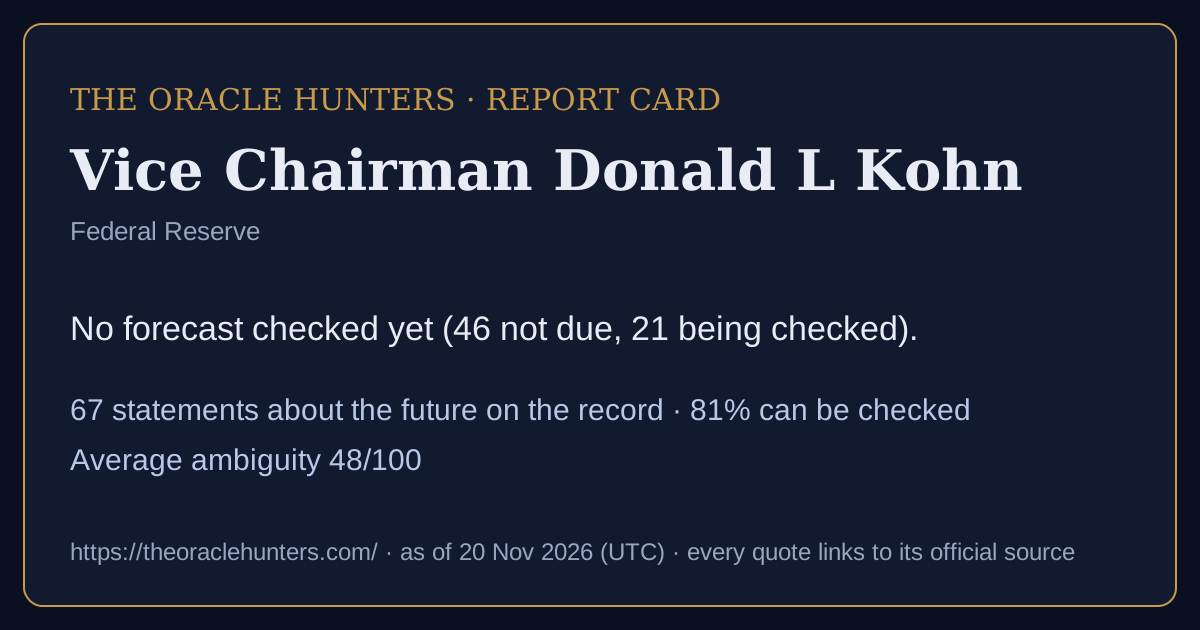
Track record: No forecast checked yet (46 not due, 21 being checked).
67forecasts & commitments on the record
81%can be checked as stated
48average ambiguity (0-100)
0goalpost moves recorded
0confirmed U-turns

Timeline

20062006: Not due yet2006: Not due yet2006: Not due yet2006: Not due yet2006: Not due yet2006: Not due yet2006: Not due yet2006: Not due yet (+2 more)20072007: Not due yet2007: Not due yet2007: Due - being checked2007: Not due yet2007: Due - being checked2007: Due - being checked2007: Due - being checked20082008: Not due yet2008: Not due yet2008: Not due yet2008: Not due yet2008: Not due yet2008: Not due yet2008: Due - being checked2008: Due - being checked (+9 more)20092009: Not due yet2009: Not due yet2009: Due - being checked2009: Due - being checked2009: Due - being checked2009: Due - being checked2009: Due - being checked2009: Not due yet (+14 more)20102010: Not due yet2010: Not due yet2010: Not due yet2010: Due - being checked2010: Due - being checked2010: Not due yet2010: Not due yet2010: Not due yet (+3 more)
came true partly did not not due / being checked / too vague

Calibration score: shown after 10 checked forecasts with a stated likelihood (now 0).
How they speak about the future: based on data 30, educated guess 21, stated on authority 16.
Kinds of claim: forecast 32, scenario (if… then) 17, mixed claim 10, commitment 8. · Download this report card as a picture
In the nine words

πρόγνωσιςInference from evidence26 · 39%πρόνοιαPreparing for the future17 · 25%μαντείαInspired knowledge10 · 15%προαναγγελίαPublic pre-announcement8 · 12%εἰκασίαConjecture5 · 7%πρόβλεψιςSeeing the signs1 · 1%
How to read this Each box is one sentence a public figure or institution said about the future, word for word, with a link to the official text. Can be checked means it names what will happen, by when, and how likely - so it can be compared with official figures later. Too vague to check means it does not. Ambiguity (0-100) is how many different ways the sentence can be read. When the date passes, the forecast is compared with official data and marked came true, partly or did not come true. Labels judge the sentence, never the person. Full guide and glossary.

On the record (67)

As a consequence, these types of purchases can increase inflation expectations among some observers who may see a risk that we will not reduce reserves and raise interest rates in a timely fashion.
προαναγγελία · Public pre-announcementPartly checkableCommitmentstated on authorityambiguity 71/100implied call / likelihood: Yes · 85% · for the most partbelow the RIM-1 standardNot due yetinflationinterest rates
Failure to do so risks a market reaction that could increase longer-term interest rates; economic growth would be hindered if government borrowing boosts the cost of capital and diverts resources away from private investment.
Federal Reserve · said 08 Apr 2010 (date) · The Economic Outlook · evidence & why
πρόνοια · Preparing for the futurePartly checkableScenario (if… then)educated guessambiguity 56/100implied call / likelihood: No · 35% · probablebelow the RIM-1 standardNot due yetinterest ratesgrowth
For the moment, the public seems confident that the Fed will keep inflation stable over time.
Federal Reserve · said 08 Apr 2010 (date) · The Economic Outlook · evidence & why
Second, I do not expect that the recovery in housing construction will boost growth substantially this year, in contrast to its usual pattern early in economic recoveries.
Federal Reserve · said 08 Apr 2010 (date) · The Economic Outlook · evidence & why
μαντεία · Inspired knowledgeCan be checkedForecaststated on authorityambiguity 0/100implied call / likelihood: Yes · 70% · probablemeets the RIM-1 standarddue 31 Dec 2010Due - being checkedgrowthhousing
I expect the expansion to be sustained by continued increases in private final demand, even as the temporary boost from inventories passes and the contribution of fiscal stimulus to growth likely wanes later this year.
Federal Reserve · said 08 Apr 2010 (date) · The Economic Outlook · evidence & why
μαντεία · Inspired knowledgeCan be checkedForecaststated on authorityambiguity 0/100implied call / likelihood: Yes · 70% · probablemeets the RIM-1 standarddue 31 Dec 2010Due - being checkedgrowthfiscal
If those banks were instead targeting a price level growing at 2 percent, their webpages would have to provide a table of inflation rate targets for a variety of horizons, and the targets would change each month.
Federal Reserve · said 24 Mar 2010 (date) · Homework Assignments for Monetary Policymakers · evidence & why
πρόγνωσις · Inference from evidencePartly checkableMixed claimbased on dataambiguity 56/100below the RIM-1 standardNot due yetinflationfinance
Second, 4 percent inflation may be higher than can be ignored, and businesses and households may take inflation more into account when writing contracts and making investments, increasing the odds that otherwise transitory inflation would become more persistent.
Federal Reserve · said 24 Mar 2010 (date) · Homework Assignments for Monetary Policymakers · evidence & why
Those forecasts indicate that most of the FOMC participants believe that inflation should converge to 1-3/4 to 2 percent over time.
Federal Reserve · said 24 Mar 2010 (date) · Homework Assignments for Monetary Policymakers · evidence & why
πρόγνωσις · Inference from evidencePartly checkableMixed claimbased on dataambiguity 71/100below the RIM-1 standardNot due yetinflation
Unless the trajectory is changed, the competition for savings between the government, on the one hand, and households and businesses, on the other, could be significant as households and businesses begin to borrow and spend in the recovery, putting upward pressure on interest rates.
Federal Reserve · said 29 Jan 2010 (date) · Focusing on Bank Interest Rate Risk Exposure · evidence & why
πρόνοια · Preparing for the futurePartly checkableScenario (if… then)educated guessambiguity 56/100implied call / likelihood: No · 35% · probablebelow the RIM-1 standardNot due yetinterest rates
In the current situation, with output expected to be well below its potential for some time and inflation likely to be under the 2 percent level that many FOMC participants see as desirable over the long run, tightening policy to head off a perceived threat of asset price misalignment could be expensive in terms of medium-term economic stability.
Federal Reserve · said 03 Jan 2010 (date) · Monetary Policy in the Crisis: Past, Present, and Future · evidence & why
πρόγνωσις · Inference from evidencePartly checkableForecastbased on dataambiguity 71/100implied call / likelihood: Yes · 70% · probablebelow the RIM-1 standardNot due yetinflationgrowth
Policy adjustments need to damp speculation; if higher rates just weaken output and inflation without damping speculation, the economy could be even more vulnerable when the speculative bubble bursts.
Federal Reserve · said 03 Jan 2010 (date) · Monetary Policy in the Crisis: Past, Present, and Future · evidence & why
εἰκασία · ConjecturePartly checkableMixed claimeducated guessambiguity 56/100implied call / likelihood: No · 35% · probablebelow the RIM-1 standardNot due yetinflationgrowth
Still, we will need to be alert to any tendencies for movements in prices for commodities and assets to result in a sustained increase in inflation and inflation expectations; unanchored inflation expectations would ultimately destabilize output and undermine our ability to foster higher levels of employment.
Federal Reserve · said 16 Nov 2009 (date) · Policy Challenges for the Federal Reserve · evidence & why
μαντεία · Inspired knowledgePartly checkableMixed claimstated on authorityambiguity 36/100implied call / likelihood: Yes · 85% · for the most partbelow the RIM-1 standardNot due yetinflationgrowthlabour
Indeed, if inflation expectations were to begin to ratchet down toward the actual inflation rates that we have experienced recently, inflation could move appreciably lower.
Federal Reserve · said 13 Oct 2009 (date) · The Economic Outlook · evidence & why
πρόνοια · Preparing for the futurePartly checkableScenario (if… then)educated guessambiguity 56/100implied call / likelihood: No · 35% · probablebelow the RIM-1 standardNot due yetinflation
The fiscal stimulus program enacted earlier this year is likely playing a role, and it will continue to do so for a while as the states spend their stimulus funds to pay for infrastructure projects, hire more teachers, and finance other types of spending.
Federal Reserve · said 13 Oct 2009 (date) · The Economic Outlook · evidence & why
μαντεία · Inspired knowledgePartly checkableForecaststated on authorityambiguity 36/100implied call / likelihood: Yes · 70% · probablebelow the RIM-1 standarddue 31 Dec 2009Due - being checkedfiscal
The difficult conditions in labor markets and the consequent implications for household incomes are important reasons for my expectation that the recovery in overall economic activity moving into next year will be restrained.
Federal Reserve · said 13 Oct 2009 (date) · The Economic Outlook · evidence & why
μαντεία · Inspired knowledgePartly checkableForecaststated on authorityambiguity 56/100implied call / likelihood: Yes · 85% · for the most partbelow the RIM-1 standarddue 31 Dec 2010Due - being checkedgrowthlabourtrade
All told, I expect that the recovery in U.S. economic activity will proceed at a moderate pace in the second half of this year before strengthening some in 2010.
Federal Reserve · said 13 Oct 2009 (date) · The Economic Outlook · evidence & why
πρόγνωσις · Inference from evidenceCan be checkedForecastbased on dataambiguity 36/100implied call / likelihood: Yes · 70% · probablebelow the RIM-1 standarddue 31 Dec 2010Due - being checkedgrowth
In the business sector, fixed investment plummeted late last year and early this year as current and expected sales tumbled--the typical accelerator effect--and credit conditions tightened.
Federal Reserve · said 13 Oct 2009 (date) · The Economic Outlook · evidence & why
μαντεία · Inspired knowledgePartly checkableForecaststated on authorityambiguity 36/100implied call / likelihood: Yes · 70% · probablebelow the RIM-1 standarddue 31 Dec 2009Due - being checkedfinance
And, while the unemployment rate has not been rising as rapidly since midyear as it did over the preceding year, it could well reach 10 percent by early 2010.
Federal Reserve · said 13 Oct 2009 (date) · The Economic Outlook · evidence & why
πρόγνωσις · Inference from evidenceCan be checkedForecastbased on dataambiguity 36/100implied call / likelihood: No · 35% · probablebelow the RIM-1 standarddue 31 Mar 2010Due - being checkedlabour
But spreads eventually could become narrower than what would be consistent with underlying risk, and lending could grow more quickly than appropriate for price stability if very high levels of reserves remain in place.
Federal Reserve · said 30 Sep 2009 (date) · Central Bank Exit Policies · evidence & why
πρόνοια · Preparing for the futurePartly checkableScenario (if… then)educated guessambiguity 83/100implied call / likelihood: No · 35% · probablebelow the RIM-1 standardNot due yetinflation
In addition, although to date the high volume of reserves evidently has not increased bank lending or reduced spreads of rates on bank loans or other assets relative to, say, Treasury rates, it could begin to do so if banks start to perceive the risk-adjusted returns on loans as superior to our deposit rate.
Federal Reserve · said 30 Sep 2009 (date) · Central Bank Exit Policies · evidence & why
πρόνοια · Preparing for the futurePartly checkableScenario (if… then)educated guessambiguity 56/100implied call / likelihood: No · 35% · probablebelow the RIM-1 standardNot due yetfinance
We will need to begin to remove the extraordinary degree of accommodation in its various dimensions when we judge that exiting from the current stance of policy will be necessary to preserve price stability as the economy returns to higher levels of resource utilization.
Federal Reserve · said 30 Sep 2009 (date) · Central Bank Exit Policies · evidence & why
εἰκασία · ConjecturePartly checkableMixed claimeducated guessambiguity 36/100implied call / likelihood: Yes · 85% · for the most partbelow the RIM-1 standardNot due yetinflation
Moreover, we could run off these holdings slowly while still raising the federal funds rate if we increased the rate paid on excess reserves held at the Federal Reserve.
πρόνοια · Preparing for the futurePartly checkableScenario (if… then)educated guessambiguity 56/100implied call / likelihood: No · 35% · probablebelow the RIM-1 standardNot due yetinterest rates
However, if financial market participants anticipate that the federal funds rate will remain at zero for an appreciable period of time following the hike in government spending, the simulated short-run fiscal multiplier rises to 1.3 for some time.
πρόνοια · Preparing for the futurePartly checkableScenario (if… then)based on dataambiguity 56/100implied call / likelihood: Yes · 70% · probablebelow the RIM-1 standardNot due yetinterest ratesfiscal
Such stimulus would not only significantly improve the economic welfare of our nation's citizens, but also could provide the federal government with as much as about $175 billion in greater tax revenues than it would otherwise receive.
Although any calculation of the effect of our asset purchases on the economy is highly uncertain, estimates from our models suggest that nominal GDP could be as much as $1 trillion higher over the next several years than it would be without the large-scale asset purchase program.
But here too, confidence could bounce back more rapidly, and if credit conditions were to ease appreciably, businesses might move ahead quickly with capital spending projects that had been postponed during the recession.
Federal Reserve · said 20 Apr 2009 (date) · The Economic Outlook · evidence & why
πρόνοια · Preparing for the futurePartly checkableScenario (if… then)educated guessambiguity 83/100implied call / likelihood: No · 35% · probablebelow the RIM-1 standardNot due yetgrowthfinance
Business fixed investment has also fallen sharply since last fall, and it is likely to remain weak through the remainder of 2009.
Federal Reserve · said 20 Apr 2009 (date) · The Economic Outlook · evidence & why
πρόγνωσις · Inference from evidencePartly checkableForecastbased on dataambiguity 36/100implied call / likelihood: Yes · 70% · probablebelow the RIM-1 standarddue 31 Dec 2009Due - being checked
In all, real gross domestic product (GDP) dropped at an annual rate of 6-1/4 percent in the fourth quarter of 2008; the Commerce Department's advance estimate for the first quarter of 2009--which will be released next week--is expected to show another sizable decrease.
Federal Reserve · said 20 Apr 2009 (date) · The Economic Outlook · evidence & why
That additional GDP translates into an unemployment rate by the end of next year that is between 1/2 and 2 percentage points lower than it otherwise would be.
Federal Reserve · said 20 Apr 2009 (date) · The Economic Outlook · evidence & why
πρόγνωσις · Inference from evidencePartly checkableForecastbased on dataambiguity 36/100below the RIM-1 standarddue 31 Dec 2010Due - being checkedgrowthlabour
These developments may be an early indication that conditions are falling into place for real GDP to decline at a slower rate in the second quarter and to stabilize later this year.
Federal Reserve · said 20 Apr 2009 (date) · The Economic Outlook · evidence & why
μαντεία · Inspired knowledgeCan be checkedForecaststated on authorityambiguity 56/100implied call / likelihood: No · 40% · probablebelow the RIM-1 standarddue 31 Dec 2009Due - being checkedgrowth
According to the Congressional Budget Office, the effect of the stimulus package on the level of real GDP at the end of 2010 could range from about 1 percent to more than 3 percent, relative to a baseline forecast that does not include the stimulus.
Federal Reserve · said 20 Apr 2009 (date) · The Economic Outlook · evidence & why
πρόγνωσις · Inference from evidenceCan be checkedForecastbased on dataambiguity 36/100implied call / likelihood: Yes · 70% · probablebelow the RIM-1 standarddue 31 Dec 2010Due - being checkedgrowthfiscal
Then again, the substantial increase in the size of the Federal Reserve's balance sheet as a result of the credit programs that have been implemented have led some to worry that inflation could rise sharply when the economy recovers unless the Federal Reserve moves quickly when the time comes to unwind the programs and limit the growth in credit.
πρόνοια · Preparing for the futurePartly checkableScenario (if… then)educated guessambiguity 71/100implied call / likelihood: No · 35% · probablebelow the RIM-1 standardNot due yetinflationgrowthfinance
In the second half of 2007 and into the spring of 2008, the federal funds rate target was cut rapidly, and, as the financial turbulence intensified last fall and the economic outlook deteriorated, the Federal Open Market Committee (FOMC) responded by cutting the target further, setting a range of 0 to 1/4 percent by the end of last year.
πρόγνωσις · Inference from evidencePartly checkableForecastbased on dataambiguity 56/100below the RIM-1 standardNot due yetinterest rates
More recently, the Federal Reserve has announced that it will purchase $600billion in debt issued by the housing-related government-sponsored enterprises and in mortgage-backed securities backed by Fannie Mae, Freddie Mac, and Ginnie Mae, which could reduce funding costs for mortgages.
Thus, even if we could have known for sure that a housing bubble existed, and that tighter monetary policy would have significantly checked the unwarranted rise in home prices, policymakers would have had to make this call early on--at least a year and probably more before the peak in the real estate market in 2006--for such an action to have …
Federal Reserve · said 19 Nov 2008 (date) · Monetary Policy and Asset Prices Revisited · evidence & why
πρόνοια · Preparing for the futurePartly checkableScenario (if… then)based on dataambiguity 56/100implied call / likelihood: Yes · 70% · probablebelow the RIM-1 standardNot due yetinflationinterest rateshousing
Although we have seen signs of improvement, financial market functioning remains impaired in many ways, and we will need to continue to consider whether additional steps are needed to re-open credit flows and support the economy.
Federal Reserve · said 12 Nov 2008 (date) · Productivity and Innovation in Financial Services · evidence & why
πρόβλεψις · Seeing the signsPartly checkableMixed claimstated on authorityambiguity 36/100implied call / likelihood: Yes · 85% · for the most partbelow the RIM-1 standardNot due yetfinance
To counter this dynamic and adjust its policy to the evolving economic outlook, the FOMC reduced the target federal funds rate 50 basis points last week.
Federal Reserve · said 15 Oct 2008 (date) · Economic Outlook · evidence & why
πρόγνωσις · Inference from evidencePartly checkableForecastbased on dataambiguity 56/100below the RIM-1 standardNot due yetinterest rates
I am confident that we will emerge from this episode with a stronger and more robust financial system and with a restoration of solid and sustainable economic growth.
Federal Reserve · said 15 Oct 2008 (date) · Economic Outlook · evidence & why
As Chairman Bernanke has often remarked, at the Federal Reserve we will utilize all the tools at our disposal to meet our responsibilities for fostering high employment and stable prices.
Federal Reserve · said 15 Oct 2008 (date) · Economic Outlook · evidence & why
Given the likely drawn-out nature of the prospective adjustments in housing and financial markets, I see the most probable scenario as one in which the performance of the economy remains subpar well into next year and then gradually improves in late 2009 and 2010.
Federal Reserve · said 15 Oct 2008 (date) · Economic Outlook · evidence & why
πρόγνωσις · Inference from evidenceCan be checkedForecastbased on dataambiguity 36/100implied call / likelihood: Yes · 70% · probablebelow the RIM-1 standarddue 31 Dec 2009Due - being checkedhousing
This weakening in foreign activity suggests that the support to domestic production from net exports that was evident in the first half of this year is likely diminishing.
Federal Reserve · said 15 Oct 2008 (date) · Economic Outlook · evidence & why
εἰκασία · ConjectureCan be checkedForecasteducated guessambiguity 0/100implied call / likelihood: Yes · 70% · probablemeets the RIM-1 standarddue 31 Dec 2008Due - being checkedtrade
Although the current financial and economic situation remains quite difficult, I believe that the most likely scenario over the next year or so is one in which economic activity firms during the second half of this year and then gathers some strength in 2009.
Federal Reserve · said 20 May 2008 (date) · The Economic Outlook · evidence & why
πρόγνωσις · Inference from evidenceCan be checkedForecastbased on dataambiguity 36/100implied call / likelihood: Yes · 80% · for the most partbelow the RIM-1 standarddue 31 Dec 2009Due - being checkedgrowth
The demand for housing continued to decline early this year, and sales could fall even further in coming months, given the tightness in mortgage lending.
Federal Reserve · said 20 May 2008 (date) · The Economic Outlook · evidence & why
μαντεία · Inspired knowledgeCan be checkedForecaststated on authorityambiguity 36/100implied call / likelihood: No · 35% · probablebelow the RIM-1 standarddue 31 Dec 2008Due - being checkedhousing
Doing so could have important implications for the stance of monetary policy--all the more so if we expected rising energy costs to lead to higher inflation expectations and elevated wage gains.
πρόνοια · Preparing for the futurePartly checkableScenario (if… then)educated guessambiguity 56/100implied call / likelihood: Yes · 70% · probablebelow the RIM-1 standardNot due yetinflationinterest rateslabourenergytrade
If we were to project a continued significant rise in energy prices over the medium run, we would need to factor that expectation into the outlook for overall inflation.
εἰκασία · ConjecturePartly checkableMixed claimeducated guessambiguity 56/100below the RIM-1 standardNot due yetinflationenergy
A related concern is that inflation expectations might drift higher if the current rapid rates of headline inflation persist for longer than anticipated or if the recent easing in monetary policy is misinterpreted as reflecting less resolve among Committee members to maintain low and stable inflation over the medium run.
Federal Reserve · said 26 Feb 2008 (date) · The U.S. Economy and Monetary Policy · evidence & why
πρόνοια · Preparing for the futurePartly checkableScenario (if… then)educated guessambiguity 56/100implied call / likelihood: No · 35% · probablebelow the RIM-1 standardNot due yetinflationinterest rates
Certainly, interest rates on loans will be lower than if policy had not been eased, and, if policy is eased sufficiently, they can be absolutely lower than before for many borrowers, which could well be necessary in an environment where standards and nonprice terms on access to credit are tighter.
Federal Reserve · said 26 Feb 2008 (date) · The U.S. Economy and Monetary Policy · evidence & why
πρόνοια · Preparing for the futurePartly checkableScenario (if… then)educated guessambiguity 56/100implied call / likelihood: Yes · 85% · for the most partbelow the RIM-1 standardNot due yetinterest ratesfinance
I believe we will see a return to stronger growth, lower unemployment, lower inflation and improved flows in financial markets, but it probably will take a little while.
Federal Reserve · said 26 Feb 2008 (date) · The U.S. Economy and Monetary Policy · evidence & why
προαναγγελία · Public pre-announcementPartly checkableCommitmenteducated guessambiguity 36/100implied call / likelihood: Yes · 70% · probablebelow the RIM-1 standardNot due yetinflationgrowthlabour
In the end, we will have a safer system, but one with more bank intermediation, less leverage, and higher financing costs for many borrowers.
Federal Reserve · said 26 Feb 2008 (date) · The U.S. Economy and Monetary Policy · evidence & why
For example, participants' projections in October of gross domestic product (GDP) growth for 2008 differed by one full percentage point and differences were still a half a percentage point for 2010.
πρόγνωσις · Inference from evidencePartly checkableForecastbased on dataambiguity 36/100below the RIM-1 standarddue 31 Dec 2010Due - being checkedgrowth

Showing the newest 50 - the ledger has all 67.

Also said - not checkable as stated (12 newest)

Remarks about the future with no date, figure or likelihood that could be checked. They are kept on the record and shown here, but not scored.

But the portfolio behavior of banks might shift as the economy and confidence recover, and we will need to watch and study this channel carefully.
The more we buy, the more reserves we will ultimately need to absorb, and the more assets we will ultimately need to dispose of before the conduct of monetary policy, the behavior of interbank markets, and the Federal Reserve's balance sheet can return completely to normal.
But we are aware that the size of our balance sheet is a potential source of policy stimulus, and we need to be alert to the risk that households, businesses, and investors could begin to expect higher inflation based partly on an expanded central bank balance sheet.
πρόνοια · Preparing for the futurePartly checkableCall for actionstated on authorityambiguity 56/100implied call / likelihood: Yes · 70% · probablebelow the RIM-1 standardinflationfinance
Confidence in those tools should help allay any fears by the public that unusual actions will necessarily lead to inflation.
But we should use our experience to foster a constructive discussion of these critical questions, because addressing these issues will enable central banks to more effectively promote financial stability and reduce the odds of future crises.
The U.S. economy will need to be less driven by consumption and housing and will need to rely less on debt to finance spending on consumption and housing.
Federal Reserve · said 11 May 2010 (date) · Global Imbalances · evidence & why
And exports and capital investment will need to play a larger role in the economy.
Federal Reserve · said 11 May 2010 (date) · Global Imbalances · evidence & why
For some economies, a rebalancing of demand toward domestic sectors will require significant changes in relative prices, and hence more flexible exchange rates will need to be part of the equation.
Federal Reserve · said 11 May 2010 (date) · Global Imbalances · evidence & why
To some extent, this "reach for yield" may have been driven by a failure on the part of investors to recognize that the underlying equilibrium real interest rate had fallen, which implied that maintaining a given return on investment could only be achieved by accepting greater risk.
Federal Reserve · said 11 May 2010 (date) · Global Imbalances · evidence & why
εἰκασία · ConjectureToo vague to checkSpeculationeducated guessambiguity 92/100implied call / likelihood: No · 40% · probablebelow the RIM-1 standardinterest rates
In contrast, the pickup in business investment as the economic recovery strengthens could well outpace any increase in business profits and saving, and part of the narrowing in the current account deficit could be reversed, absent other developments.
Federal Reserve · said 11 May 2010 (date) · Global Imbalances · evidence & why
While much of this spending in excess of tax collections represents the transitory effect of the economic downturn, the aging of our population will pose severe challenges in the decades to come.
Federal Reserve · said 11 May 2010 (date) · Global Imbalances · evidence & why
As the economy improves and credit losses become easier to estimate, banks should be able to build capital from earnings and outside investors, and they will have greater confidence in the prospective profitability of lending.
Federal Reserve · said 08 Apr 2010 (date) · The Economic Outlook · evidence & why