Verizon
Institution - official statements with no named speaker · USA
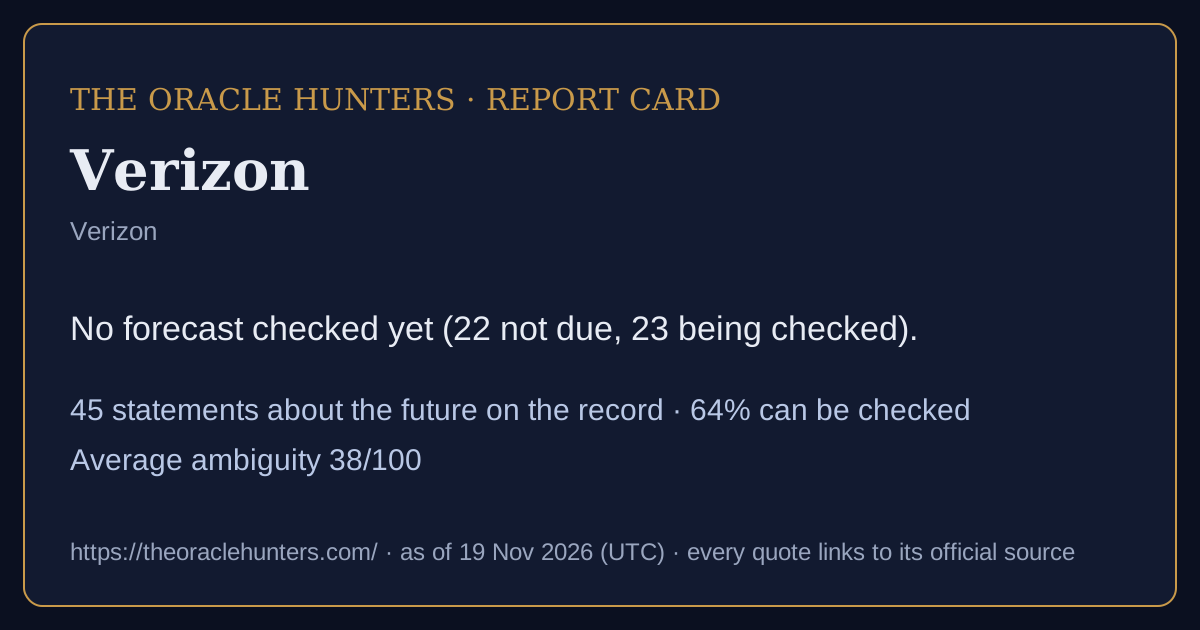
Track record: No forecast checked yet (22 not due, 23 being checked).
45forecasts & commitments on the record
64%can be checked as stated
38average ambiguity (0-100)
0goalpost moves recorded
0confirmed U-turns
Timeline
came true partly did not not due / being checked / too vague
Calibration score: shown after 10 checked forecasts with a stated likelihood (now 0).
How they speak about the future: based on data 43, stated on authority 2.
Kinds of claim: forecast 45. · Download this report card as a picture
In the nine words
How to read this
Each box is one sentence a public figure or institution said about the future, word for word, with a link to the official text. Can be checked means it names what will happen, by when, and how likely - so it can be compared with official figures later. Too vague to check means it does not. Ambiguity (0-100) is how many different ways the sentence can be read. When the date passes, the forecast is compared with official data and marked came true, partly or did not come true. Labels judge the sentence, never the person. Full guide and glossary.On the record (45)
Net Cash Provided by Operating Activities Growth Forecast %3.5 % - 5.1 %2.2 % - 4.0 %
•Free cash flow¹: expected to approach 12.0 percent growth year-over-year, up from 9.0 to 10.0 percent.
•The company continues to anticipate total fiber passings to exceed 32 million by year-end, remaining on track toward a target of 40 to 50 million fiber passings over the medium term.
•Mobility and broadband service revenue grew by 2.8 percent in second-quarter 2026, and forecasted to rise to approximately 4.0 percent growth in fourth-quarter 2026
Net Cash Provided by Operating Activities Growth Forecast %2.2 % - 4.0 %1.0 % - 2.3 %
Total mobility and broadband service revenue growth is expected to approach 3.0 percent in third-quarter 2026 and approximately 4.0 percent in fourth-quarter 2026, accelerating from the 2.8 percent increase reported in the second-quarter 2026.
Given our strong performance and momentum, we are raising our 2026 Adjusted EPS1 guidance to year-over-year growth of 5.0 to 6.0 percent and we now expect our total retail postpaid phone net additions to be in the upper half of our 750,000 to one million range."
•Verizon paid down approximately half of the Frontier debt since the acquisition closed, and expects to repay substantially all of Frontier's debt by the end of the year.
"It’s only going to get better this year and beyond, as we have continued to strengthen Verizon with the pending Frontier acquisition, new satellite partnerships, and ongoing AI enablement, which we expect will enhance and broaden our network for everybody we serve."
Verizon is ahead of schedule to achieve its goal of 4 to 5 million subscribers by the end of 2025.
•Verizon is focused on continuously improving operating efficiencies and mitigating inflation impacts, and has started a new cost savings program that is expected to provide a reduction in annual costs of between $2 billion and $3 billion by 2025.
The company's net unsecured debt1 balance increased sequentially by $1.9 billion to $135.6 billion, and its net unsecured debt to adjusted EBITDA ratio1 at quarter-end was approximately 2.8 times, as it issued its fourth Green Bond, with the net proceeds expected to be allocated to renewable energy.
"We expect that over 75 percent of our growth over the next four years will come from 5G mobility and nationwide broadband.
We continue to accelerate our C-Band network build with our goal of reaching at least 175 million people by the end of the year and, with the recent early clearing spectrum announcement, we now have the ability to deploy more of this spectrum a full year sooner.”
On a reported basis, which includes the net impact of the sale of Verizon Media and the company's ownership of TracFone, service and other revenue growth is expected to be in a range of 1.0 percent and 1.5 percent.
•The company now expects total wireless service revenue growth of around 4 percent.
Expenditures related to the deployment of the company's C-Band 5G network will be in addition to this amount, and the company previously announced an incremental $10 billion of capital expenditures from 2021 to 2023, of which $2 billion to $3 billion is expected in 2021.
•The company now expects total wireless service revenue growth of 3.5 percent to 4 percent, an update from prior guidance for 2021 total wireless service revenue growth of at least 3 percent.
•In 2018, Verizon announced a goal to achieve $10 billion in cumulative cash savings by the end of 2021.
This initiative has yielded $9.5 billion of cumulative cash savings since the program began and is on track to achieve its target by the end of 2021.
•The company now expects total wireless service revenue growth of at least 2 percent in fourth-quarter 2020 compared to last year.
The company expects total wireless service revenue growth for third-quarter 2020 of -1 percent to flat year over year.
The company increased its bad debt reserve in first-quarter by $228 million based on the expected number of customers who will seek payment relief under the Keep Americans Connected pledge.
In 2018, Verizon announced a goal to achieve $10 billion in cumulative cash savings by the end of 2021.
Cash taxes to be $2 billion to $3 billion higher than in 2018 due to benefits that were realized in 2018 that are not expected to repeat in 2019.
The accretive benefit to full-year 2018 consolidated operating income is expected to moderate in 2019 and become insignificant in 2020, as the timing impacts to revenues and commission costs converge.
The company expects Oath revenues to be relatively flat in the near term and does not expect to meet the previous target of $10 billion in Oath revenues by 2020.
The resulting 2018 effective tax rate is projected to be in the range of 24 to 26 percent.
The expected savings from tax reform will generate a net $3.5 billion to $4 billion uplift to cash flow from operations in 2018.
Capital spending for 2018 will be in the range of $17.0 billion to $17.8 billion, including the commercial launch of 5G.
Verizon expects service revenue growth on a GAAP reported basis to turn positive by the end of 2018.
The expected savings from tax reform will generate a net $3.5 billion to $4.0 billion uplift to cash flow from operations in 2018.
These two initiatives have a projected EPS impact of 5 to 6 cents for each of the next two years.
Tax-reform legislation will have a positive impact to cash flow from operations in 2018 of approximately $3.5 billion to $4 billion.
On a GAAP basis, Verizon expects service revenue growth to turn positive around the end of 2018 or early 2019.
in the company’s success, and the company will also be increasing contributions to the Verizon Foundation by $200 million to $300 million over the next two years.
Oath expects to realize more than $1 billion in cumulative operating expense synergies through 2020.
of the contributions, Verizon’s mandatory pension funding through 2020 is expected to be minimal, which will benefit future cash flows and improve the funded status of qualified pension plans.
Yahoo’s annual report on Form 10-K for the year ended December 31, 2015, as amended, and Yahoo’s proxy statement for its 2016 annual meeting of stockholders filed with the SEC on May 23, 2016.
service revenue growth by the end of 2017.
Wireline: 3.7 percent Fios revenue growth; $500 million in anticipated cash savings over the term of new labor contracts.
4 and 5, and additional information is also available in Yahoo’s annual report on Form 10-K for the year ended December 31, 2015, as amended, and Yahoo’s proxy statement for its 2016 annual meeting of stockholders filed with the SEC on May
in a transaction expected to close in first-quarter 2017.
expects the decline in service revenues to slow throughout the year and ultimately turn positive by the end of 2017.
Verizon reiterates that by 2018-2019 the company expects to return to its credit-rating profile prior to the acquisition