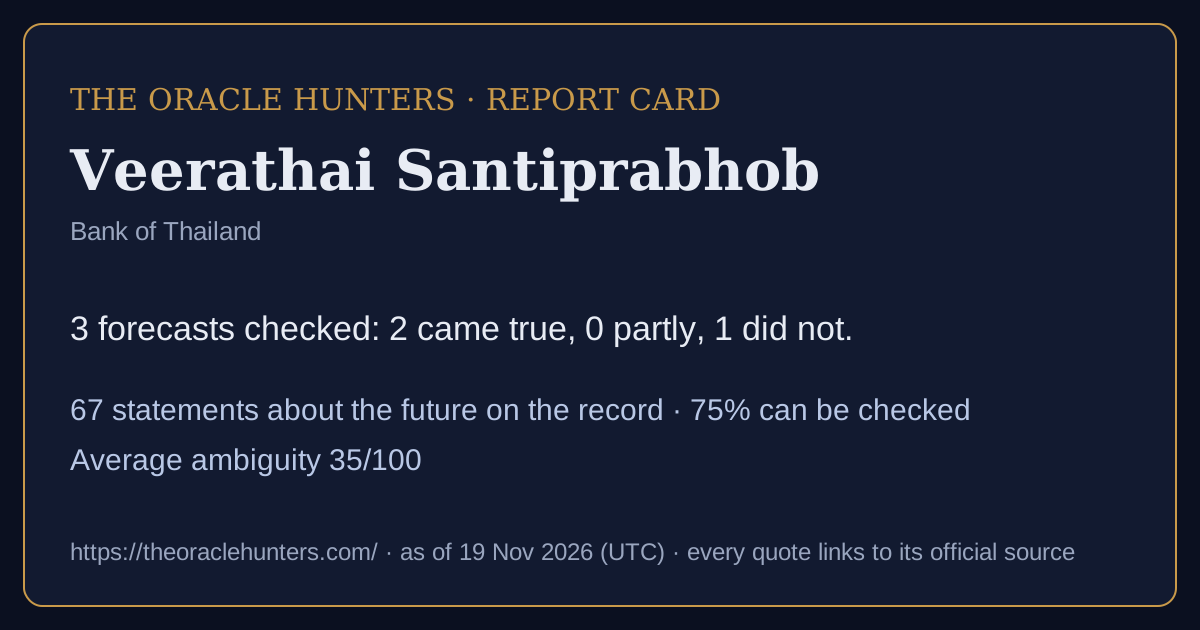
Veerathai Santiprabhob
Bank of Thailand
Track record: 3 forecasts checked: 2 came true, 0 partly, 1 did not.
67forecasts & commitments on the record
75%can be checked as stated
35average ambiguity (0-100)
0goalpost moves recorded
0confirmed U-turns
Timeline
came true partly did not not due / being checked / too vague
Calibration score: shown after 10 checked forecasts with a stated likelihood (now 3).
How they speak about the future: based on data 50, stated on authority 17.
Kinds of claim: forecast 57, mixed claim 8, scenario (if… then) 1, commitment 1. · Download this report card as a picture
In the nine words
πρόγνωσιςInference from evidence49 · 73%μαντείαInspired knowledge16 · 24%προαναγγελίαPublic pre-announcement1 · 1%πρόνοιαPreparing for the future1 · 1%
How to read this
Each box is one sentence a public figure or institution said about the future, word for word, with a link to the official text. Can be checked means it names what will happen, by when, and how likely - so it can be compared with official figures later. Too vague to check means it does not. Ambiguity (0-100) is how many different ways the sentence can be read. When the date passes, the forecast is compared with official data and marked came true, partly or did not come true. Labels judge the sentence, never the person. Full guide and glossary.Checked
In our latest forecast, the economy is projected to grow at 4.4 percent this year and 4.2 percent in 2019-the strongest twoyear performance since 2008.
Did not come true. Said: economic growth around 4.2% in 2019. Official figure for Thailand: 2.1% (World Bank open data). Missed. Off by 2.1 points. official data · checked 14 Nov 2026 · automatic check against official data (rules v3)
Thus far, the Thai macroeconomic outlook remains favorable, with the economy expected to grow 4.4 percent this year, the highest since 2012.
Came true. Said: economic growth around 4.4% in 2018. Official figure for Thailand: 4.2% (World Bank open data). On target. Off by 0.2 points. official data · checked 14 Nov 2026 · automatic check against official data (rules v3)
Headline inflation, though currently in negative territory, is expected to gradually rise, and turn positive in 2016.
Came true. Said: inflation would rise in 2016. Official figures for Thailand: -0.9% in 2015, 0.2% in 2016 (World Bank open data). official data · checked 14 Nov 2026 · automatic check against official data (rules v3)
On the record (67)
In the event of a global economic downturn that is half as severe as the one spurred by the Global Financial Crisis, the IMF estimated that almost 40 percent of corporate debt-approximately 19 trillion USD-could be at risk of defaulting, exceeding the levels seen during the last crisis.
By 2030, these regions will be home to more than 45 percent of the world population.
Let me end my talk by saying once again that we will not know with certainty what the Thai economy will look like in 2025.
Indeed, we will not know with certainty what the Thai economy will look like in 2025, but we know the major trends that will have significant implications for the
With today's topic of 'Thailand 2025', I would like to commend TNSC for inviting us to look beyond short-term issues: what this year's GDP growth rate will be, how many tourists we will get this year, or what will the exchange rate be by year-end.
We were the third Asian country to become an aging society, and by 2035 we will be the first developing country to become a hyperaged society by the definition of the World Health Organization-meaning 20 percent of the population will be over the age of 65.
As you all know, this year is a very special one to all of the Thai people as well as the Japanese people as both our countries will hold national celebrations for our respective head of state in early May-to celebrate and honor the coronation of His Majesty the King Maha Vajiralongkorn and the ascension of Crown Prince Naruhito to …
expected to grow at an annual average of more than 20 percent over the next three years.
It is expected that the number of foreign tourists will exceed 40 million this year.
Our current account surplus has been in the positive for five consecutive years and is projected to be around at 34.5 billion USD this year, or around 6.4 percent of GDP.
Looking ahead, the Thai economy is projected to continue to expand around its potential, with growth this year will slightly moderate to 3.8 percent as slower growth of major trading partners weighs on the export sector.
To date, more than 44 million PromptPay accounts have been registered with more than 100 million transactions per month, and we expect to see a continual growth in these numbers as more people, especially business sectors, utilize the system.
Moreover, according to the Institute of International Finance, approximately 2.7 trillion US dollars of EME bonds and syndicated loans are due by the end of 2019, with approximately a third of that amount denominated in foreign currencies.
In our latest forecast, the economy is projected to grow at 4.4 percent this year and 4.2 percent in 2019-the strongest twoyear performance since 2008.
Did not come true. Said: economic growth around 4.2% in 2019. Official figure for Thailand: 2.1% (World Bank open data). Missed. Off by 2.1 points. official data · checked 14 Nov 2026 · automatic check against official data (rules v3)
Nonetheless, the full impact of the ongoing trade war is expected to come next year, and the series of trade disputes could be far from over.
Our current account surplus has been running in the positive for 4 years and is projected to be at 35.4 billion USD for this year, or 7 percent of GDP.
Since 2015, the Bank of Thailand has set a medium-term headline inflation target at 2.5 percent with a band of one to four percent.
As we move into the second half of this year and the next, even more spillovers are expected from various public infrastructure projects that we have heard about earlier this morning.
The solid growth number slightly beat our expectations back in June when we revised our 2018 GDP growth forecast from 4.1 percent to 4.4 percent.
I am certain we will be able to navigate the Thai economy towards sustained growth in this increasingly volatile global landscape.
We expect this year's headline inflation to be in the target range, albeit around the lower end.
After running below the target for the past three years, inflation is finally back within the target range, albeit around the lower end, with headline inflation this year and the next forecasted at 1.1 and 1.2 percent, respectively.
The scheme is expected to roll out by October this year.
Thus far, the Thai macroeconomic outlook remains favorable, with the economy expected to grow 4.4 percent this year, the highest since 2012.
Came true. Said: economic growth around 4.4% in 2018. Official figure for Thailand: 4.2% (World Bank open data). On target. Off by 0.2 points. official data · checked 14 Nov 2026 · automatic check against official data (rules v3)
It is also estimated that the cost of cybercrime will be in excess of USD 600 billion this year.
Headline inflation in April and May has turned up above the lower bound of our target, which is set at 2.5±1.5%, mainly due to the recent pickup in energy prices.
We can expect to see these dual-track railways up and running from 2019 and 2020 onwards.
Although growth benefits have not spilled over to other segments of the economy as much as we would like to see, domestic demand is improving and we expect a more robust and more balanced GDP growth this year.
These figures are likely to be revised up given better-than-expected growth outturns in the first quarter this year.
The economy is expected to continue a strong momentum this year, with GDP growth in
In our March forecast, the GDP growth for both 2018 and 2019 was projected at 4.1 percent.
According to United Nations' World Population Ageing Report 5 , the number of people aged 60 years or over is projected to increase by 56% by 2030.
I could not agree more with the United Nations' 2030 agenda for sustainable development that 'no one should be left behind' 6 .
From the increasing trend of mobile payment volume which has heightened by 100% from the previous year, we recognize that mobile will be a major payment channel in the near future; therefore, mobile payment security is a vital issue.
Most of the relaxations are expected to be completed by the end of this year.
At the same time, this also translates into less use of cash, saving operating costs for commercial banks in terms of lower demand for physical branches and manpower as well as reducing the cost of cash management which could amount to a saving for banks of as much as 20 billion Baht per year 1 .
However, there is a possibility that inflation may be temporarily lower than the target band in some periods due to supply-side factors, especially on account of lower fresh food prices this year from last year high base on the back of the severe drought.
Our latest projection for the output growth is 3.4% for this year and 3.6% for 2018, on the back of firmer recovery in global growth.
Political evolution in the UK as well as on the Continent over the next two years will continue to play a major role in determining the long-term business environment of the region, including trade, investment and immigration policy directions.
We are now discussing a similar framework with Indonesia, which will be implemented by the end of this year.
The public debt to GDP ratio currently at 43 percent is projected to stand well below the sustainability ceiling under the ongoing fiscal reform.
In addition, fiscal policy will continue to be expansionary with a budget deficit of 2.9% of GDP proposed for the fiscal year 2018.
For example, the public debt ceiling will be set by law at 60 percent of GDP.
Given this, Thailand's small and medium enterprises, which constitute 95 percent 2 of the total number of firms and make up 30 percent of total employment 3 , are expected to gain better access to credit, thus representing a better distribution of economic opportunity.
Notably, our unemployment rate continues to dwell at a low level, while external stability is sound, with current account surplus expected to be around 7 percent of GDP this year, declining from 10% of GDP in 2016.
If someone had asked you back in 2007 what you would expect to see if the major central banks in the world cut policy rates to zero and held it there for almost a decade, triple the size of their balance sheets, and bought up roughly a third of all outstanding government bonds in their jurisdiction, very few of us …
Among others, we will be rolling out a new Faster payment platform early this year that will encourage greater digital payments as well as lower transaction costs.
In terms of the outlook going forward, we forecast continued economic growth this year at broadly similar pace to 2016 while inflation should pickup as the base effect from lower oil prices dissipate.
Also, there will be less reliance on currencies of advanced countries which last year account for over 85 percent of Thailand's trade with Indonesia and Malaysia.
Slow growth momentum is most pronounced in the core advanced economies, with 1.8 percent forecast for 2017.
Showing the newest 50 - the ledger has all 67.
Also said - not checkable as stated (12 newest)
Remarks about the future with no date, figure or likelihood that could be checked. They are kept on the record and shown here, but not scored.
For example, in the low-for-long interest rate environment, EMs may need to follow AEs in delaying or reversing normalization of monetary policy to avoid appreciation of their currencies.
On a domestic-level , financial stability will have to play a more prominent role in monetary policy decisions.
With limited monetary and fiscal policy space we have, we need to give more consideration to structural policies that will help safeguard our competitiveness from global challenges.
Second, assessments of global imbalances and implications for currency valuation need to adopt a 'broader view' that takes into consideration not only current account imbalances but also capital flows which have become much larger than current account flows; taking a narrow perspective of current account imbalance alone could lead us to a policy misstep.
Priorities for emerging nations should be to get ready for the world that will be more volatile, more uncertain, more complex, and more ambiguous ahead.
Trade tension might be comparatively short-lived when compared to other structural changes like demographic shift and technological disruptions, but these short-term factors could result in a long-term impact to medium-size firms and the structure of the economy through channels such as changes in competition landscape, market dominance power, and investment and employment patterns.
As such, I don't think it is an over exaggeration to say that cyber threats have kept many bank executives and regulators awake at night given the nature of these threats that can occur anytime and anywhere without warning, and the significant damage they could cause.
In addressing these threats, it is important to operate under the assumption that it is not a matter of ' if ' but rather ' when ' these threats will occur, and focusing solely on 'protection' and 'detection' is no longer sufficient.
The financial sector, for example, has started these exercises within the banking sector and will soon expand to other parts of the financial sector.
In other words, cybersecurity alone is not enough, but we also need to proactively think about cyber resilience: how do we not only prepare, but also withstand and recover from disruptions.
For instance, the banking sector needs to have joint exercise with telecommunication companies for scenarios involving mobile banking attacks, or with the utilities sector for power outage scenarios.
Although the financial sector has made significant progress in terms of cyber resilience, the never-ending development of cyber threats means that we too must continue to improve our defenses.