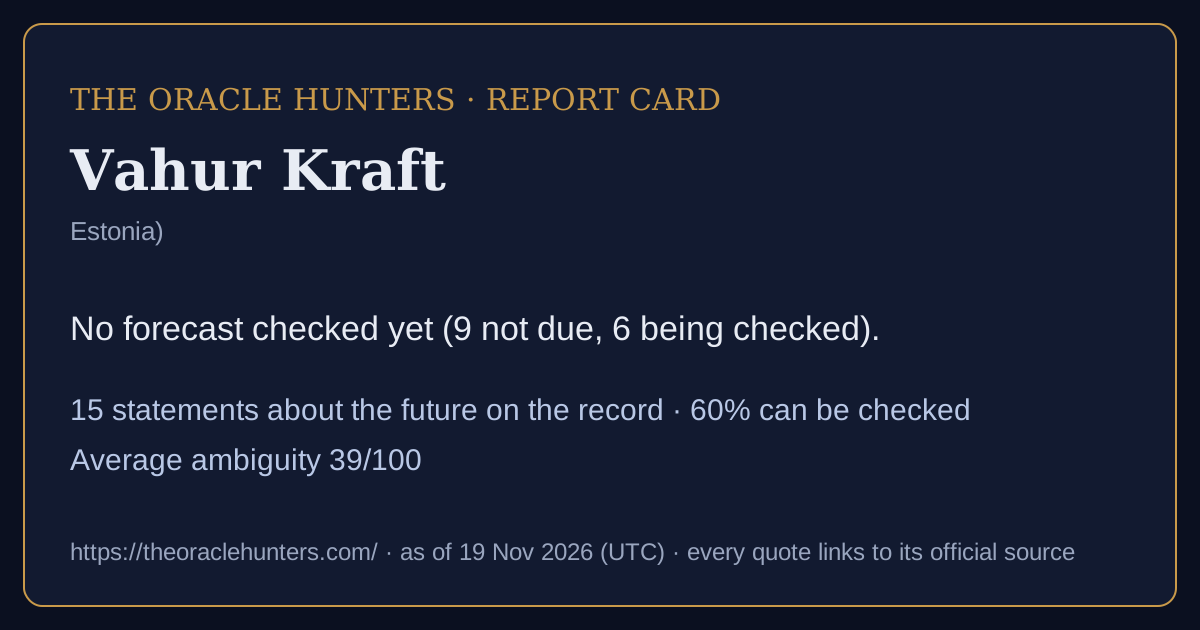
Vahur Kraft
Estonia)
Track record: No forecast checked yet (9 not due, 6 being checked).
15forecasts & commitments on the record
60%can be checked as stated
39average ambiguity (0-100)
0goalpost moves recorded
0confirmed U-turns
Timeline
came true partly did not not due / being checked / too vague
Calibration score: shown after 10 checked forecasts with a stated likelihood (now 0).
How they speak about the future: based on data 11, educated guess 2, stated on authority 2.
Kinds of claim: forecast 12, scenario (if… then) 2, mixed claim 1. · Download this report card as a picture
In the nine words
πρόγνωσιςInference from evidence11 · 73%μαντείαInspired knowledge2 · 13%πρόνοιαPreparing for the future2 · 13%
How to read this
Each box is one sentence a public figure or institution said about the future, word for word, with a link to the official text. Can be checked means it names what will happen, by when, and how likely - so it can be compared with official figures later. Too vague to check means it does not. Ambiguity (0-100) is how many different ways the sentence can be read. When the date passes, the forecast is compared with official data and marked came true, partly or did not come true. Labels judge the sentence, never the person. Full guide and glossary.On the record (15)
According to the present financial estimates, the inflowing amount will be around 40 billion kroons in 2007-2013, an average of 5.6 billion kroons a year.
The excessive budget deficit procedure was initiated against Germany and France which exceeded the maximum budget deficit allowed according to the Growth and Stability Pact, 3% of the GDP - and the number of such member states will probably grow.
The look of Estonia's euro coins will become clear this year.
This year spring is going to be different, chirp-chirp!
- The following six months will indeed bring about several one-off price rises related to the accession to the European Union all in all, according to our current analysis, these should escalate Estonian consumer prices 1-1.4%.
In that sense - Estonia, most likely, would be technically ready for joining the euro area even as early as 2006.
Provided nothing adverse happens, Estonia might be in a position to submit its application for ERM2 membership as early as mid-2004.
According to the present estimates, Estonian CPI growth will remain at 1.5% in 2003.
High domestic demand, a continuously strong inflow of foreign investments and a lower than expected export growth have resulted in a significantly high current account deficit - an estimated 14% or more of the GDP by end-2003.
I stress that the projections which form the basis of the national pre-accession programme and the premise that in Estonian economy the real total output is going to increase at the rate of about 6% per year are attainable only if the current economic policy continues.
With the regard to the Stability and Growth Pact, it is assumed that automatic stabilisation mechanisms shall function smoothly within the 3% GDP scale.
Thus we can conclude that inflation rates in the new member states will for several years stay higher than the mean rate of the three lowest inflation economies in the European Union plus 1.5 per cent.
We believe that our mean economic growth rate will continue to be about 6% per annum.
That might be even more relevant if credit growth is high in the early stage of the cycle.
In essence, we do not know how the strategic partners of Estonian banks would react if the GDP growth will slow, loan losses amount and bank profitability starts to decline.
Also said - not checkable as stated (9 newest)
Remarks about the future with no date, figure or likelihood that could be checked. They are kept on the record and shown here, but not scored.
- While assessing the relevance of the budgetary balance requirement from the viewpoint of Estonia's future competitive ability, one certainly has to bear in mind that merely meeting the budget criterion might not be a sufficient success guarantee.
It must be stressed, in this context, however, that one indicator taken alone - even if it were an indication of possibly unfavourable developments - would not give an adequate picture of the relative health of an economy.
It could be said that recent inflation developments have been most encouraging.
The goal of the economic policy should be the prevention of the internal demand-driven boom immediately prior and after the EU accession which will be followed by a significantly slower growth phase.
And even more importantly, harmonised and flexible commodity markets will help to reduce adjustment costs - and thus minimise the need to use budget stabilisation mechanisms during the short-term adjustment period.
We will further adjust the system of reserve requirements in the future as monetary policy framework will converge towards the eurosystem principles.
Bank of Estonia is responsible for banking regulations while the Ministry of Finance will regulate insurance and securities market.
It is important to underline that in heavily bank dominated financial system, banking regulations might serve also as an instrument to affect domestic demand more directly than under other circumstances.
One obvious shortcoming is that as financial markets do mature and financial instruments become more complex, tightening banking regulations will simply intensify financial disintermediation.