Usha Thorat
Reserve Bank of India
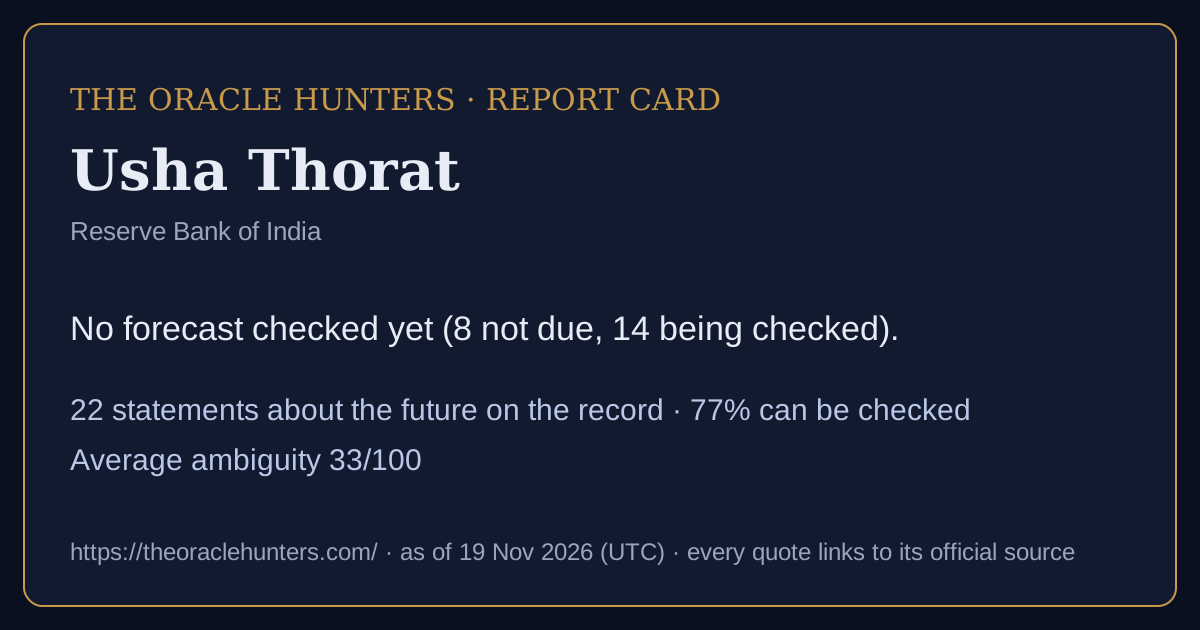
Track record: No forecast checked yet (8 not due, 14 being checked).
22forecasts & commitments on the record
77%can be checked as stated
33average ambiguity (0-100)
0goalpost moves recorded
0confirmed U-turns
Timeline
came true partly did not not due / being checked / too vague
Calibration score: shown after 10 checked forecasts with a stated likelihood (now 0).
How they speak about the future: based on data 21, stated on authority 1.
Kinds of claim: forecast 19, mixed claim 2, scenario (if… then) 1. · Download this report card as a picture
In the nine words
πρόγνωσιςInference from evidence19 · 86%μαντείαInspired knowledge1 · 5%φρόνησιςPractical wisdom1 · 5%πρόνοιαPreparing for the future1 · 5%
How to read this
Each box is one sentence a public figure or institution said about the future, word for word, with a link to the official text. Can be checked means it names what will happen, by when, and how likely - so it can be compared with official figures later. Too vague to check means it does not. Ambiguity (0-100) is how many different ways the sentence can be read. When the date passes, the forecast is compared with official data and marked came true, partly or did not come true. Labels judge the sentence, never the person. Full guide and glossary.On the record (22)
If the coverage of those borrowing less than Rs.2,00,000 has to increase to at least 50 per cent of the adult population in the next three years, the number of borrowal accounts will have to increase annually by at least 41.3 per cent.
It is expected that by latter part of this year, the UIDAI will begin issuing UIDs and roll out 600 million UIDs in a phased manner by 2014.
Also various off balance sheet transactions such as letters of credit and guarantees are very important for supporting the real sector but would likely have 100 per cent credit equivalence for calculation of the proposed leverage ratio.
The impact assessment of the new proposals made by the BCBS will be completed this year and a consensus on fully calibrated measures is expected to be evolved by the end of the year.
Recognising the impact that restructuring and slower growth could have on the credit quality of banks and taking into account the need to build up provisions when banks' earnings are good, banks were advised in December 2009 that their total provision coverage ratio, including floating provisions, should not be below 70 per cent by September 2010.
Still, the country is the second fastest growing economy in the world with over 6 % growth projected for the current year.
The economy is unlikely to revert back to trend growth soon, as recession in the advanced economies would persist with global growth projected to contract by 1.4 per cent by the IMF with a more sizeable fall in world trade by 12 per cent.
The Eleventh Five Year Plan envisages stepping up of the gross capital formation in infrastructure from 5 per cent of GDP in 2006-07 to 9 per cent of GDP by end of the Plan period in 2011-12, which could be critical for achieving the 9 per cent growth.
Euro area, on the other hand, is expected to shrink by 4.8 per cent and 0.3 per cent both in 2009 and 2010, respectively (WEO, 2009a).
African countries are forecast to register much lower growth of 1.8 per cent in 2009 and recover to 4.1 per cent in 2010.
Emerging and developing economies are projected to post a much subdued growth of 1.5 per cent in 2009, notwithstanding an expected pick up in growth momentum during the second half of 2009.
Unemployment in advanced countries is projected to scale higher from 5.8 per cent in 2008 to 8.1 per cent in 2009 and further to 9.2 per cent in 2010 (WEO, 2009).
The GDP of US and the UK is forecast to witness a fall of 2.6 per cent and 4.2 per cent in 2009 before an anaemic recovery to 0.8 per cent and 0.2 in 2010, respectively.
The world output is expected to contract by 1.4 per cent in 2009, GDP in the advanced economies is projected to decline by 3.8 per cent in 2009 before growing by a meagre 0.6 per cent in 2010.
As per the estimate made by the RBI in its Annual Policy announced on April 21, 2009, GDP is expected to grow by 6 per cent in 2009-10.
So far between March and May this year, cash balances of nearly $8 billion have been de-sequestered.
Effective from April 1, 2009 a customer will be able to use any ATM (including other bank ATMs) to operate his /her account at no cost.
Looking to 2020, it is even more apparent that the task of banking the unbanked will be truly daunting.
Reflecting these developments, housing stock in the country had also increased from 148 million units in 1991 to 187 million units in 2001 and is expected to further gone up to 218 million units in 2007 (NHB, 2006).
The aged population in India (i.e. over 60 years) that stood at 84.7 million (7.5 per cent) in 2005 is expected to rise to 141 million (10.2 per cent) by 2020 and thereafter reach 194 million (13 per cent) in 2030.
Going by the available data on the number of savings bank accounts and assuming that one person has only one account, (which assumption may not be correct as many persons could have more than one bank account) we find that on an all India basis 59 per cent of adult population in the country have bank accounts - in other …
If we assume that a bank branch can serve at least 3000 households, it would imply at the minimum tripling of the business at rural branches This might require redeployment and some increase in staff, especially field staff, and would be more than worth the effort considering the increase in business and profitability that it would result in.
Also said - not checkable as stated (12 newest)
Remarks about the future with no date, figure or likelihood that could be checked. They are kept on the record and shown here, but not scored.
Totally freeing rates could, in situations where there is virtual monopoly of banking, lead to lowering rates in some areas while leading to increase in other areas - it would need to be ensured that there is no discrimination between different customers of the same bank.
Transparency in cost recovery could facilitate deregulation - this would also need to be nondiscriminatory across locations.
Standard products like GCC / ODs against savings products at affordable rates will have to be offered based on the track record in savings and recovery, as there is no likelihood of offer of any security.
Similar credit risk mitigation products will need to be evolved by NABARD for small farmers, who cannot offer any document of proof of possession of land farmed by them, as also for the landless engaged in non farm and allied activities.
NHB will need to evolve similar products for minimizing documentation risk, credit risk and other risks involved in financing low income housing.
would have to be brought under financial regulation and this could inhibit their other activities.
Looking at the success of credit unions and community banks world-wide in providing financial services to local communities, it could be argued that smaller regional banks could be the answer for financial inclusion.
Under this programme, banks provide loans to the SHGs against group guarantee and the quantum of loan could be several times the deposits placed by such SHGs with the banks.
Hence, we have, as will be described below allowed branchless banking to ensure that these accounts are more accessible to their holders.
Banks could benefit by synchronizing opening of bank accounts for those who will be enrolled through this exercise.
Hence if we have to make rational allocation of natural resources from a global societal and inter-generational perspective, one will need to attribute monetary values to biodiversity and the costs and benefits should include such values for decision making.
Gains and losses to natural and human capital will thus need to factored-in as a mandatory requirement.