Turalay Kenç
Republic of Turkey
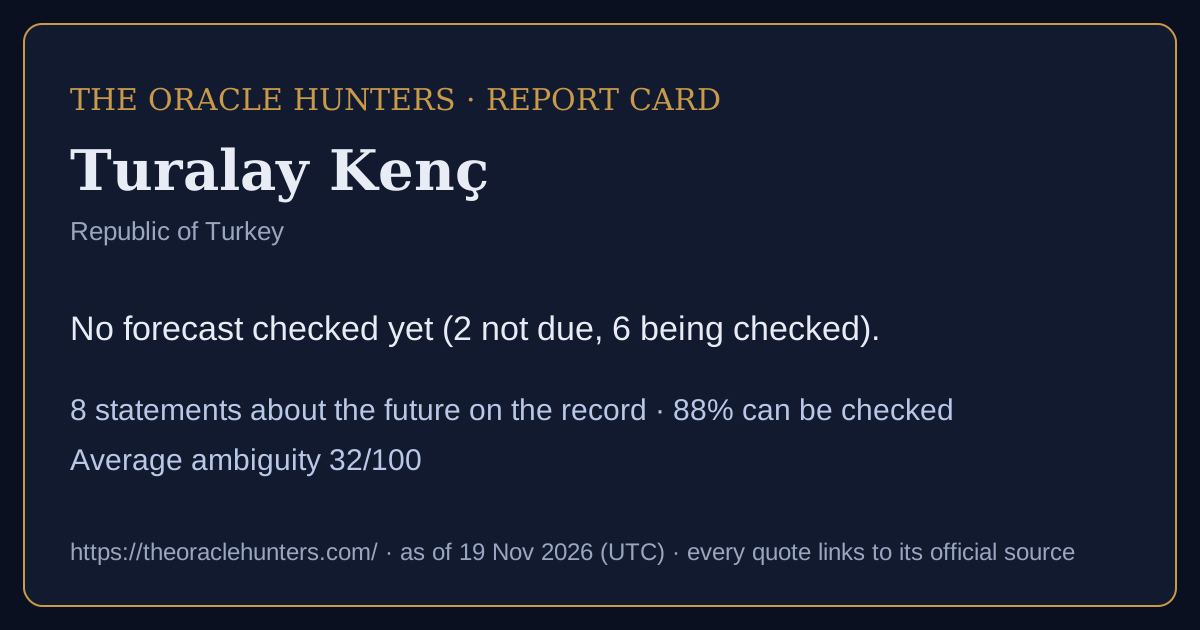
Track record: No forecast checked yet (2 not due, 6 being checked).
8forecasts & commitments on the record
88%can be checked as stated
32average ambiguity (0-100)
0goalpost moves recorded
0confirmed U-turns
Timeline
came true partly did not not due / being checked / too vague
Calibration score: shown after 10 checked forecasts with a stated likelihood (now 0).
How they speak about the future: based on data 8.
Kinds of claim: forecast 8. · Download this report card as a picture
In the nine words
How to read this
Each box is one sentence a public figure or institution said about the future, word for word, with a link to the official text. Can be checked means it names what will happen, by when, and how likely - so it can be compared with official figures later. Too vague to check means it does not. Ambiguity (0-100) is how many different ways the sentence can be read. When the date passes, the forecast is compared with official data and marked came true, partly or did not come true. Labels judge the sentence, never the person. Full guide and glossary.On the record (8)
Therefore, it is highly likely that Turkey will record a current account deficit of below 4 percent of its Gross Domestic Product in 2016, representing a major achievement in satisfying the norm of the European Union's Macroeconomic Imbalances Procedure (Figure 15).
These factors together with some deterioration in inflation expectations led the MPC to revise its inflation forecasts for 2016 and 2017 up to 7.5 percent and 6 percent respectively and postpone the projected realization year of the 5 percent target to 2018 (Figure 16).
GDP growth is estimated at around 4 percent in 2015 with an expected gradual strengthening of economic activity in 2016 and in 2017 (Figure 12).
Therefore, it is highly likely that Turkey will record a current account deficit of below 4 percent of its Gross Domestic Product in 2016, representing a major achievement in satisfying the norm of the European Union's Macroeconomic Imbalances Procedure.
These factors together with some deterioration in inflation expectations led the MPC to revise its inflation forecasts for 2016 and 2017 up to 7.5 percent and 6 percent respectively and postpone the projected realization year of the 5% target to 2018.
GDP growth is estimated at around 4 percent in 2015 with an expected gradual strengthening of economic activity in 2016 and in 2017.
In the spirit of the MoU agreement, a primary step in our cooperation is to establish high level policy dialogue with the Bundesbank on a regular basis, the first of which will be held in 2014.
This is timely, considering that not only will Turkey assume the G20 presidency in 2015 and engage in an even closer interaction with the central banks of the G20 member states, but will also help meet the recently increased need for policy dialogues over the implementation and implications of new unconventional monetary policies.
Also said - not checkable as stated (9 newest)
Remarks about the future with no date, figure or likelihood that could be checked. They are kept on the record and shown here, but not scored.
I will finish my talk with the Central Bank of Turkey's roadmap of policy actions before and after global monetary policy normalization.
Recent research suggests that agents tend to cut back their spending when their debt reaches certain levels. 3,4 Going forward, we are likely to see only a gradual improvement in this stock balances problem as they take longer time to heal than flow balances problems.
The right window of Figure 7 reveals that the probably biggest post-crises' success of EMEs is in the area of price stability.
In these circumstances, any change in interest rate differential across countries is likely to create greater impacts than otherwise.
If this interest rate change takes place in the largest and the most significant economy in the world, then the impact will expectedly be further magnified.
- Should and can the systematically important countries 'internalize' their spillovers effects to mitigate negative external impacts?'
Of course, probably the most significant development of the last year or so has been the sharp decline in oil prices.
Going forward, the current levels in oil prices and depressed producer prices in most part of the world due to weak economic activity are expected to lead to further improvements in external balances.
First, the latest improvement in the external balances together with the already strong fiscal balances is likely to boost the effectiveness of the monetary policy.