Toshiro Muto
Bank of Japan
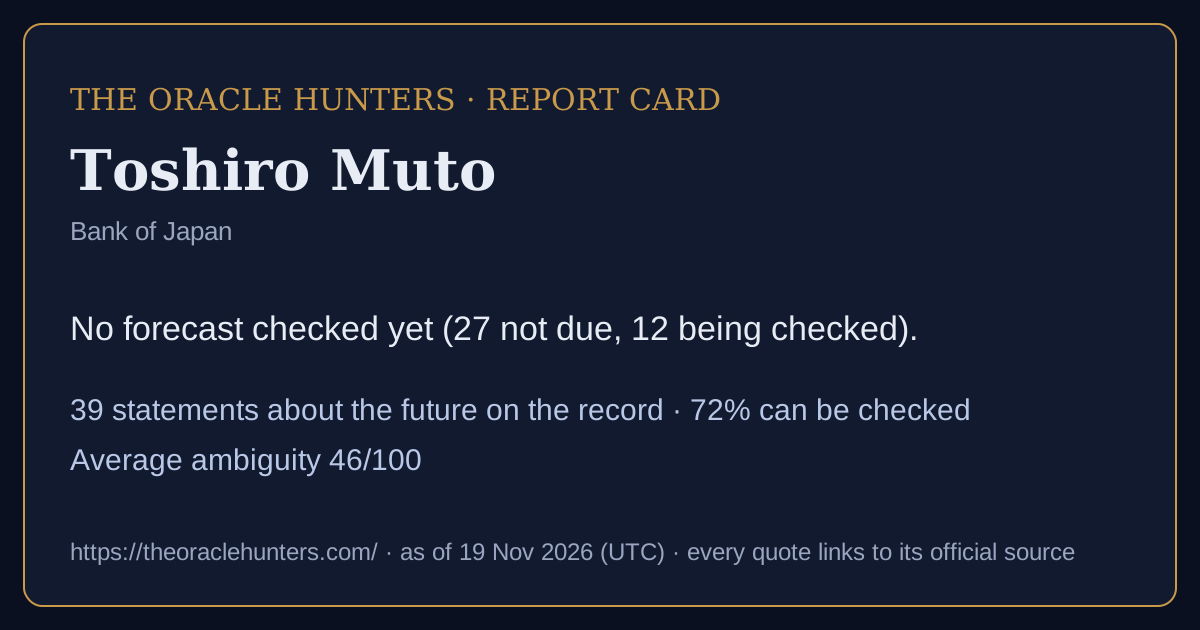
Track record: No forecast checked yet (27 not due, 12 being checked).
39forecasts & commitments on the record
72%can be checked as stated
46average ambiguity (0-100)
0goalpost moves recorded
0confirmed U-turns
Timeline
came true partly did not not due / being checked / too vague
Calibration score: shown after 10 checked forecasts with a stated likelihood (now 0).
How they speak about the future: based on data 27, educated guess 9, stated on authority 3.
Kinds of claim: forecast 25, scenario (if… then) 10, commitment 3, mixed claim 1. · Download this report card as a picture
In the nine words
πρόγνωσιςInference from evidence25 · 64%πρόνοιαPreparing for the future10 · 26%προαναγγελίαPublic pre-announcement3 · 8%μαντείαInspired knowledge1 · 3%
How to read this
Each box is one sentence a public figure or institution said about the future, word for word, with a link to the official text. Can be checked means it names what will happen, by when, and how likely - so it can be compared with official figures later. Too vague to check means it does not. Ambiguity (0-100) is how many different ways the sentence can be read. When the date passes, the forecast is compared with official data and marked came true, partly or did not come true. Labels judge the sentence, never the person. Full guide and glossary.On the record (39)
It is conceivable that if, for instance, the expectation takes hold that interest rates will remain low for a long time regardless of developments in economic activity and prices, there is a medium- to long-term risk of larger swings and an inefficient allocation of resources as firms and financial institutions overextend themselves.
If labor supply and demand conditions continue to tighten, it is likely that upward pressure on wages will gradually
Furthermore, the Hokkaido Toyako Summit will be held in July this year with environmental problems as one of the major themes.
We are determined to conduct appropriate monetary policy with the aim of achieving sustainable growth under price stability while carefully assessing our projections, their likelihood, and upside and downside risks.
The primary balance deficit, which expanded to around 6 percent of GDP in fiscal 2003, is expected to fall to around 0.9 percent this fiscal year.
Given those factors, the annual rate of change in our consumer prices is expected to be around 0 percent in the short run, but gradually to rise in the longer run.
Second, turning to the longer horizon of the second perspective and examining the various risks most relevant in conducting monetary policy, it appeared likely that, with the prospects for the economy and prices improving, the stimulative effects of monetary policy would increase if the policy interest rate were left at its recent level.
In other words, taking a forward-looking perspective on the economic and price situation for one to two years ahead, prices were judged likely to trend upward given the fundamentals behind the economy and prices, even if the rate of change in the CPI might temporarily fall into negative territory in the short run.
The results for business fixed investment suggest that firms on aggregate are expecting their capital investment for fiscal 2006 to have grown by 9.5 percent from a year earlier, its fourth consecutive year of growth.
They are expecting profits for fiscal 2006 to have increased by 6.2 percent from the preceding fiscal year, posting a fifth consecutive year-on-year increase.
If this turns out to be the case, our economy will have been growing at around 2 percent per annum since fiscal 2003.
The Bank will publish a new Outlook Report later this month in which our projections for the economy and prices up to fiscal 2008 will be released.
With respect to price indices, domestic corporate goods prices recorded a year-on-year increase of 3.3 percent in May and June, reflecting higher crude oil and other international commodity prices.
According to the Bank's Opinion Survey on the General Public's Views and Behavior , which asks households to give specific numbers to reflect their expectations of future price conditions, the average of the expected inflation rate for the next five years has increased to 2 percent from around 1 percent in previous surveys.
The rate of change in the CPI (nationwide basis, excluding fresh food) is expected to stay within the range given in the outlook through fiscal 2007.
fiscal 2007 the year-on-year rate of change is likely be around the level predicted in the Outlook Report.
At the MPM held on July 13 and 14, we examined the current condition of the economy and prices and conducted a midterm review of the outlook for economic activity and prices through fiscal 2007, with a view to assessing whether economic and price conditions are likely to follow the path stated in the Outlook Report.
In the April 2006 Outlook Report, we presented our view that, through fiscal 2007, the Japanese economy is likely to experience a sustained period of expansion under price stability.
As far as the economic effects of these demographic trends are concerned, the workforce has been declining since 1999, and this will eventually depress economic growth, unless labor is substituted with capital assets or there is an increase in the rate of technological innovation.
However, even when memories of past experience gradually fade away, firms' expectations of growth will not increase if they do not respond proactively to recent changes in the economic environment.
Theory also suggests that, if growth in the nonmanufacturing sector can be realized, this will enable the surplus labor emerging as the share of labor-intensive industries declines to be successfully absorbed.
Although the timing of a change to the quantitative easing framework is not certain at present, if current projections regarding economic activity and prices in fact materialize, the possibility of a change in the policy is likely to gradually increase over the course of fiscal 2006.
In the April Outlook Report, consumer prices are projected to remain around zero percent on a year-on-year basis in fiscal 2005, and to become slightly positive in fiscal 2006.
In terms of real GDP growth, the growth rate is expected to be around 1.5 percent for both fiscal 2005 and 2006, slightly above the potential growth rate.
Together with another 0.5% decline coming from the labor factor that I mentioned, the economic growth rate overall will decline by as much as 1%.
According to the Bank's research staff, assuming that the labor participation rate at any given age stays constant, the decline in the labor force caused by the demographic change will pull down the economic growth rate by 0.5% in the 2010s.
As is shown in Chart 6, Japan's population is expected to start declining in 2007.
As for the inflation forecast, the semiannual Outlook Report at the end of April shows that the Board members' median outlook for the core CPI for fiscal 2004 is -0.2%.
The Bank's corporate survey Tankan shows that nominal capital spending by large manufacturers will increase by more than 7% for fiscal 2004 after a 9% increase for fiscal 2003.
As you see in Chart 1, economic growth, after showing 3.2% for fiscal 2003, will be 3.1% for fiscal 2004 according to the median forecast by the Bank of Japan's Policy Board at the end of April.
The government takes initiatives to accelerate the resolution of non-performing loans with the target to halve the non-performing loan ratio of major banks by the end of March 2005.
If shortterm interest rates are significantly above zero, financial institutions will limit the amount of funds in their current account deposits, which pay no interest, roughly to the required reserves.
Obviously, if we provide ample funds to the market, short-term interest rates will fall to zero.
But, based on the observation that the yield on ten-year JGBs has been fluctuating between 0.4 percent and 1.4 percent for the past month or so, the relationship between long-term interest rates and the outright purchase of long-term JGBs may not be as simple as it appears.
In fact, in the month of May 2001, only two months after a new target of 5 trillion yen for the current account deposits was introduced, we frequently observed undersubscription in market operations where bids fell short of the Bank's offers.
We at the Bank will continue to exert every effort to enhance the transmission mechanism of monetary policy, while ensuring the smooth provision of funds within the framework of quantitative easing.
Although it does have a positive effect on real economy, it has brought about the risk that inflation rates could turn negative if downward pressure on prices increases from either the demand or supply side.
The nation's population is expected to decrease from 2006.
Such efforts are indispensable to ensure economic prosperity in the future, since we will not be able to count on an increase in the population as a source of economic growth and an improvement in productivity is virtually the only way to create growth.
Also said - not checkable as stated (12 newest)
Remarks about the future with no date, figure or likelihood that could be checked. They are kept on the record and shown here, but not scored.
However, the risk should be borne in mind that depending on future developments in the housing market correction and in global financial markets, private consumption and business fixed investment may fall below expectations through negative wealth effects, credit tightening, and deterioration in business and consumer sentiment, thereby leading to further deceleration in U.S. economic growth.
context, monetary policy judgments should be made based on the careful analysis of the following issues, which will be incorporated in the future assessment of the economy and prices: (1) whether the slowdown is temporary and the economy can be expected to return to its growth path, or whether there is a possibility that it will last longer than expected;
Unfortunately, however, two senior Bank staff sent to Calcutta became ill, probably due to the difference in climate between India and Japan.
However, there will definitely be no "unwinding" of the 50-year-long good relationship between Hong Kong and the Bank of Japan.
We will carefully assess incoming economic data and other information as well as the financial market situation both at home and abroad, so as to ensure appropriate policy decisions.
According to the Tankan (ShortTerm Economic Survey of Enterprises in Japan), a business survey conducted by the Bank of Japan, the ratio of firms' current profits to sales is at a record high and corporate fixed investment this fiscal year is likely to register its fifth consecutive year of growth.
Taking a rather longer perspective, however, the environment surrounding prices is likely to change gradually.
That will eventually lead to rising wages although this may be gradual.
Summary of a speech by Mr Toshiro Muto, Deputy Governor of the Bank of Japan, at the Spring Meeting of the Japan Society of Monetary Economics, Chiba, 12 May 2007.
However, I do not believe that the free-riding problem is likely to emerge in decisionmaking in committees based on my experience at the Bank, where each member participates in the decisionmaking autonomously and independently.
Mr. Meyer, a former member of the Board of Governors during Chairman Greenspan's era, noted that there were two traditions at the FOMC: the first was that the Chairman was always expected to be on the winning side of a policy vote, and the second was that the FOMC strove to reach a consensus on the policy decision. 7 However, …
"[T]he decision falls out by majority vote . . . it logically follows, as night follows day, that there will be some times when each and every member of the Committee may find themselves in a minority, including the Governor, and I was in that position . . .