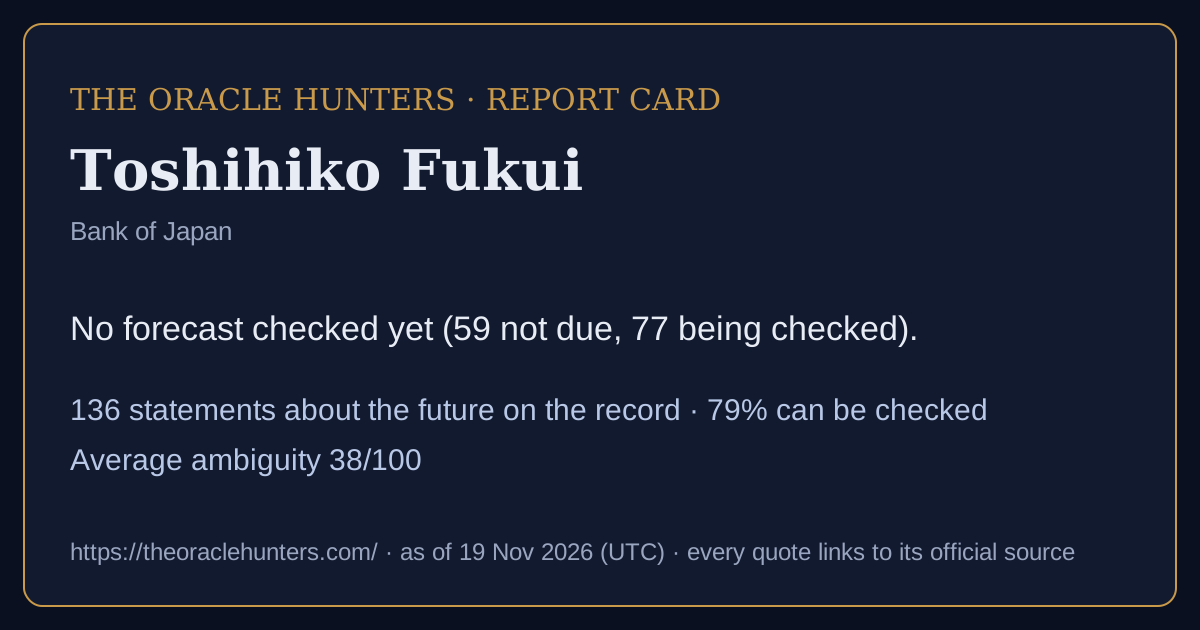
Toshihiko Fukui
Bank of Japan
Track record: No forecast checked yet (59 not due, 77 being checked).
136forecasts & commitments on the record
79%can be checked as stated
38average ambiguity (0-100)
0goalpost moves recorded
0confirmed U-turns
Timeline
came true partly did not not due / being checked / too vague
Calibration score: shown after 10 checked forecasts with a stated likelihood (now 0).
How they speak about the future: based on data 99, educated guess 21, stated on authority 16.
Kinds of claim: forecast 92, scenario (if… then) 21, mixed claim 14, commitment 9. · Download this report card as a picture
In the nine words
πρόγνωσιςInference from evidence93 · 68%πρόνοιαPreparing for the future21 · 15%προαναγγελίαPublic pre-announcement9 · 7%μαντείαInspired knowledge8 · 6%εἰκασίαConjecture3 · 2%πρόβλεψιςSeeing the signs1 · 1%φρόνησιςPractical wisdom1 · 1%
How to read this
Each box is one sentence a public figure or institution said about the future, word for word, with a link to the official text. Can be checked means it names what will happen, by when, and how likely - so it can be compared with official figures later. Too vague to check means it does not. Ambiguity (0-100) is how many different ways the sentence can be read. When the date passes, the forecast is compared with official data and marked came true, partly or did not come true. Labels judge the sentence, never the person. Full guide and glossary.On the record (136)
Higher inflation alone will not produce the desired effect if the real growth rate does not rise.
We will continue to carefully assess the levels of uncertainty associated with the projected future paths of the economy and prices and to remain attentive to both upside and downside risks, thereby ensuring the appropriate conduct of monetary policy.
The Bank will continue to conduct appropriate monetary policy while confirming that Japan's economy remains likely to follow a path of sustainable growth under price stability by monitoring economic activity and prices as well as the situation of financial markets at home and abroad and thoroughly assessing relevant upside and downside risk factors.
If downside risks related to the U.S. and European economies were to materialize and have significant adverse effects, growth in other parts of the world may be hampered and this could cause global economic growth to be weaker than expected.
Given this, the year-on-year rate of change in the CPI (excluding fresh food) is likely to be around 0 percent in the short run, but is expected gradually to rise in the longer run.
In terms of the rate of real GDP growth, we projected that this is likely to register around 2 percent on average, somewhat higher than the potential growth rate.
That means that net asset profitability was only around 0.3%, and it could only remain positive if the credit cost was kept exceptionally low, for example, due to the reversals of allowances for loan losses.
If expectations take hold that a low interest rate environment will continue indefinitely, the rate for discounting expected future returns in the determination of asset prices will be likely to decline, bringing about a rise in asset prices.
World GDP growth is likely to register around 5 percent this year, close to what we have been observing since 2003.
The year-on-year rate of change in the CPI (excluding fresh food) is likely to be around 0 percent in the short run, but is expected gradually to rise in the longer run.
With these understandings, the year-on-year rate of change in the CPI (excluding fresh food) is likely to be around 0 percent in the short run, but is expected gradually to rise in the longer run.
In sum, under the first perspective, we are of the view that, through fiscal 2008, Japan's economy is likely to realize sustainable growth under price stability.
On the other hand, if the economy continues to grow at a pace exceeding its potential through fiscal 2008, it is likely that the utilization of resources such as labor and production capacity will rise further and the output gap will show further tightening of supply and demand conditions.
The rate of increase is projected to be around 0 percent in fiscal 2007 and around 0.5 percent in fiscal 2008.
In the Outlook for Economic Activity and Prices (hereafter the Outlook Report), released at the end of last month, we have provided an outlook that, toward fiscal 2008, our economy will grow, under stable prices, at an average pace of around 2 percent, which is somewhat above its potential growth rate.
If domestic markets and institutions are not flexible enough to facilitate reallocation of labor and financial resources from unproductive sectors to productive sectors smoothly, the cost might appear in the form of stagnant growth and unemployment.
Through fiscal 2008, the economy, as I said earlier, is likely to continue its sustained expansion with a virtuous circle of production, income, and spending in place.
From the first perspective, we examine the prospects for economic activity and prices for one to two years ahead - this time, through fiscal 2008 - and assess whether the most likely outlook is for the economy to follow a path of sustained growth under price stability.
On the other hand, if the economy continues to grow at a pace exceeding the potential through fiscal 2008, it is likely that the rate of utilization of resources such as production capacity and labor will rise further and the output gap will show further tightening of supply and demand conditions.
In the latest Outlook Report, which was released at the end of April, the Bank projected that from fiscal 2007 through fiscal 2008, the economy is likely to continue its sustained expansion, growing at a rate slightly above its potential.
The year-on-year rate of increase in the CPI is expected to be slightly above 0 percent in fiscal 2007 and around 0.5 percent in fiscal 2008.
From fiscal 2007 through fiscal 2008, Japan's economy is likely to continue its sustained growth of around 2 percent, somewhat above its potential.
It is a generally accepted view that the global economy will continue to expand in 2007, at around the same pace as in 2006, across a broader range of regions.
According to the International Monetary Fund (IMF), the global economy is likely to register growth of around 5 percent in 2006 for the third consecutive year.
Japan's economy is expected to continue its expansion through fiscal 2007 with gradual rises in the rate of increase in the CPI.
Given these developments, our main scenario is that the global economy as a whole will likely keep expanding through 2007, with possible slowing growth in the U.S. economy being offset by high growth in other regions.
If the number of employees keeps increasing in line with the continuing economic expansion, a further tightening of labor market conditions will become inevitable.
In Germany, fullscale fiscal consolidation has started; for example, the value-added tax rate will be raised from January 1, 2007, and such measures may place downward pressure on the economy in the short term.
That is, from the second half of fiscal 2006 through fiscal 2007, the economy is likely to experience a sustained period of expansion, with domestic and external demand increasing and the positive influence of the strength in the corporate sector feeding through into the household sector.
In the April Outlook Report, the Bank presented the projection that, from fiscal 2006 through fiscal 2007, Japan's economy was likely to experience a sustained period of expansion, with the positive influence of the strength in the corporate sector feeding through into the household sector and the corporate and household sectors well in balance.
The global economy is expected to continue expanding at around the same pace, at 5.1 percent in 2006 and 4.9 percent in 2007.
The year-on-year increase in the consumer price index (CPI; excluding fresh food, on a nationwide basis) is likely to gradually rise from the 0.0-0.5 percent range in fiscal 2006 to around 0.5 percent in fiscal 2007.
As a result, the economic growth rate is likely to slow gradually from around 2.5 percent for fiscal 2006 to around 2 percent for fiscal 2007, approaching the potential growth rate.
If the economy develops in line with the projection, changing the policy interest rate in the light of developments in economic activity and prices will stave off an excess of economic activity, minimize the volatility of business cycles, and lead the economy onto a sustainable growth path.
Recently released statistics show that the year-on-year rate of increase in domestic corporate goods prices was 3.3 percent in May, faster than the 2.5 percent increase in April.
As for economic activity in fiscal 2005, which is the basis of the projection for fiscal 2006 and 2007, it was confirmed that the economy had continued to grow with balanced external demand and domestic demand particularly in the private sector.
The world economy has been expanding steadily since 2003, recording a growth rate of around 5 percent in 2005, and is projected to maintain high growth into the future.
Through fiscal 2007, unit labor costs are likely to show smaller declines, and to start increasing slightly at some point.
As I have already explained, the output gap has closed, and as the economy is likely to continue expanding at a pace above its potential through fiscal 2007, the output gap is likely to become positive and then to widen moderately.
The Bank of Japan projected in its Outlook for Economic Activity and Prices (hereafter the Outlook Report) released on April 28, 2006 that from fiscal 2006 through fiscal 2007 the economy was likely to experience a sustained period of expansion, with domestic and external demand and also the corporate and household sectors well in balance.
As for the year-on-year rate of change in the consumer price index (CPI; excluding fresh food), which has been positive since November 2005, we estimate that this will gradually rise to around the middle of the range between zero and 1 percent in fiscal 2006 and to slightly below 1 percent in fiscal 2007.
The forecast is around 2.5 percent for fiscal 2006 and around 2 percent for fiscal 2007.
In this process, if the risk I have described remains muted, in other words, if it is judged that inflationary pressures are restrained as the economy follows a balanced and sustainable growth path, an accommodative monetary environment ensuing from very low interest rates will probably be maintained for some time.
If the stimulus becomes too strong, there is a risk that, even if current prices are stable, investment activity could become excessive, resulting in volatile economic fluctuations.
This means that the uncollateralized overnight call rate, which will be effectively zero percent in accordance with the new guideline for money market operations, will basically not exceed this ceiling of 0.1 percent even if it surges temporarily.
Although the level of interest rates depends on developments in economic activity and prices as well as in financial markets, if it is judged that inflationary pressures are restrained as the economy follows a balanced and sustainable growth path, then the accommodative monetary environment ensuing from very low interest rates will probably be maintained for some time.
Some might question why the Bank should terminate the quantitative easing policy if the policy effects are equivalent to those of an interest rate policy targeting a short-term interest rate of zero percent.
As for the outlook, the economy is likely to experience a relatively long period of growth, albeit at a moderate pace, and the Bank will continue its close monitoring of developments.
If crude oil prices rise further due to supply-side constraints, the global economy will be affected by a decline in real purchasing power in non-oil-producing countries, or by rising concerns over increasing inflationary pressures worldwide.
Focusing on the near future, as the baby-boomers reach retirement age between 2007 and 2009, the trend of a decreasing labor force population may accelerate.
Showing the newest 50 - the ledger has all 136.
Also said - not checkable as stated (12 newest)
Remarks about the future with no date, figure or likelihood that could be checked. They are kept on the record and shown here, but not scored.
I am convinced that we will be seeing more in the near future.
I believe that the growth of Islamic finance will also contribute to resolving these problems.
Islamic finance is making impressive growth and is expected to continue to do so in the years ahead.
The Bank of Japan will closely follow developments in the Islamic finance industry through its IFSB observer membership status.
The credit for this must go to the leadership of Governor Zeti, who has adopted a variety of policy measures to make Malaysia an Islamic financial center.
The risk should, however, be borne in mind that, if the negative effects from the housing market correction or financial market developments are greater than expected, the U.S. economy may slow further through negative wealth effects, credit tightening, and deterioration in business and consumer sentiment.
We must think how this could be achieved under market mechanisms and how externalities, such as the global-scale environmental problem posed by CO2 emissions, could be addressed.
We must be attentive to factors likely to affect the economy and prices in the long run, such as developments in asset prices as well as the financial market situation and state of the financial system.
To achieve long-run economic and price stability, therefore, we need to be constantly vigilant concerning risk factors such as bubbles or financial system disruptions that cause large losses when they materialize, even though the probability of such materialization may be low.
Therefore, Japan's economy is expected to continue expanding moderately, although for the time being the pace of growth is likely to slow in a situation where housing investment is likely to remain sluggish.
As for the outlook, it is projected to follow a positive trend due to the rise in prices of petroleum products and food products in the short run and the positive output gap in the longer run.
Looking ahead, however, as economic growth is expected to continue at a rate somewhat higher than the potential growth rate, the level of utilization of resources, namely in labor and production capacity, should rise further, and unit labor costs (labor costs per unit of output) are likely to stop falling.