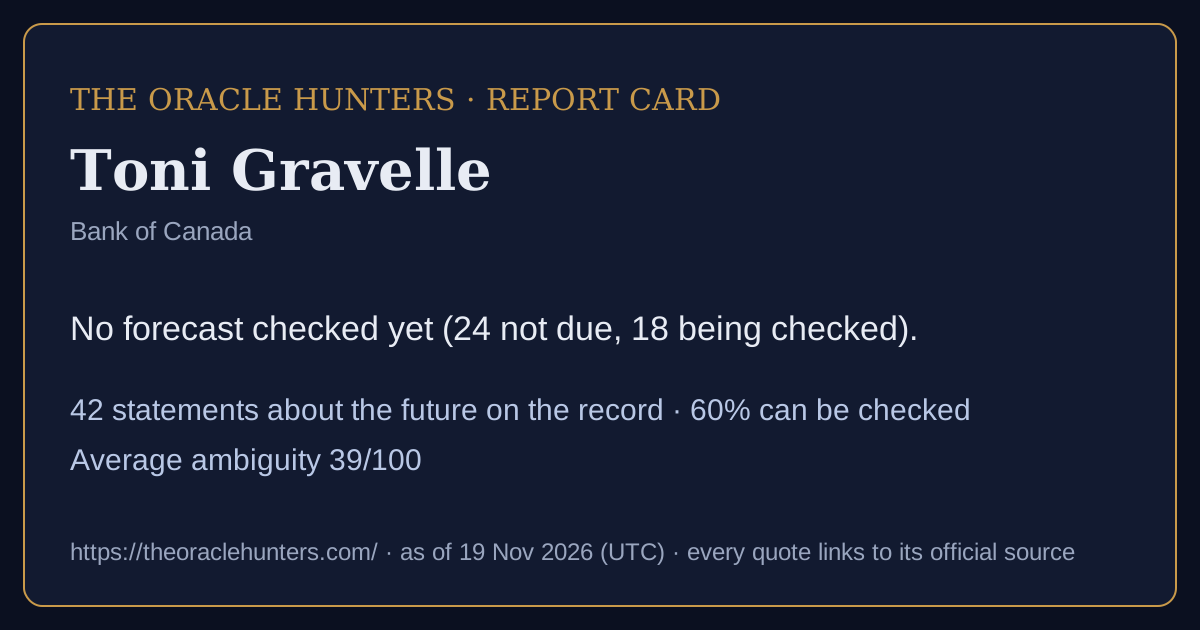
Toni Gravelle
Bank of Canada
Track record: No forecast checked yet (24 not due, 18 being checked).
42forecasts & commitments on the record
60%can be checked as stated
39average ambiguity (0-100)
0goalpost moves recorded
0confirmed U-turns
Timeline
came true partly did not not due / being checked / too vague
Calibration score: shown after 10 checked forecasts with a stated likelihood (now 0).
How they speak about the future: based on data 28, stated on authority 12, educated guess 2.
Kinds of claim: forecast 27, commitment 7, mixed claim 6, scenario (if… then) 2. · Download this report card as a picture
In the nine words
πρόγνωσιςInference from evidence27 · 64%προαναγγελίαPublic pre-announcement7 · 17%μαντείαInspired knowledge6 · 14%πρόνοιαPreparing for the future2 · 5%
How to read this
Each box is one sentence a public figure or institution said about the future, word for word, with a link to the official text. Can be checked means it names what will happen, by when, and how likely - so it can be compared with official figures later. Too vague to check means it does not. Ambiguity (0-100) is how many different ways the sentence can be read. When the date passes, the forecast is compared with official data and marked came true, partly or did not come true. Labels judge the sentence, never the person. Full guide and glossary.On the record (42)
We expect them to resume in the fourth quarter of this year, initially with relatively small amounts through each bi-weekly GoC debt auction.
Going forward, we will hold not only GoC bonds but also GoC treasury bills (t-bills) and term repos, just as we did before the pandemic.
The forecast assumes a constant level of RG cash balances after fiscal year-end 2024-25.
- see Forecast level of settlement balances until fiscal year-end 2024-25
We will announce the end of QT in the first half of this year, and we will re-start business-as-usual asset purchases after it ends.
Once we resume purchasing assets to offset the growth of currency in circulation, we will aim to manage our balance sheet in a way that keeps settlement balances in the range of $50 billion to $70 billion.
We have also said that balance sheet normalization will likely continue once inflation is on a sustainable path to 2% and we have started cutting our policy rate.
As our pandemic-related asset purchases continue to roll off our balance sheet and settlement balances continue to fall, we expect settlement balances to land in a range of $20 billion to $60 billion.
To settle this transaction, the first bank will transfer $1 million of settlement balances from its account to the second bank's account.
GoC bonds will still be our biggest asset type and we will also hold GoC t-bills and term repos, just like before the pandemic.
Before | conclude, | want to explain how we will manage the balance sheet once we're back to normal and routinely buying assets to offset the autonomous growth of our liabilities.
Our assessment is that the surge in demand for repo funding in Canada came from growing market expectations that interest rates are going to fall.'° Late in 2023, market participants around the world became increasingly convinced that major central banks would pivot to aggressive policy rate cuts this year.
10 For example, the Federal Reserve Bank of Dallas forecasts that rent inflation (including owners' equivalent rent) will fall to 5.7% in the first quarter of 2024.
Yesterday the Bank of Canada announced that we will hold the policy interest rate at 5%. | will expand a bit on our discussion and the thinking behind our decision.
As for the question of when QT will end, this will likely occur sometime around the end of 2024 or the first half of 2025.
We continue to expect consumer price index (CPI) inflation to come down in the months ahead, but we will need to see further slowing in core inflation to get CPI inflation back to the 2% target.
And we are committed to bringing inflation back to target, using higher interest rates and communicating clearly along the way.
Commodity prices could start to decline, especially if the war in Ukraine is resolved.
First, what might lead us to pause our policy rate increases as the rate enters our estimated range for neutral of 2% to 3%?
And we expect growth around 5% in the first half of 2022.
We said in April that we expect inflation to average almost 6% in the first half of 2022 before easing to about 2½% in the second half of 2023 and returning to the 2% target in 2024 .
If supply disruptions and related cost pressures persist for longer than expected and strong goods demand continues, this would increase the likelihood of inflation remaining above our control range.
Third-quarter GDP data showed impressive consumption-led growth of 5.4 percent-in line with our October forecast.
These businesses also expected the disruptions to persist into the second half of 2022.
While we expect inflation to ease in the second half of next year, we are closely watching inflation expectations and labour costs to ensure that the forces pushing up prices do not become embedded in ongoing inflation.
Our current view remains that we should see elevated inflation subside in the second half of next year.
As it does, the Bank's balance sheet-after being relatively stable since July-will decline to about $475 billion, about $100 billion smaller than its current level.
They ensured that the impact of our very low policy interest rate-which has been at 0.25 percent since late last March-could be felt in all corners of the economy and that credit could keep flowing to Canadians to set the stage for recovery.
In addition, three asset purchase programs-for commercial paper, provincial bonds and corporate bonds-will not be extended beyond their upcoming planned one-year end dates.
As part of this journey, we will be mindful of the possibility that our stimulative monetary policy-while essential to achieving our inflation objective-could increase financial vulnerabilities.
By the end of April 2021, though, GoC bond holdings are expected to be the largest piece of the balance sheet by far-at roughly $350 billion, or more than 70 percent of total assets.
Meanwhile, a decision on the policy rate is linked to the economic outcomes described in our forward guidance-which says that we will leave the policy rate at 0.25 percent until economic slack is absorbed so that the 2 percent inflation target is sustainably achieved.
Both markets are working well now, but the feedback will help us prepare for any future episodes of stress-just as lessons we learned a decade ago helped us earlier this year.
In the months ahead, leading up to our 2021 FSR, Bank staff will continue to research the data on deferrals to see whether debt repayment is proving difficult for households.
The recent extension of these subsidies into 2021 will continue to help businesses-and their employees-hurt by the pandemic.
And plenty of construction was underway in Toronto before the pandemic, so thousands of units will hit the market in 2021.
Many mortgage deferrals ended only in October, so we may not have a full picture of how many homeowners have fallen behind on those payments until the end of the year or early 2021. 4
For the second quarter, we are expecting the level of output to be a further 10 to 20 percent lower.
By comparison, only 15 percent of Canadians who lost their job during the global financial crisis said they expected to return to the same one.
However, the last Labour Force Survey from Statistics Canada shows that 43 percent of people who have lost their job since February said they expected to return to it.
We will be paying close attention to how the pandemic is affecting growth and demand in key markets for Canadian exports.
We are buying at least $5 billion of securities per week, and we will continue to do so until the economic recovery is well underway.
Also said - not checkable as stated (12 newest)
Remarks about the future with no date, figure or likelihood that could be checked. They are kept on the record and shown here, but not scored.
Canada has had the fastest growing population in the G7 every year since 2016. | probably don't need to tell you that newcomers are driving most of this population growth.
Then | will dive into recent shifts in Canada's population growth, focusing in on how newcomers contribute to our economy.
The recent increase in newcomers has coincided with those material supply issues, raising questions about how chronic housing challenges might limit Canada's future growth and what the implications are for inflation.
However, shelter price inflation has picked up. | will come back to this later.
If a similar situation were to arise in Canada, the CTRF could serve to reduce the need for the Bank to conduct outright bond purchases because pension funds would have access to the liquidity they need to meet margin calls.
First, we will be offering extraordinary liquidity like we did in the pandemic only in extreme market-wide situations, when the entire financial system faces funding constraints.
In future times of crisis, we will avoid this issue by clearly distinguishing between asset purchases for market functioning and those for monetary policy.
In this type of exceptional circumstance, we may need to use our extended tool kit to provide additional monetary policy stimulus.
Or put another way, it has allowed workers to bargain for and-expect-wage gains that recognize their skills and experience, not the need to compensate for the erosion of purchasing power.
However, we will conduct a full assessment of this risk in January when we update our projection for the economy and inflation.
We will update these over the coming months as we monitor these dynamics.
It's vitally important that Government of Canada debt markets are in tip-top shape, so when the Bank takes policy actions-like raising or lowering our policy interest rate-these actions will transmit through the economy and we will be better able to achieve our inflation target.