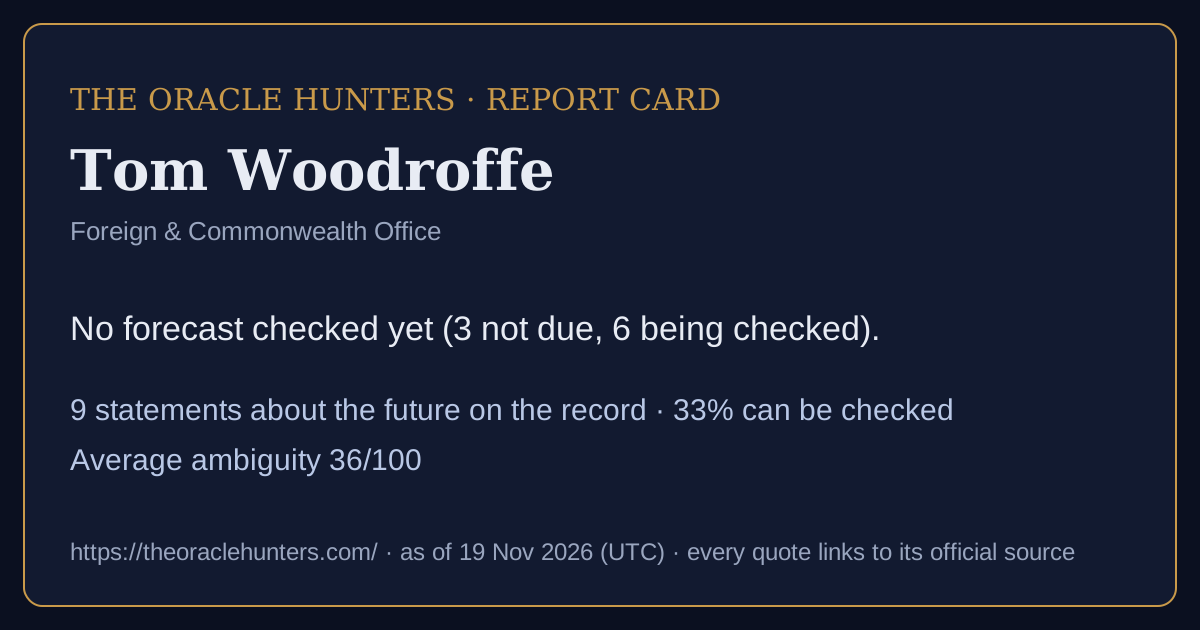
Tom Woodroffe
Foreign & Commonwealth Office · GBR
Track record: No forecast checked yet (3 not due, 6 being checked).
9forecasts & commitments on the record
33%can be checked as stated
36average ambiguity (0-100)
0goalpost moves recorded
0confirmed U-turns
Timeline
came true partly did not not due / being checked / too vague
Calibration score: shown after 10 checked forecasts with a stated likelihood (now 0).
How they speak about the future: based on data 7, stated on authority 2.
Kinds of claim: forecast 6, mixed claim 3. · Download this report card as a picture
In the nine words
How to read this
Each box is one sentence a public figure or institution said about the future, word for word, with a link to the official text. Can be checked means it names what will happen, by when, and how likely - so it can be compared with official figures later. Too vague to check means it does not. Ambiguity (0-100) is how many different ways the sentence can be read. When the date passes, the forecast is compared with official data and marked came true, partly or did not come true. Labels judge the sentence, never the person. Full guide and glossary.On the record (9)
And finally, Mr. President, next year’s High-Level Meeting on Anti-Microbial Resistance will be a landmark opportunity to tackle AMR on a truly global scale.
And while TB still kills more people than any other infectious disease, we welcome the commitment to redouble efforts to get back on track to end TB by 2030, which will also help us in the fight against Anti-Microbial Resistance.
It will be critical for us to build on our 2050 agreements as we go into the second committee this year, CSW and ICPD30 next year, the proposed social summit, and indeed the Summit of the Future, in order to be sure we really do leave no one behind.
We will press the World Bank to deliver swiftly on its plans to strengthen fragile economies by distributing $170 billion over the next 15 months.
We will support the most vulnerable countries with over $3.5 billion of humanitarian aid over the next three years.
The planned leaders meeting ahead of the 2023 global stocktake, named in both Our Common Agenda and the Glasgow Climate Pact, will be a critical moment between COP27 and COP28 for leaders to assess their commitments and take the necessary steps to close the 2030 ambition gap.
With that in mind, later this year the UK will invite representatives of SIDS, donor countries, international financial institutions and civil and private sector partners to discuss solutions to the concessional and private finance challenges facing SIDS, as described so eloquently and clearly by the distinguished Minister of Fiji at the start of today’s discussion.
In 2020, nearly 168 million people in 53 countries – and that is one in only 45 people in the world – will need humanitarian assistance and protection.
In 2020, we will all need to do more to face the scale and severity of the challenge ahead.
Also said - not checkable as stated (12 newest)
Remarks about the future with no date, figure or likelihood that could be checked. They are kept on the record and shown here, but not scored.
And we urge all parties to allow for humanitarian pauses, which would ensure safe aid delivery and critical repairs to key infrastructure including water and electricity.
We urge the opening of other border crossings, such as Kerem Shalom, as well as increased access through existing commercial routes such as Port Said, to enable more humanitarian aid to reach civilians in need.
President, we share the SRSG’s concerns about the Kurdistan region, and we urge the Kurdistan Regional Government to take all necessary steps to ensure that the planned elections take place on 25 February 2024 next year without further postponement.
Progress here will bolster Iraq’s security and we stand ready to support.
Noting Iraq’s recent request, we will work closely with the Government of Iraq, the UN and this Council to improve evidence sharing arrangements in accordance with UNITAD’s Terms of Reference, as well as options for the future of UNITAD’s work.
This funding will contribute to strengthening health systems; boosting collaboration on research and development; improving coordination across human, animal and environmental health sectors; and improving access to safe and effective vaccines, medicines and tests.
Despite that, we hope that these declarations will act as a platform from which we can all move forward with renewed ambition, cooperation and partnership to achieve health and well-being for all.
We must reform the international financial system to release more finance for health systems and pandemic preparedness in developing countries, including through greater investments in the Pandemic Fund.
However, domestic public resources must be the primary source for stronger health systems, alongside enhanced international support.
We must also ensure that this is invested in areas which will accelerate progress across all the goals, such as gender equality, science and data, education, health, food security, and renewable energy.
We must rapidly cut emissions, decarbonise, and transition to renewable energy to keep 1.5 degrees in reach.
As we look ahead to ICPD at 30, the UK will continue to listen to and amplify the voices of women, adolescents, and girls and those most marginalised and to empower them as decision-makers, advocates, and leaders to make informed choices – their choices - over their lives and bodies, free of coercion, discrimination and violence.