Tom Alweendo
Bank of Namibia
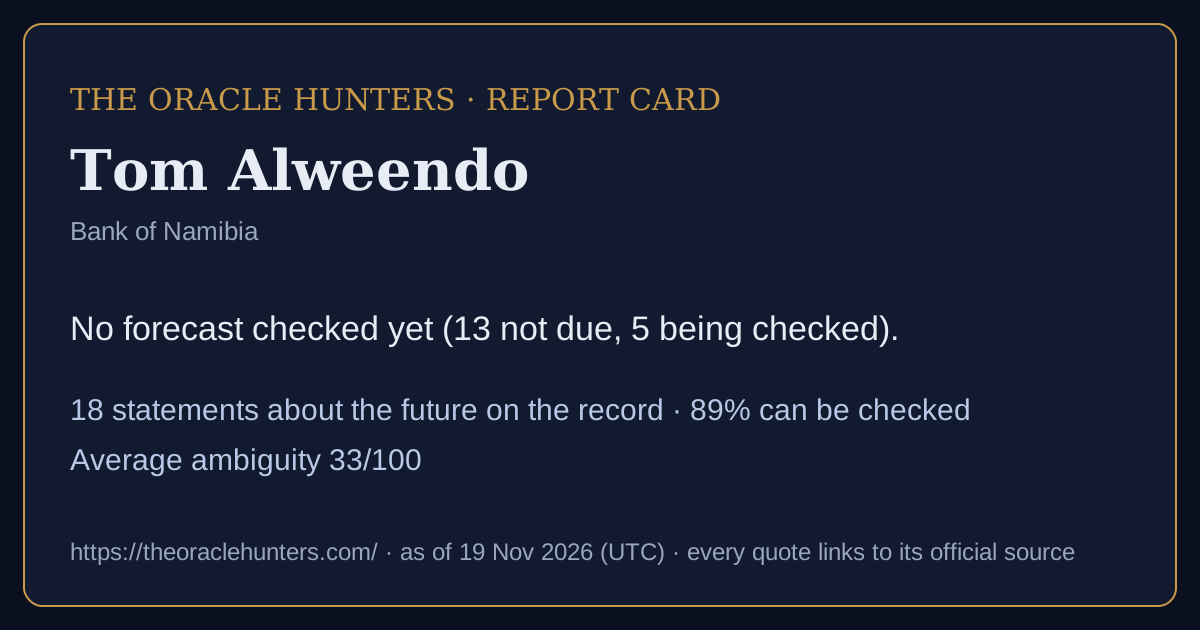
Track record: No forecast checked yet (13 not due, 5 being checked).
18forecasts & commitments on the record
89%can be checked as stated
33average ambiguity (0-100)
0goalpost moves recorded
0confirmed U-turns
Timeline
came true partly did not not due / being checked / too vague
Calibration score: shown after 10 checked forecasts with a stated likelihood (now 0).
How they speak about the future: based on data 14, educated guess 2, stated on authority 2.
Kinds of claim: forecast 11, mixed claim 4, commitment 2, scenario (if… then) 1. · Download this report card as a picture
In the nine words
πρόγνωσιςInference from evidence14 · 78%προαναγγελίαPublic pre-announcement2 · 11%πρόνοιαPreparing for the future1 · 6%εἰκασίαConjecture1 · 6%
How to read this
Each box is one sentence a public figure or institution said about the future, word for word, with a link to the official text. Can be checked means it names what will happen, by when, and how likely - so it can be compared with official figures later. Too vague to check means it does not. Ambiguity (0-100) is how many different ways the sentence can be read. When the date passes, the forecast is compared with official data and marked came true, partly or did not come true. Labels judge the sentence, never the person. Full guide and glossary.On the record (18)
If we do this in a correct manner, the economy could grow at close to 7 percent per annum, which is more in line with what is required to meet Vision 2030.
We again project that if we continue with the same strategies, by 2030 the unemployment figure will be much higher than the current level.
At the current growth rate, we project that by 2030, our per capita income will be US$10,000.
Consequently, the economy is expected to contract by about 1.1 percent in 2009, while a moderate recovery is envisaged for 2010.
Our 20th anniversary as a sovereign nation is also symbolic in the sense that we will be exactly 20 years away from the target date of Vision 2030.
In sub-Saharan Africa, for example, economic growth is projected to minimally slow from 6.9 percent in 2007 to 6.3 percent in 2008.
Depending on how long it may last, there is a greater risk that the crisis will spill-over to developing economies and that we will see further tightening in the commodity markets that will pose risks to growth in many commodity-exporting developing countries.
For example, global economic growth is projected to decline this year and during 2009, potentially aggravating the financial crisis and thereby the loss of confidence in the financial markets.
If the continent is able to sustain these growth rates at this level, we might see a difference in the high incidence of poverty on the continent.
The AACB has suggested a tentative work program that will see the African Central Bank being established by the year 2021.
of employment and economic growth is expected to grow further as its contribution to investment increased from 5.1 per cent in 2002 to 8.5 per cent in 2003.
Using the past average growth in the economically active population of 2.4% gives rise to a figure of 751,000 people that will be economically active at the end of the tenth year.
Assuming unchanged productivity growth rates in both the primary and non-primary sectors, total employment has been projected to grow by 2.7% on average to a level of about 500,000 people at the end of the tenth year period.
Unfortunately, the near-term prospects for economic growth are not very bright, as GDP growth for the present year will not be significantly different from last year's rate of about 3%.
Let us all, individuals and institutions, take personal responsibilities and accept the challenge to promote economic growth, lest we will continue to be marginalised economically.
For the ensuing five years beyond 2005, growth is expected to fall to an average of around 4%.
Economic prospects for the next five years are particularly positive as GDP is projected to grow on average at a rate slightly below 5% per year between 2001 and 2005.
If it is the case that stable prices can help to generate a faster trend rate of economic growth, whatever short run costs a country may initially incur in attaining the objectives of price stability, would have to be balanced against the long run benefits of economic growth.
Also said - not checkable as stated (12 newest)
Remarks about the future with no date, figure or likelihood that could be checked. They are kept on the record and shown here, but not scored.
In carrying out our responsibilities, we will always do so in the best interest of Namibia.
Another consequence of money laundering on a grand scale is that it may erode the effectiveness and management of monetary policy, because of its potential of changing the demand for cash in the economy.
We must, however, be aware that there are economies that are less market-oriented than others, where the behaviour of economic actors may be less sensitive to the price of money and where bottom-line considerations may not be of prime importance in business decisions.
You may also need to have an operational target, which is an economic variable that the central bank wants to influence on a day-to-day basis, through its monetary policy instruments.
As you read, please remember that our doors at Bank of Namibia are open, should you want to engage us on certain issues that may be of interest to you.
What we forget is that expertise comes with practice and if we fail to practice what we have learned, we will never become experts at anything.
While I firmly believe that a nation without culture and tradition will be a lost nation, we should also recognize the fact that all cultures do evolve.
Africa will then need to scale up its investment in the agriculture sector.
Speech by Mr Tom K Alweendo, Governor of the Bank of Namibia, at the Annual Dr. Sam Nujoma Public Lecture Series, Windhoek, 22 May 2007.
Not only is education important for economic growth, it is probably the most basic necessity after those that are vital to life itself, such as food, clothing and shelter.
It will take some time for Africa to build up accurate statistics on money laundering as this would have to be sourced from actual cases investigated and finalized.
In instances where banks may condone and are active parties to money laundering, the end result is that legitimate business would avoid such banks.