Timothy Lane
Bank of Canada
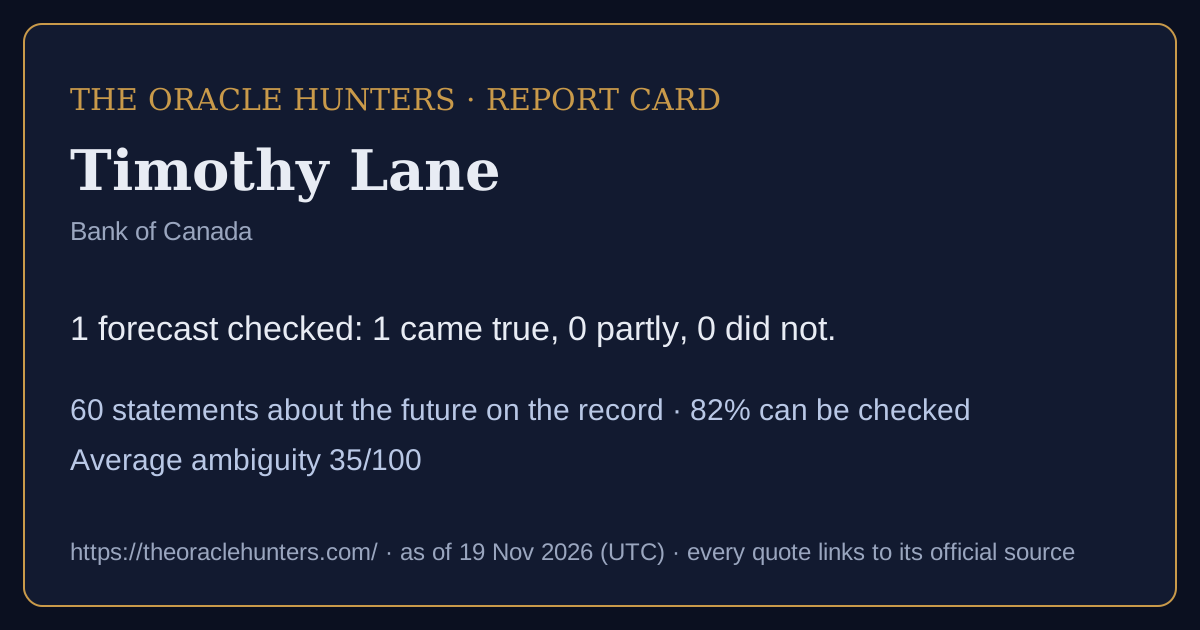
Track record: 1 forecast checked: 1 came true, 0 partly, 0 did not.
60forecasts & commitments on the record
82%can be checked as stated
35average ambiguity (0-100)
0goalpost moves recorded
0confirmed U-turns
Timeline
came true partly did not not due / being checked / too vague
Calibration score: shown after 10 checked forecasts with a stated likelihood (now 0).
How they speak about the future: based on data 44, stated on authority 9, educated guess 7.
Kinds of claim: forecast 44, mixed claim 6, scenario (if… then) 6, commitment 4. · Download this report card as a picture
In the nine words
πρόγνωσιςInference from evidence44 · 73%πρόνοιαPreparing for the future6 · 10%μαντείαInspired knowledge5 · 8%προαναγγελίαPublic pre-announcement4 · 7%εἰκασίαConjecture1 · 2%
How to read this
Each box is one sentence a public figure or institution said about the future, word for word, with a link to the official text. Can be checked means it names what will happen, by when, and how likely - so it can be compared with official figures later. Too vague to check means it does not. Ambiguity (0-100) is how many different ways the sentence can be read. When the date passes, the forecast is compared with official data and marked came true, partly or did not come true. Labels judge the sentence, never the person. Full guide and glossary.Checked
The Bank projects GDP growth of 3.7 per cent in 2010, with a gradual slowing to 3.1 per cent in 2011 and 1.9 per cent in 2012.
Came true. Said: economic growth around 3.1% in 2011. Official figure for Canada: 3.1% (World Bank open data). On target. Off by 0.0 points. official data · checked 14 Nov 2026 · automatic check against official data (rules v3)
On the record (60)
We can see in Chart 5 that our earlier projection showed inflation creeping up to our 2% target over three years.
That's because, if left unchecked, the pandemic forces at work on the economy in those early days could drive inflation persistently below zero, starting a deflationary spiral.
While we now expect supply disruptions to ease and inflation to come down quickly in the second half of this year, we are alert to the risk that inflation may again prove more persistent.
And it was in that spirit that we announced our decision in January, making it clear that with slack now absorbed, interest rates will need to be on a rising path to bring inflation sustainably back to the 2% target.
We expect that interest rates will need to increase, with the timing and pace of those increases guided by the Bank's commitment to achieving our 2% inflation target.
We now expect that inflation will remain close to 5% through the first half of this year.
But the new Real-Time Rail system-which will go live in 2022-will provide real-time payments beyond what is already offered through e-Transfer.
Over the next year or so, these improvements will start to come online.
In a recent survey, almost 60 percent of central banks reported the possibility that they will issue a central bank digital currency within six years.
The inflation target remains our objective, and in the period ahead we will continue to manage the risk that inflation could persistently diverge from target in either direction.
And we're not alone-a recent survey by the Bank for International Settlements covering 66 central banks found that about 80 percent of them are currently engaged in CBDC work and 10 percent are likely to issue a CBDC within three years. 6
Total consumer price index inflation was 1.9 percent in October and is expected to fluctuate around 2 percent.
We were expecting investment to decline in the second half of this year, but instead we have seen solid growth.
Economic growth in the third quarter was 1.3 percent, as projected in the October MPR.
Turning to Canada, the Bank has been forecasting slower economic growth in the second half of 2019 after a very strong second quarter.
While it has been supporting growth recently, this support is expected to wane in 2020 as consolidation in Ontario and Alberta takes hold and the recent strength in Quebec and British Columbia normalizes.
Inflation is expected to rise temporarily above 2 percent in the coming months, reflecting the impact of weak gasoline prices a year earlier.
In particular, we are assessing how we could respond if cryptoassets were to evolve in a way that undermines our ability to provide Canadians with a means of payment with stable purchasing power that they can use with confidence.
But the decline in inflation, to 1.7 per cent, was a bit less than we had anticipated, reflecting a number
Yet, even as the annual pace of growth came in at 1.7 per cent, under the 2.5 per cent pace in our projections, the underlying details suggest that the economy is progressing much as we thought it would.
That confirmation gives us greater confidence that inflation will remain sustainably near our 2 per cent target.
For example, we expected that inflation would drop temporarily below 2 per cent in January because of effects from gasoline prices a year earlier (Chart 6).
We will be providing a fuller assessment of potential growth, as well as of the neutral interest rate, in our April Monetary Policy Report.
From mid-2016 until the end of 2018, other factors mostly represent the expected impact of below-average inflation in food products, the estimated impact on electricity prices of Ontario's Fair Hydro Plan and the estimated impact of minimum wage increases.
That growth potential could be greater than we think -if businesses find new ways to engage with GVCs and develop new products and processes to make them more productive and competitive.
They will become even more so as average global temperatures continue to rise, even if action is taken now to address climate change.
I don't want to prejudge any of the specific recommendations that may end up in the final report, which is to be released later this year.
We will continue to pursue low, stable and predictable inflation amid the structural shift to a lower-carbon economy.
Thus, as the effects of the oil shock have bottomed out, the Canadian economy is expected to return to its potential around the middle of next year.
On the cost side, the same increase in the policy rate might cut output by up to 1 per cent and push inflation down by 0.5 percentage point relative to what it would have been otherwise.
On the benefits side, they estimated that increasing the Bank's policy rate by 1 percentage point for one year would reduce real household debt by 2 per cent over five years. 5 Everything else being equal, less household debt reduces the vulnerability of the economy and the financial system; the results, however, suggest that this difference may be very small.
We could see that a 60 per cent decline in the price of oil would, on balance, be bad for the Canadian economy.
Our October forecasts were for U.S. growth to average around 3 per cent over the next couple of years, and the positive oil shock adds an upside risk to our projection.
The dollar's depreciation by over 10 per cent against the U.S. dollar in the past six months will help cushion the economy from the impact of lower oil prices.
Another is the maturing growth of emerging economies such as China: it is probably impossible for China to sustain economic growth at the double-digit rates of the 2000s - although its growth rate is still expected to stabilize at an enviable annual pace of 7 per cent for the foreseeable future.
As a result, Canadian oil makes up about 40 per cent of U.S. crude oil imports, and that share is expected to grow over the years ahead (Chart 2).
Second, we will closely monitor its broader impacts on growth and the delay it may cause to the economy's return to its production potential.
We will continue to work to bring the Canadian economy back to its potential and return inflation sustainably to our 2 per cent target.
A key step in normalizing policy will be to start increasing the target for the federal funds rate, which is currently still in a range of 0 to 1/4 per cent.
Research at the Bank of Canada indicates that, on balance, the benefits will far outweigh the costs: Basel III, by improving the safety and robustness of the Canadian and international financial systems, should yield a net economic benefit to Canada equivalent to about 13 per cent of GDP in present-value terms.
The euro area, however, is still in recession, and is projected to show only a modest recovery later this year, although the risks around this projection are high.
However, economic growth is expected to gain momentum over 2013-14, as exports to advanced economies recover.
Both overall inflation and underlying inflation are expected to remain close to 2 per cent through to the end of 2014 ( Chart 9 ).
These growth rates may seem relatively modest, but over the 2012 to 2013 period, they are somewhat above the rate at which the potential of the economy is expanding, estimated at 2 per cent in 2012 and 2.1 per cent in 2013.
In addition, growth is expected to continue in the period ahead - at 2.4 per cent in 2012 and 2013, easing to 2.2 per cent in 2014.
Overall, global economic growth is now projected to moderate in 2012 to 3.2 per cent and to recover to 3.4 per cent in 2013 and 3.8 per cent in 2014.
If the surplus countries do not increase their domestic demand, the United States and other deficit countries will have trouble weaning their economies off fiscal stimulus.
In making those decisions, we will always stay focused on achieving the 2 per cent inflation target.
Inflation is expected to remain close to our 2 percent target through this period.
The Bank projects GDP growth of 3.7 per cent in 2010, with a gradual slowing to 3.1 per cent in 2011 and 1.9 per cent in 2012.
Came true. Said: economic growth around 3.1% in 2011. Official figure for Canada: 3.1% (World Bank open data). On target. Off by 0.0 points. official data · checked 14 Nov 2026 · automatic check against official data (rules v3)
Showing the newest 50 - the ledger has all 60.
Also said - not checkable as stated (12 newest)
Remarks about the future with no date, figure or likelihood that could be checked. They are kept on the record and shown here, but not scored.
By ensuring that risks are well managed, the Bank, through its new supervisory role, will support confidence in payment service providers and should further encourage competition and innovation in retail payments.
The Bank will continue to explore the possibilities of a digital currency that would be an electronic version of the bank notes that Canadians trust and rely on.
And we will push forward with work to make cross-border payments cheaper, easier and safer for people around the globe to send and receive money.
We will also likely see some further changes in consumption patterns.
While the steps we have taken should help, we are likely to emerge from the shutdown with both demand and supply weaker than before.
I'd like to take this time to discuss what has happened to the economy and financial system, outline how the Bank of Canada has responded, and explain how we are providing the foundation for the recovery that will come next.
It is also unclear how long it will take for jobs to return after containment measures are lifted.
Once businesses reopen, rehiring for these jobs may be relatively fast if not hampered by high search costs and skills mismatches.
And part of our response involves looking at whether a case could-or should-be made in the future for a digital currency issued by the Bank of Canada.
And as the world changes, the Bank will continue to fulfill its mandate to support secure, reliable and efficient payment options that benefit all Canadians.
While we don't know what the future may bring, we need to move forward to work out what a potential CBDC might look like and how it could be managed, if the decision were ever taken to issue one.
We will use this platform to share experiences as we assess potential cases for a CBDC in our home jurisdictions.