Tiff Macklem
Bank of Canada
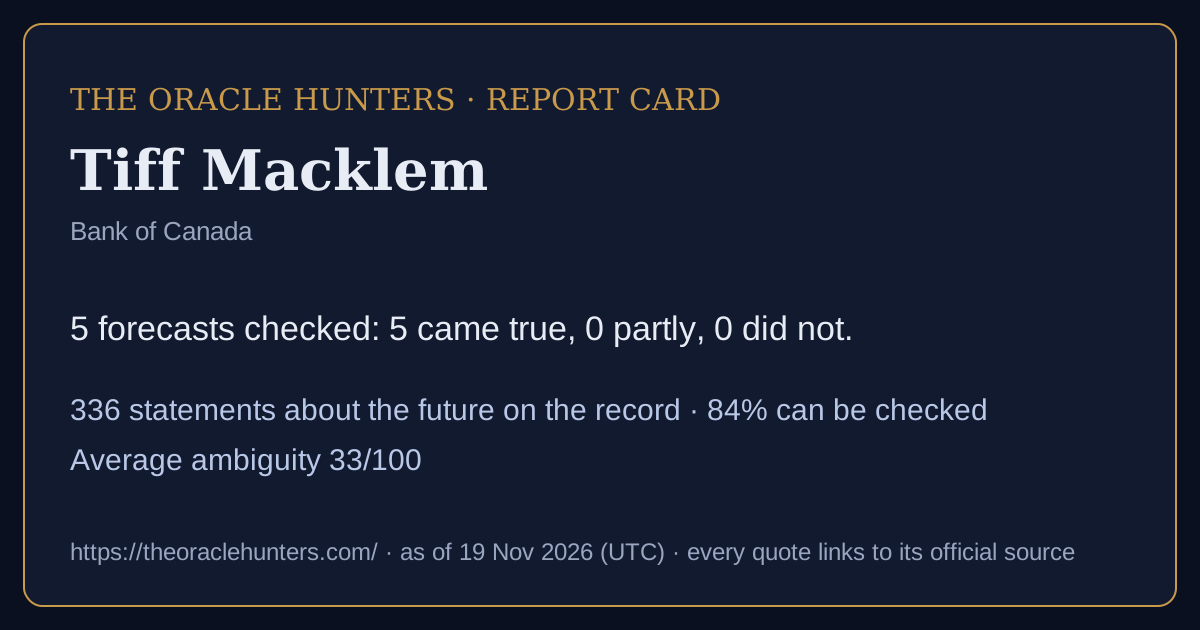
Track record: 5 forecasts checked: 5 came true, 0 partly, 0 did not.
336forecasts & commitments on the record
84%can be checked as stated
33average ambiguity (0-100)
0goalpost moves recorded
0confirmed U-turns
Timeline
came true partly did not not due / being checked / too vague
Calibration score: shown after 10 checked forecasts with a stated likelihood (now 5).
How they speak about the future: based on data 238, stated on authority 61, educated guess 37.
Kinds of claim: forecast 230, mixed claim 48, commitment 32, scenario (if… then) 26. · Download this report card as a picture
In the nine words
πρόγνωσιςInference from evidence220 · 65%μαντείαInspired knowledge43 · 13%προαναγγελίαPublic pre-announcement32 · 10%πρόνοιαPreparing for the future26 · 8%εἰκασίαConjecture12 · 4%πρόβλεψιςSeeing the signs2 · 1%φρόνησιςPractical wisdom1 · 0%
How to read this
Each box is one sentence a public figure or institution said about the future, word for word, with a link to the official text. Can be checked means it names what will happen, by when, and how likely - so it can be compared with official figures later. Too vague to check means it does not. Ambiguity (0-100) is how many different ways the sentence can be read. When the date passes, the forecast is compared with official data and marked came true, partly or did not come true. Labels judge the sentence, never the person. Full guide and glossary.Checked
Looking ahead, GDP growth is forecast to gradually strengthen to around 2% in 2025 and 2…% in 2026, supported by lower interest rates.
Came true. Said: economic growth around 2% in 2025. Official figure for Canada: 1.7% (World Bank open data). On target. Off by 0.3 points. official data · checked 14 Nov 2026 · automatic check against official data (rules v3)
Looking ahead, we expect inflation to moderate further, though progress over the next year will likely be uneven.
Came true. Said: inflation would fall in 2025. Official figures for Canada: 2.4% in 2024, 2.1% in 2025 (World Bank open data). official data · checked 14 Nov 2026 · automatic check against official data (rules v3)
Overall, we forecast GDP growth in Canada of 1.5% this year and about 2% in 2025 and 2026.
Came true. Said: economic growth around 2% in 2025. Official figure for Canada: 1.7% (World Bank open data). On target. Off by 0.3 points. official data · checked 14 Nov 2026 · automatic check against official data (rules v3)
To put this in numbers, growth in gross domestic product (GDP) is projected to decline from about 3…% this year to just under 1% next year and then rise to 2% in 2024.
Came true. Said: economic growth around 2% in 2024. Official figure for Canada: 2.0% (World Bank open data). On target. Off by 0.1 points. official data · checked 14 Nov 2026 · automatic check against official data (rules v3)
## Chart 3: Inflation projected to return to 2 per cent by end of 2015
Came true. Said: inflation at the end of the year around 2% in 2015. Official figure for Canada: 1.6% (BIS consumer prices (December, year on year)). On target. Off by 0.4 points. official data · checked 17 Nov 2026 · automatic check against official data (rules v4)
On the record (336)
While businesses have mostly absorbed higher input costs so far, past experience and Bank surveys suggest that cost pass-through will increase over the next year.
Inflation is projected to remain at or above 3% through much of 2027 before returning close to the 2% target by the middle of 2028.
Given persistently high oil prices and elevated refinery margins, CPI inflation has been around 3% since April and is expected to rise to about 3½% by year end.
Following GDP growth of 1% in 2026, the economy is projected to grow by about 2% in 2027 and 2028.
And if growth weakens once again for several quarters, economic slack will persist, making it harder for businesses to raise prices.
And if they pass them on, will those price increases spread more broadly through the economy, fuelling ongoing inflation?
If these new US tariffs remain in place, they will hit affected sectors hard.
If these new tariffs remain in place, growth could be roughly halved in the fourth quarter, to below 1%.
Higher global oil prices and a shortage of refining capacity will keep inflation elevated in the next few months, while the escalation in trade uncertainty will likely dampen growth.
As things stand now, if oil prices stay near $100 per barrel, we would expect inflation to edge up in the coming months.
If the tariffs remain in place, they will hit targeted sectors hard.
As expected, the economy strengthened in the second quarter, with GDP up by 3.3% following very weak growth in the first quarter.
With recent data coming out largely in line with our July forecast, we decided to maintain the policy interest rate at 2.25%.
Based on the MPR projection published today, Governing Council judges the current policy rate remains appropriate to sustain the economic recovery and bring inflation back to the 2% target.
If cost increases and their pass-through are larger than expected or the economy recovers faster than expected, inflationary pressures will increase.
CPI inflation rose further to 3.2% in May, mainly because of higher gasoline prices linked to the conflict in the Middle East.
As we have said before, we will not let higher oil prices become persistent inflation.
Inflation is expected to stay elevated in June then ease gradually in the coming months, returning to the 2% target in early 2027.
Following GDP growth of 0.7% in 2026, the economy is projected to grow by 1.8% in both 2027 and 2028.
Canada is not a contributor to excessive global imbalances, but we are being knocked by increased trade tensions, and we could be sideswiped if financial stability risks crystallize.
We will be watching developments closely and assessing their implications for growth and inflation.
Governing Council agreed to look through the war's immediate impact on inflation but if energy prices stay high, we will not let their effects become persistent inflation.
We will be watching all these developments closely and assessing their implications for growth and inflation.
Governing Council agreed to look through the war's near-term impact on inflation but if energy prices stay high, we will not let their effects become broad-based persistent inflation.
Based on this, we expect CPI inflation to hover close to 3% in coming months before easing gradually toward 2%.
If that happens, inflation should peak around 3% in April and ease back to the 2% target by early next year.
Based on recent market expectations, oil prices are assumed to decline from an average of about US$90 a barrel in the second quarter to about US$75 a barrel by the middle of next year.
Until the war, we expected inflation to stay close to the 2% target.
In our forecast today, the Bank projects the economy will expand 1.2% in 2026, 1.6% in 2027 and 1.7% in 2028, as growth in exports and business investment gradually resumes.
If higher oil prices are maintained, this will boost income from energy exports.
Governing Council will look through the war's immediate impact on inflation but if energy prices stay high, we will not let their effects broaden and become persistent inflation.
The recent sharp increase in global energy prices is causing higher prices at the pump, which will push up inflation in the coming months.
But if the impact of AI is less profound or more disruptive than expected, growth could slow.
The Bank of Canada's latest forecast has global growth continuing at about 3%.
The European Union is also looking to increase the share of centrally cleared repos, and the European Central Bank will centrally clear some of its operations this year.
Total CPI inflation has been close to the 2% target for more than a year now, and we expect it to remain near the target.
The reconfiguration of global trade and the restructuring of Canada's economy will likely continue to dominate the economic landscape in 2026.
Our newest bank note will be issued in early 2027.
And next year, the Bank will add two more responsibilities: regulating stablecoins and implementing consumer-driven banking.
I wish I could tell you more, but you'll have to wait for the unveiling next year.
We will work closely with the Department of Finance Canada to support the drafting of regulations next year so Canadians can use stablecoins with confidence.
Seeing through this choppiness, we expect ongoing economic slack to roughly offset cost pressures associated with the reconfiguration of trade, keeping CPI inflation close to the 2% target.
While information since the last decision has affected the near-term dynamics of GDP growth, it has not changed our view that GDP will expand at a moderate pace in 2026 and inflation will remain close to target.
We expect growth in final domestic demand to resume, but with an anticipated decline in net exports, GDP growth is likely to be weak in the fourth quarter before picking up in 2026.
We will support economic growth while ensuring inflation remains well controlled.
GDP declined by 1.6% in the second quarter, largely as expected.
Final domestic demand in Canada was soft in the first quarter, and if tariffs and uncertainty were to continue, households and businesses will likely remain cautious.
Excluding taxes, inflation was 2.3% in April, slightly stronger than the Bank had expected and up from 2.1% in March.
It's not as easy as saying a 10% tariff will increase the price of a product by 10%.
By the end of the year, employment growth was strengthening.
Showing the newest 50 - the ledger has all 336.
Also said - not checkable as stated (12 newest)
Remarks about the future with no date, figure or likelihood that could be checked. They are kept on the record and shown here, but not scored.
There could be a need to raise the policy rate further, but given the uncertainties, we will proceed carefully.
But growth should pick up again in 2027 as consumer spending continues, exports pick up and business investment strengthens, supported by fiscal measures.
We will be a source of stability as Canadians navigate shifting global developments.
But we don't expect them to have a large direct impact on the overall level of economic activity.
The added uncertainty about the future of Canada-US trade relations may lead businesses more broadly to delay investment and hiring decisions.
As the United States reduces its fiscal deficit- and its reliance on capital inflows-Europe and China will need to do their part by reducing excess savings through stronger domestic investment and consumption.
Imbalances may also be fuelling financial stability risks.
Liquidity, leverage and cross-border funding channels transmitted stress faster than trade flows ever could.
Oneway flows can fuel asset bubbles-we saw this in the run-up to the global financial crisisand we may be seeing it again with the AI boom.
As the financial system evolves away from a bank-centred and well-supervised world toward one that is faster, more opaque and more interconnected, gaps may be opening up between jurisdictions, instruments and institutions.
But, as we've seen, the war in Iran is causing oil prices to move sharply higher and this will push up inflation in the short term.
Beyond the jump in energy prices, the war in Iran will affect households and businesses in other ways.