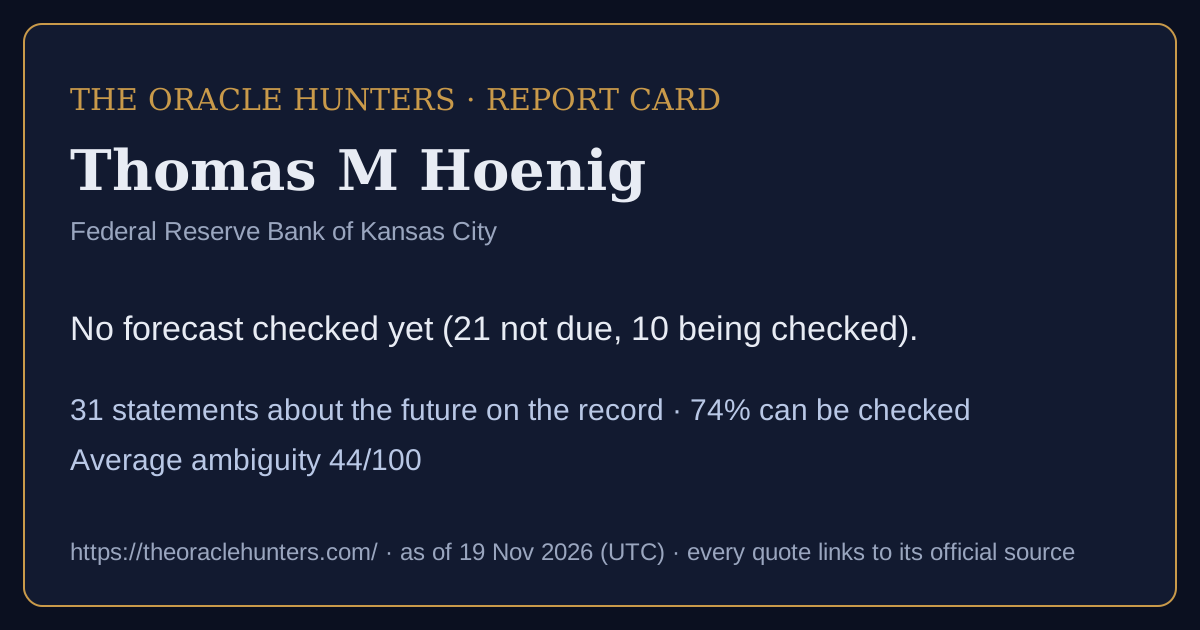
Thomas M Hoenig
Federal Reserve Bank of Kansas City
Track record: No forecast checked yet (21 not due, 10 being checked).
31forecasts & commitments on the record
74%can be checked as stated
44average ambiguity (0-100)
0goalpost moves recorded
0confirmed U-turns
Timeline
came true partly did not not due / being checked / too vague
Calibration score: shown after 10 checked forecasts with a stated likelihood (now 0).
How they speak about the future: based on data 20, educated guess 6, stated on authority 5.
Kinds of claim: forecast 21, scenario (if… then) 7, mixed claim 3. · Download this report card as a picture
In the nine words
πρόγνωσιςInference from evidence19 · 61%πρόνοιαPreparing for the future7 · 23%μαντείαInspired knowledge5 · 16%
How to read this
Each box is one sentence a public figure or institution said about the future, word for word, with a link to the official text. Can be checked means it names what will happen, by when, and how likely - so it can be compared with official figures later. Too vague to check means it does not. Ambiguity (0-100) is how many different ways the sentence can be read. When the date passes, the forecast is compared with official data and marked came true, partly or did not come true. Labels judge the sentence, never the person. Full guide and glossary.On the record (31)
If we choose to increase our savings rate, if government, labor and management see the mutual advantage of investing in and building a competitive manufacturing environment, then job growth will follow.
If current policy remains in place, we almost certainly will stimulate the growth of asset values and inflation.
If capitalization rates would rise to 10 percent as they did during the 1980s farm crisis, land values could drop by half.
Moreover, even if crop prices remain high but capitalization rates return to their historic average, farmland values could fall by as much as a third, which most certainly would erode the financial health of the farm sector.
For example, if capitalization rates return to their historical average and corn prices drop to $4 per bushel, their 2009 average, irrigated land values in eastern Nebraska could fall almost 50 percent to $2,700 per acre (Chart 4).
If interest rates would rise and lift capitalization rates to their historical average of 7.5 percent, the capitalized value of irrigated farmland in eastern Nebraska could fall by a third to $3,300 per acre (Chart 3).
Since June, grain prices have doubled, and futures markets suggest that prices could remain elevated through 2014.
Looking out a little further, economists expect global growth to exceed 4 percent well into 2012, with the developing and emerging market economies remaining in the lead.
Even so, with the number of people out of work and the growing numbers of new job entrants, it will be some time before we see the unemployment rate well below 9 percent.
That said, I expect the recovery to be moderate, with real GDP growing about 3 ½ to 4 percent a year over the next couple years.
Reserve Bank presidents vote in rotation, so I will be a participant rather than a voting member this year.
Also, the risk of further disinflation or outright deflation is small and, with an improving economy, should only decline further in the coming months.
Although creative and flexible financing might remain a goal in housing, sound lending standards cannot be ignored if we are to have sustainable housing growth.
A 1 percent federal funds rate is extremely accommodative, but from that point we could better judge the workings of the interbank and lending markets and determine the order of policy actions that would support sustained long-term growth.
It could remain where it is or inflation expectations could become unanchored and perhaps increase to 4 or 5 percent.
Third, rather than inflation rising to 2 or 3 percent, and demand rising in a systematic fashion, we have no idea at what level inflation might settle.
Some estimates suggest that purchasing $500 billion of long-term securities might reduce interest rates by as little as 10 to 25 basis points.
Expanding the balance sheet by another $500 billion to $1 trillion over the next year, and perhaps keeping the balance sheet at $3 trillion for the next several years, or increasing it even further, risks undermining the public's confidence in the Fed's commitment to long run price stability, a key element of its mandate.
The budget deficit for 2011 is expected to be about $1 trillion.
If so, the consumer will contribute to growth but is unlikely to intensify its contribution to previously unsustainable levels.
The FOMC would announce that its policy rate will move to 1 percent by a certain date, subject to current conditions.
Yet, GDP is likely to expand at somewhere around a 3 percent rate through the remainder of the year.
The recent uptick in the unemployment rate from 9.7 to 9.9 percent actually reflects an improved outlook, as workers who dropped out of the job market are gaining confidence and beginning to reenter the workforce.
Nonresidential construction will likely continue to contract this year, due to high vacancy rates in that sector.
These inflation rates are likely to continue for the next year or so.
Solid job gains in the months ahead will translate into a downward trajectory for the unemployment rate later this year and into next year.
I anticipate growth will be slower this year, coming in between 3 and 3½ percent.
Bank lending rose from 39 percent of gross domestic product (GDP) in 2004 to 47 percent by the end of 2007, and that figure excludes the rapid growth in credit from the shadow banking sector and the GSEs, Fannie Mae and Freddie Mac.
If the central bank succumbs to this pressure, its balance sheet will expand, bank reserves will grow, and inevitably the money supply will increase.
Inflation in Argentina is currently running near 8 percent and will almost certainly increase.
The CBO projects the deficit was almost 12 percent of GDP in fiscal year 2009 and will be almost 8 percent in the current fiscal year extraordinarily high levels by historical standards.
Also said - not checkable as stated (12 newest)
Remarks about the future with no date, figure or likelihood that could be checked. They are kept on the record and shown here, but not scored.
The Fed's mandate reads: 'The Board of Governors of the Federal Reserve System and the Federal Open Market Committee shall maintain long-run growth of the monetary and credit aggregates commensurate with the economy's long-run potential to increase production, so as to promote effectively the goals of maximum employment, stable prices, and moderate long-term interest rates.'
This will allow the market to begin to read credit conditions and allocate resources according to their best use rather than in response to artificial incentives.
If zero interest rates could accomplish this goal, then I would support interest rates at zero.
It is not the Federal Reserve's job to pave the yield curve with guaranteed returns for any sector of the economy, and we should not be guaranteeing a return for Wall Street or any special interest groups.
When - not if - the adjustment occurs, we will see a dramatic drop in values.
The longer we leave interest rates at zero, the more asset values will be defined by these low rates and the greater the negative impact will be once the inevitable move up in rates begins.
Without a dramatic change, the deficit and the debt will only become more daunting with the rising cost of entitlement programs and likely higher interest rates.
As the U.S. economy shifts gears to shrink its trade imbalances, many parts of the country will have a role to play.
Rebalancing our economy and improving our trade position is a necessary development, but unfortunately, it will take time.
In achieving such goals, we will enhance the stability of the fundamental mechanism through which monetary policy is conducted and the economy depends.
Finally, following a series of crises during the late 1980s and 1990s, the government confirmed that because of systemic impact, some institutions were just too big to fail - the largest institutions could put money in nearly any asset regardless of risk, and their creditors would not be held accountable for the risk taken.
A legitimate concern of limiting the safety net is that this could worsen the risk of financial instability by pushing activities to the unregulated shadow banking system.