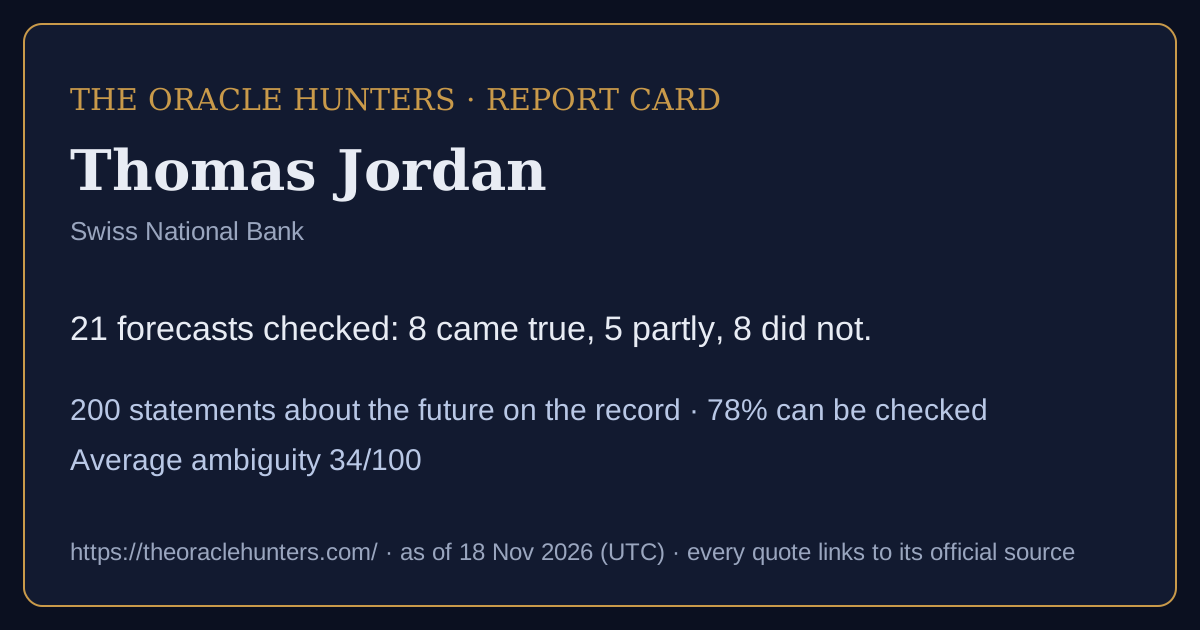
Thomas Jordan
Swiss National Bank
Track record: 21 forecasts checked: 8 came true, 5 partly, 8 did not.
200forecasts & commitments on the record
78%can be checked as stated
34average ambiguity (0-100)
0goalpost moves recorded
0confirmed U-turns
Timeline
came true partly did not not due / being checked / too vague
Calibration (Brier score, 0 is perfect, 0.25 is a coin toss): 0.237 over 18 checked forecasts.
How they speak about the future: based on data 165, educated guess 22, stated on authority 13.
Kinds of claim: forecast 164, scenario (if… then) 20, mixed claim 16. · Download this report card as a picture
In the nine words
πρόγνωσιςInference from evidence162 · 81%πρόνοιαPreparing for the future19 · 10%μαντείαInspired knowledge13 · 6%εἰκασίαConjecture5 · 2%φρόνησιςPractical wisdom1 · 0%
How to read this
Each box is one sentence a public figure or institution said about the future, word for word, with a link to the official text. Can be checked means it names what will happen, by when, and how likely - so it can be compared with official figures later. Too vague to check means it does not. Ambiguity (0-100) is how many different ways the sentence can be read. When the date passes, the forecast is compared with official data and marked came true, partly or did not come true. Labels judge the sentence, never the person. Full guide and glossary.Checked
Against this backdrop, we expect GDP growth of around 0.5% for 2023.
Came true. Said: economic growth around 0.5% in 2023. Official figure for Switzerland: 0.8% (World Bank open data). On target. Off by 0.3 points. official data · checked 14 Nov 2026 · automatic check against official data (rules v3)
Switzerland's GDP is likely to grow by around 2.0% this year.
Did not come true. Said: economic growth around 2% in 2022. Official figure for Switzerland: 3.5% (World Bank open data). Missed. Off by 1.5 points. official data · checked 14 Nov 2026 · automatic check against official data (rules v3)
The new forecast puts average annual inflation at 2.9% for 2022, 2.4% for 2023 and 1.8% for 2024 (cf. table 1).
Came true. Said: inflation around 2.4% in 2023. Official figure for Switzerland: 2.1% (World Bank open data). On target. Off by 0.3 points. official data · checked 14 Nov 2026 · automatic check against official data (rules v3)
For this year, we anticipate GDP growth of around 2%.
Did not come true. Said: economic growth around 2% in 2022. Official figure for Switzerland: 3.5% (World Bank open data). Missed. Off by 1.5 points. official data · checked 14 Nov 2026 · automatic check against official data (rules v3)
The new forecast puts average annual inflation at 3% for 2022, 2.4% for 2023 and 1.7% for 2024 (cf. table 1).
Came true. Said: inflation around 2.4% in 2023. Official figure for Switzerland: 2.1% (World Bank open data). On target. Off by 0.3 points. official data · checked 14 Nov 2026 · automatic check against official data (rules v3)
Against this backdrop, we expect GDP growth of 2.5% to 3% for 2021.
Did not come true. Said: economic growth between 2.5% and 3% in 2021. Official figure for Switzerland: 6.2% (World Bank open data). Missed. Off by 3.2 points. official data · checked 14 Nov 2026 · automatic check against official data (rules v3)
We expect that GDP will shrink by around 3% this year.
Partly came true. Said: economic growth around -3% in 2020. Official figure for Switzerland: -2.3% (World Bank open data). Close: outside the margin, but within one more half point. Off by 0.7 points. official data · checked 14 Nov 2026 · automatic check against official data (rules v3)
The inflation rate is likely to be higher again next year (0.0%) and slightly positive in 2022 (0.2%).
Did not come true. Said: inflation around 0.2% in 2022. Official figure for Switzerland: 2.8% (World Bank open data). Missed. Off by 2.6 points. official data · checked 14 Nov 2026 · automatic check against official data (rules v3)
Overall, GDP is likely to contract by around 6% this year.
Did not come true. Said: economic growth around -6% in 2020. Official figure for Switzerland: -2.3% (World Bank open data). Missed. Off by 3.7 points. official data · checked 14 Nov 2026 · automatic check against official data (rules v3)
GDP is likely to expand by around 1% in 2019, and the SNB expects growth of between 1.5% and 2% in 2020.
Did not come true. Said: economic growth between 1.5% and 2% in 2020. Official figure for Switzerland: -2.3% (World Bank open data). Missed. Off by 3.8 points. official data · checked 14 Nov 2026 · automatic check against official data (rules v3)
For 2018, we expect GDP growth of around 2%, following 1% in 2017.
Did not come true. Said: economic growth around 2% in 2018. Official figure for Switzerland: 3.3% (World Bank open data). Missed. Off by 1.3 points. official data · checked 14 Nov 2026 · automatic check against official data (rules v3)
For 2019, we continue to expect inflation of 1.1%.
Partly came true. Said: inflation around 1.1% in 2019. Official figure for Switzerland: 0.4% (World Bank open data). Close: outside the margin, but within one more half point. Off by 0.7 points. official data · checked 14 Nov 2026 · automatic check against official data (rules v3)
Overall, as for 2016, the SNB expects GDP growth for 2017 to be roughly 1.5%.
Came true. Said: economic growth around 1.5% in 2017. Official figure for Switzerland: 1.4% (World Bank open data). On target. Off by 0.1 points. official data · checked 14 Nov 2026 · automatic check against official data (rules v3)
For 2018, we continue to anticipate inflation of 0.9%.
Came true. Said: inflation around 0.9% in 2018. Official figure for Switzerland: 0.9% (World Bank open data). On target. Off by 0.0 points. official data · checked 14 Nov 2026 · automatic check against official data (rules v3)
We are expecting moderate economic growth in Switzerland for this year of 1-1.5%.
Partly came true. Said: economic growth between 1% and 1.5% in 2016. Official figure for Switzerland: 1.9% (World Bank open data). Close: outside the margin, but within one more half point. Off by 0.4 points. official data · checked 14 Nov 2026 · automatic check against official data (rules v3)
For 2016, we still anticipate an inflation rate of -0.5%, and for 2017, the forecast is now at 0.3% instead of 0.4%.
Came true. Said: inflation around -0.5% in 2016. Official figure for Switzerland: -0.4% (World Bank open data). On target. Off by 0.1 points. official data · checked 14 Nov 2026 · automatic check against official data (rules v3)
For 2014, we expect a growth rate of around 2.0%.
Partly came true. Said: economic growth around 2% in 2014. Official figure for Switzerland: 2.5% (World Bank open data). Close: outside the margin, but within one more half point. Off by 0.5 points. official data · checked 14 Nov 2026 · automatic check against official data (rules v3)
For 2014, the inflation forecast is unchanged at 0.2% and for 2015 at 0.7%.
Came true. Said: inflation around 0.2% in 2014. Official figure for Switzerland: -0.0% (World Bank open data). On target. Off by 0.2 points. official data · checked 14 Nov 2026 · automatic check against official data (rules v3)
For 2013, we expect inflation of -0.1% and for 2014, 0.4%.
Came true. Said: inflation around -0.1% in 2013. Official figure for Switzerland: -0.2% (World Bank open data). On target. Off by 0.1 points. official data · checked 14 Nov 2026 · automatic check against official data (rules v3)
For 2013, the SNB is expecting inflation of 0.3% and for 2014, of 0.6%.
Partly came true. Said: inflation around 0.3% in 2013. Official figure for Switzerland: -0.2% (World Bank open data). Close: outside the margin, but within one more half point. Off by 0.5 points. official data · checked 14 Nov 2026 · automatic check against official data (rules v3)
Against this backdrop, the SNB is expecting real GDP to grow between 1.5% and 2% this year.
Did not come true. Said: economic growth between 1.5% and 2% in 2008. Official figure for Switzerland: 2.5% (World Bank open data). Missed. Off by 0.5 points. official data · checked 14 Nov 2026 · automatic check against official data (rules v3)
On the record (200)
This is based on the assumption of a constant SNB policy rate of 1.5% over the entire forecasting horizon.
Furthermore, we focus on the medium-term inflation outlook, which means that negative inflation or inflation rates in excess of 2% can be temporarily tolerated.
Moreover, if upward risks to inflation were to materialise, this would be most likely associated with a weaker Swiss franc, which we could counteract by selling foreign exchange.
As shown in Chart 3, our latest conditional inflation forecast sees inflation between 1% and 1.5%.
In Chart 3, we see that our latest conditional inflation forecast puts medium-term inflation at around 1%.
The topic of this year's Bank of Korea International Conference - 'The Evolution of the Natural Interest Rate and Its Implications for the Global Economy' - could not have come at a better time.
Inflation has now been back below 2% for some months, and according to our most recent forecast is also likely to remain within the range consistent with price stability over the next few years.
By late summer of this year, at least 50 banks, together responsible for some 98% of retail payments in Switzerland, will be able to receive and process instant payments.
We will not hesitate to tighten our monetary policy further if necessary in order to keep inflation below 2% on a sustainable basis.
Banks' sight deposits held at the SNB will be remunerated at the SNB policy rate of 1.0% up to a certain threshold.
From mid-2023 onwards, the new forecast is higher and stands at 2.1% at the end of the forecast horizon.
Up to the beginning of 2023, the forecast is below that of September owing to the somewhat lower oil price.
Against this backdrop, we expect GDP growth of around 0.5% for 2023.
Came true. Said: economic growth around 0.5% in 2023. Official figure for Switzerland: 0.8% (World Bank open data). On target. Off by 0.3 points. official data · checked 14 Nov 2026 · automatic check against official data (rules v3)
Switzerland's GDP is likely to grow by around 2.0% this year.
Did not come true. Said: economic growth around 2% in 2022. Official figure for Switzerland: 3.5% (World Bank open data). Missed. Off by 1.5 points. official data · checked 14 Nov 2026 · automatic check against official data (rules v3)
The new forecast puts average annual inflation at 2.9% for 2022, 2.4% for 2023 and 1.8% for 2024 (cf. table 1).
Came true. Said: inflation around 2.4% in 2023. Official figure for Switzerland: 2.1% (World Bank open data). On target. Off by 0.3 points. official data · checked 14 Nov 2026 · automatic check against official data (rules v3)
This was done in order to counter the risk of a further build-up of inflationary pressures and to bring inflation back within the range of 0% to 2% that we equate with price stability.
If the public suspects that monetary authorities are making decisions with the objective of propping up government finances, it will anticipate that this will result in higher inflation.
It is considerably above the range the SNB equates with price stability, namely between 0% and 2% over the medium term.
Up to mid-2024, the forecast is above that of June.
Our new conditional inflation forecast is based on the assumption that the SNB policy rate is 0.5% over the entire forecast horizon (cf. chart 1).
Inflation rose to 3.5% in August and is likely to remain at an elevated level for the time being.
Negative interest will remain an important monetary policy instrument, which we will use if needed.
For this year, we anticipate GDP growth of around 2%.
Did not come true. Said: economic growth around 2% in 2022. Official figure for Switzerland: 3.5% (World Bank open data). Missed. Off by 1.5 points. official data · checked 14 Nov 2026 · automatic check against official data (rules v3)
The new forecast puts average annual inflation at 3% for 2022, 2.4% for 2023 and 1.7% for 2024 (cf. table 1).
Came true. Said: inflation around 2.4% in 2023. Official figure for Switzerland: 2.1% (World Bank open data). On target. Off by 0.3 points. official data · checked 14 Nov 2026 · automatic check against official data (rules v3)
Furthermore, the SNB focuses on the medium-term inflation outlook, which means that negative inflation or inflation rates in excess of 2% can also be temporarily permitted.
According to this forecast, and assuming that the SNB policy rate remains constant at -0.25%, the rate of inflation will temporarily decline before rising back to 2% over time.
From today's perspective, and assuming that the SNB policy rate remains constant at -0.25%, our new inflation forecast shows the rate of inflation temporarily declining to around 1.5% before rising back to 2% over time.
For 2022, we still anticipate GDP growth of around 2.5%.
The SNB's new conditional inflation forecast is based on the assumption that the SNB policy rate is -0.25% over the entire forecast horizon.
Inflation reached 2.9% in May and is likely to remain at an elevated level for the ti me being.
The new forecast for the next three years is above that of March (cf. chart 1), and stands at 2.8% for 2022, 1.9% for 2023, and 1.6% for 2024 (cf. table 1).
After that, Fritz Zurbrügg will present the key messages from this year's Financial Stability Report.
On the other hand, however, the neutral level of interest rates could also persist at the low level of the past 15 years if there were to be an increase in saving due to the geopolitical uncertainty or if inflation were to decline again.
We define price stability as a situation in which inflation lies between 0% and 2% over the medium term.
At the end of my remarks, I will offer some thoughts on what is likely to change with regard to monetary policy if global economic integration were to decrease again as a result of the war.
For the current year, we anticipate that Swiss GDP will grow by 2.5%.
Accordingly, our inflation forecast indicates that inflation will average 2.1% in the current year, and decline again in 2023 and 2024.
The not quite CHF 91 billion remaining forms the profit carried forward to the next year, in other words the new distribution reserve.
For the financial years through to 2025, the annual allocation to the provisions will be at least 10% of the preceding year's provisions, compared with 8% per annum previously.
Prices will decline this year as a result of the coronavirus pandemic, and economic output will be lower than in 2019.
The new conditional inflation forecast through to the end of 2021 is slightly lower than in September.
Production capacity is likely to still be underutilised next year, with inflation still at 0.0%.
Against this backdrop, we expect GDP growth of 2.5% to 3% for 2021.
Did not come true. Said: economic growth between 2.5% and 3% in 2021. Official figure for Switzerland: 6.2% (World Bank open data). Missed. Off by 3.2 points. official data · checked 14 Nov 2026 · automatic check against official data (rules v3)
We expect that GDP will shrink by around 3% this year.
Partly came true. Said: economic growth around -3% in 2020. Official figure for Switzerland: -2.3% (World Bank open data). Close: outside the margin, but within one more half point. Off by 0.7 points. official data · checked 14 Nov 2026 · automatic check against official data (rules v3)
The inflation rate is likely to be higher again next year (0.0%) and slightly positive in 2022 (0.2%).
Did not come true. Said: inflation around 0.2% in 2022. Official figure for Switzerland: 2.8% (World Bank open data). Missed. Off by 2.6 points. official data · checked 14 Nov 2026 · automatic check against official data (rules v3)
Overall, state financing needs and thus government debt have increased considerably as a result, and this could undermine the third mainstay if countermeasures are not taken over the medium term.
In April, economic activity in most countries is likely to have been only 65% to 80% of the normal level.
The conditional inflation forecast is based on the assumption that the SNB policy rate remains at -0.75% over the entire forecast horizon.
The economic revival in the second half of the year is likely to be reflected in clearly positive growth in 2021.
I will then hand over to Fritz Zurbrügg, who will present the main findings of this year's Financial Stability Report.
Showing the newest 50 - the ledger has all 200.
Also said - not checkable as stated (12 newest)
Remarks about the future with no date, figure or likelihood that could be checked. They are kept on the record and shown here, but not scored.
This will then put us in a position - should the need arise - to take an informed decision on the choice of one or perhaps multiple settlement approaches.
Remarks by Mr Thomas Jordan, Chairman of the Governing Board of the Swiss National Bank, at the BIS Innovation Summit, Basel, 6 May 2024.
It will therefore be important to carefully assess the respective benefits and risks of the approaches in order to decide on the best way forward.
If the tokenisation of assets becomes mainstream, settlement in central bank money will be crucial.
This will allow central bank money to maintain its essential role as the anchor of the monetary system and to continue to serve as a safe means of payment.
Wholesale CBDC creates an additional pool of central bank money, which needs to be managed.
We will therefore monitor the ongoing development of inflation closely and adjust our monetary policy again if necessary.
After years when it had been exceptionally low, inflation suddenly returned with all its might across the world as the coronavirus pandemic subsided.
I will concentrate on the years since the outbreak of the pandemic.
The SNB will remain committed to doing its utmost to safeguard price stability in Switzerland, in the interests of the country as a whole.
We would need to decide on key parameters, including whether Swiss franc digital central bank money could be held overnight, how it would be remunerated, and which financial institutions should have access.
The SNB is also looking into how monetary policy operations, such as repos or SNB Bills, could be settled using Swiss franc wholesale CBDC.