Thomas Jordan; Martin Schlegel; Thomas Moser
SNB
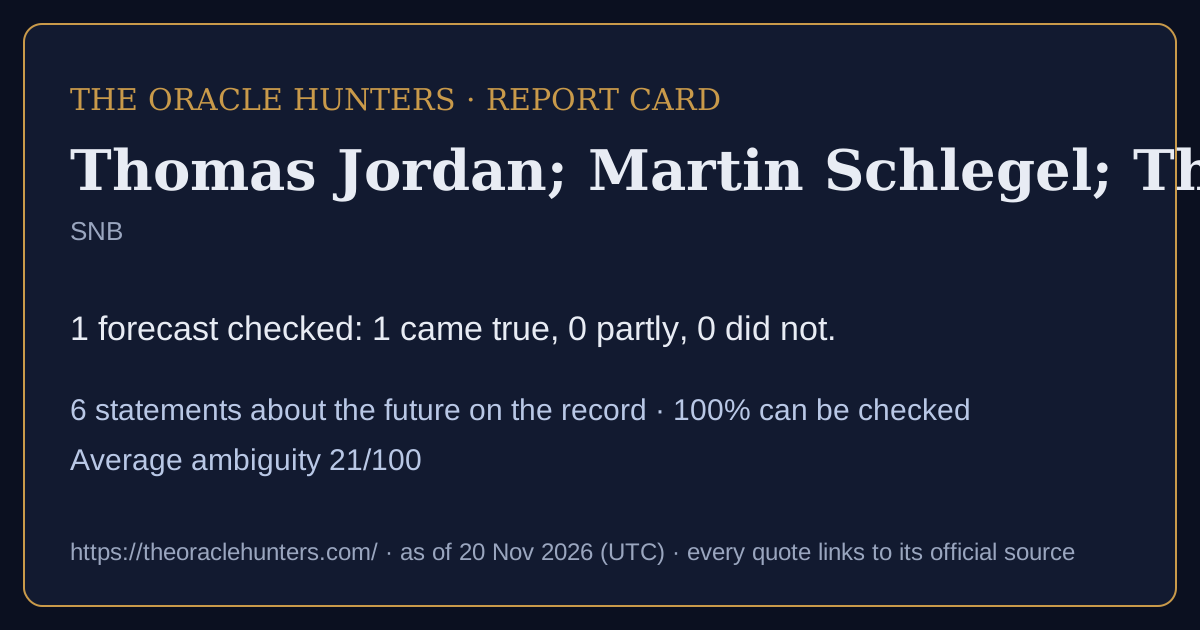
Track record: 1 forecast checked: 1 came true, 0 partly, 0 did not.
6forecasts & commitments on the record
100%can be checked as stated
21average ambiguity (0-100)
0goalpost moves recorded
0confirmed U-turns
Timeline
came true partly did not not due / being checked / too vague
Calibration score: shown after 10 checked forecasts with a stated likelihood (now 1).
How they speak about the future: based on data 3, stated on authority 2, educated guess 1.
Kinds of claim: forecast 5, mixed claim 1. · Download this report card as a picture
In the nine words
How to read this
Each box is one sentence a public figure or institution said about the future, word for word, with a link to the official text. Can be checked means it names what will happen, by when, and how likely - so it can be compared with official figures later. Too vague to check means it does not. Ambiguity (0-100) is how many different ways the sentence can be read. When the date passes, the forecast is compared with official data and marked came true, partly or did not come true. Labels judge the sentence, never the person. Full guide and glossary.Checked
Overall, Switzerland's GDP is likely to grow by around 1% this year.
Came true. Said: economic growth around 1% in 2023. Official figure for Switzerland: 0.8% (World Bank open data). On target. Off by 0.2 points. official data · checked 14 Nov 2026 · automatic check against official data (rules v3)
On the record (6)
Global economic growth was stronger than expected in the third quarter of this year.
However, inflation is likely to increase again somewhat in the coming months due to higher electricity prices and rents, as well as the rise in VAT.
We will adjust our monetary policy if necessary to ensure inflation remains within the range consistent with price stability over the medium term.
For 2024, we currently expect growth of between 0.5% and 1%.
Overall, Switzerland's GDP is likely to grow by around 1% this year.
Came true. Said: economic growth around 1% in 2023. Official figure for Switzerland: 0.8% (World Bank open data). On target. Off by 0.2 points. official data · checked 14 Nov 2026 · automatic check against official data (rules v3)
The forecast puts average annual inflation at 2.1% for 2023, 1.9% for 2024 and 1.6% for 2025 (cf. table).
Also said - not checkable as stated (6 newest)
Remarks about the future with no date, figure or likelihood that could be checked. They are kept on the record and shown here, but not scored.
In the unlikely event that such innovations - for example, the widespread use of stablecoins - allowed payments to be settled without the involvement of central bank money, in a floor system demand for central bank money should still be sufficiently large to allow central banks to steer money market interest rates. 11
At our most recent monetary policy assessment, in September 2023, we decided to leave the SNB policy rate unchanged. 2 However, we also signalled that a further tightening of monetary policy could not be ruled out to ensure price stability over the medium term.
Currently, this factor is 28; however, as announced last week, it will be 25 as of 1 December 2023. 9 How will this change affect banks?
We also announced that reserve holdings which banks use to fulfil their minimum reserve requirements will no longer earn interest.
As a result, some banks will end up with more reserves in excess of their threshold, which can then be traded in the interbank money market or placed in the SNB's reserveabsorbing operations.
Hauser (2023) provides arguments for why maintaining financial stability is likely to involve a materially higher steady state stock of reserves than pre-2008 and discusses how the associated costs and risks might be mitigated.