Thierry Breton
European Commission · EU
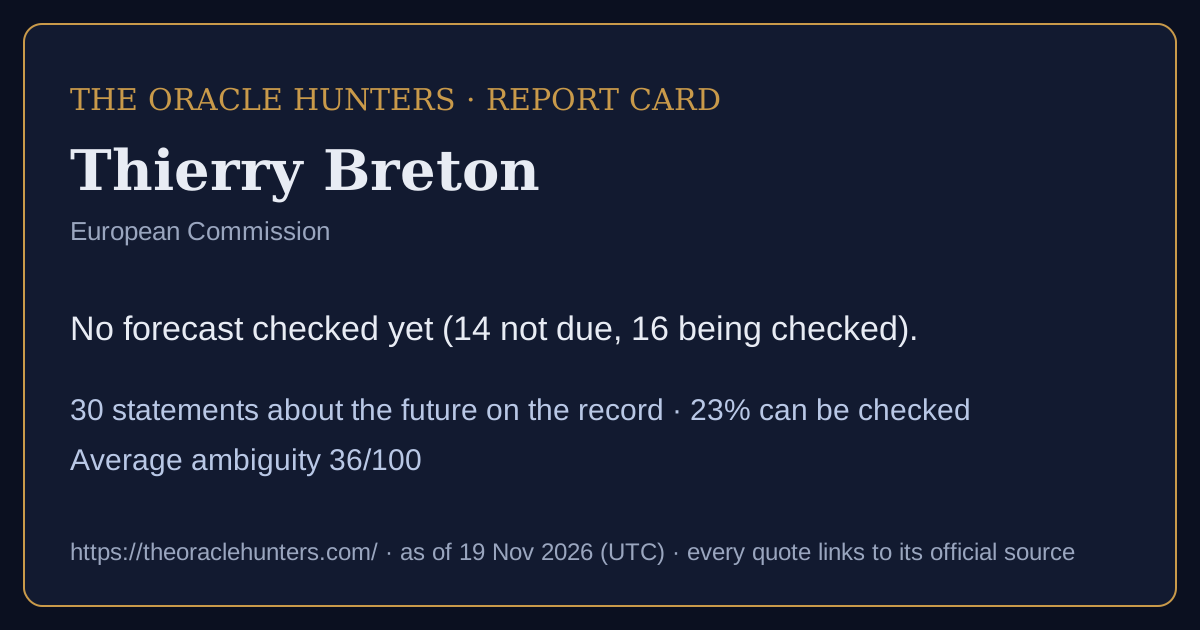
Track record: No forecast checked yet (14 not due, 16 being checked).
30forecasts & commitments on the record
23%can be checked as stated
36average ambiguity (0-100)
0goalpost moves recorded
0confirmed U-turns
Timeline
came true partly did not not due / being checked / too vague
Calibration score: shown after 10 checked forecasts with a stated likelihood (now 0).
How they speak about the future: based on data 25, stated on authority 5.
Kinds of claim: forecast 21, mixed claim 8, commitment 1. · Download this report card as a picture
In the nine words
πρόγνωσιςInference from evidence25 · 83%μαντείαInspired knowledge4 · 13%προαναγγελίαPublic pre-announcement1 · 3%
How to read this
Each box is one sentence a public figure or institution said about the future, word for word, with a link to the official text. Can be checked means it names what will happen, by when, and how likely - so it can be compared with official figures later. Too vague to check means it does not. Ambiguity (0-100) is how many different ways the sentence can be read. When the date passes, the forecast is compared with official data and marked came true, partly or did not come true. Labels judge the sentence, never the person. Full guide and glossary.On the record (30)
And we will not hesitate to present new and reinforced instruments to defend our interests: outbound investment screening, export control coordination, strengthened FDI screening.
We have already started with a pilot project that already brings together 17 countries in 3 large SOCs and will be deployed this year, even before the Act is negotiated.
This will occur at the latest on 1 September this year.
Our DMA team is actively engaging with potential gatekeepers to prepare the designation process, which will be undertaken within the very short timeframe of 45 days during this year's summer period.
With these measures, we estimate that it will be possible to double the km of Gigabit networks deployed by 2030 (470,000 km instead of 250,000 km).
Demand for battery raw materials will rise significantly: for lithium, 15 times by 2030; 4 times for cobalt and natural graphite.
30 million electric cars are expected on European roads in 2030.
In 2030 already, the grid will need to be able to integrate the charging needs of these vehicles, while promoting the vehicle-to-grid potential.
Electric cars on European roads will need 150 GW of electricity capacity by 2050, 10% of the overall capacity.
We will have next year the mid-term review of the EU's long-term budget, the Multiannual Financial Framework.
I know the Automotive Skills Alliance – some of you are members – is already doing a great job. 2023 will be the European Year of Skills and we should use the momentum to intensify the work.
I am convinced that thanks to this Alliance, the EU will reach 30 Gigawatt of annual solar energy manufacturing capacity by 2025 across all segments of the value chain: from the polysilicone through ingots, wafers, cells and finally modules and of course recycling.
We are going to adopt ecodesign criteria for solar panels by mid next year.
That is why, to achieve REPowerEU objectives, 600 gigawatt of solar capacity will need to be available by 2030.
2023 will be a challenging year for our competitiveness and our long-term resilience. 2023 will also be the opportunity for us, Europeans, to show ambition, assertiveness and leadership.
The European Year of Skills 2023 will be an opportunity to gather steam.
That is why I will work with my colleagues in the College so that for every new initiative planned next year, a comprehensive SME test is carried out.
I have in mind the Single Digital Gateway, with the Your Europe Portal as a hub: by the end of 2023, it will direct people to over twenty national administrative procedures online, such as registering a car in another Member State or claiming pension from another Member State.
We will make available another 10 million Euros to help SMEs improve the energy efficiency of their facilities and production lines.
The European Chips Act and, early next year, the Critical Raw Materials Act, will ensure our secure and sustainable access to critical technologies.
I will work with Member States, industry, and the EIB to provide support to the scale up of EU manufacturing capacities and industrial value chains in key low-carbon energy technologies (wind, solar, heat pumps, electrolysers, electricity grids…) needed for a decarbonised and largely electrified continent by 2050.
Several Member States are now investing heavily into defence (more than €200bn announced, more will follow).
We will work towards an ambitious European Defence Innovation Scheme, designed to bridge all the EU instruments supporting disruptive innovation, and create a Cassini for defence fund of €1bn.
As of 2023, new launch systems will have the possibility to provide launch services for certain institutional launches, starting with In-Orbit Demonstration and Validation.
This year, under Horizon Europe calls, we are channeling approximately 300 million euros towards innovative and more sustainable raw materials projects.
We are in a similar situation with permanent magnets where the EU demand is expected to at least double by 2030.
Production of lithium will go from 43.000 tonnes in 2017 to 415.000 tonnes by 2050!
We are talking about 33 zettabytes of data produced in the world in 2018, which is expected to increase to a mind-blowing volume of 175 zettabytes in 2025.
The stakes are high: by 2050, there could be up between 180 and 470 billion EUR of investments in renewable hydrogen, compared to 3-18 billion EUR for low-carbon fossil-based hydrogen.
The targets are clear: from producing 6GW by 2024, we will need to reach 40 GW of renewable hydrogen electrolysers by 2030.
Also said - not checkable as stated (12 newest)
Remarks about the future with no date, figure or likelihood that could be checked. They are kept on the record and shown here, but not scored.
So in light of this new reality, what if I put forward the following ambition: “We will build a future in Europe, with European workers, with European companies, with European made products.” No doubt I would immediately be labelled as the French protectionist.
We will not hesitate to use them to safeguard our interests.
No need to recall the investment needs: more than 700 billion euros each year until 2030 in clean tech deployment for our Green Deal objectives, including more than 100 billion euros in clean tech manufacturing capacity only.
And no need to restate the obvious: most of these will need to be financed by private means.
And what might be good for the climate is certainly a challenge for our industry: carbon pricing and regulation on one side; and tax credits and subsidies on the other.
While it will be possible to make self-declarations of conformity for 90% of the products, for about thirty products, the most critical in terms of cyber risk – such as industrial firewalls, routers or operating systems – the conformity examination will have to be carried out by a third party.
The Commission will work very hard to ensure this.
The CRA will raise the level of cybersecurity "by default" in all products and introduce a concept of "cybersecurity by design".
To this end, in a few weeks' time, the Commission will propose a Cyber Solidarity Act to establish a European infrastructure of security operation centres (SOCs) which will scan the network using artificial intelligence technologies and detect weak signals of attacks.
I will propose an important building block to this goal: the Cyber Solidarity Act.
My team is analysing the numbers which have been published and we will proceed with the designation of very large online platforms and very large online search engines in the coming weeks.
This is not to say that we are planning to do this all by ourselves; of course, both under the DSA and the DMA, there is an important role for national authorities and we will cooperate and coordinate with them.