Tarisa Watanagase
Bank of Thailand
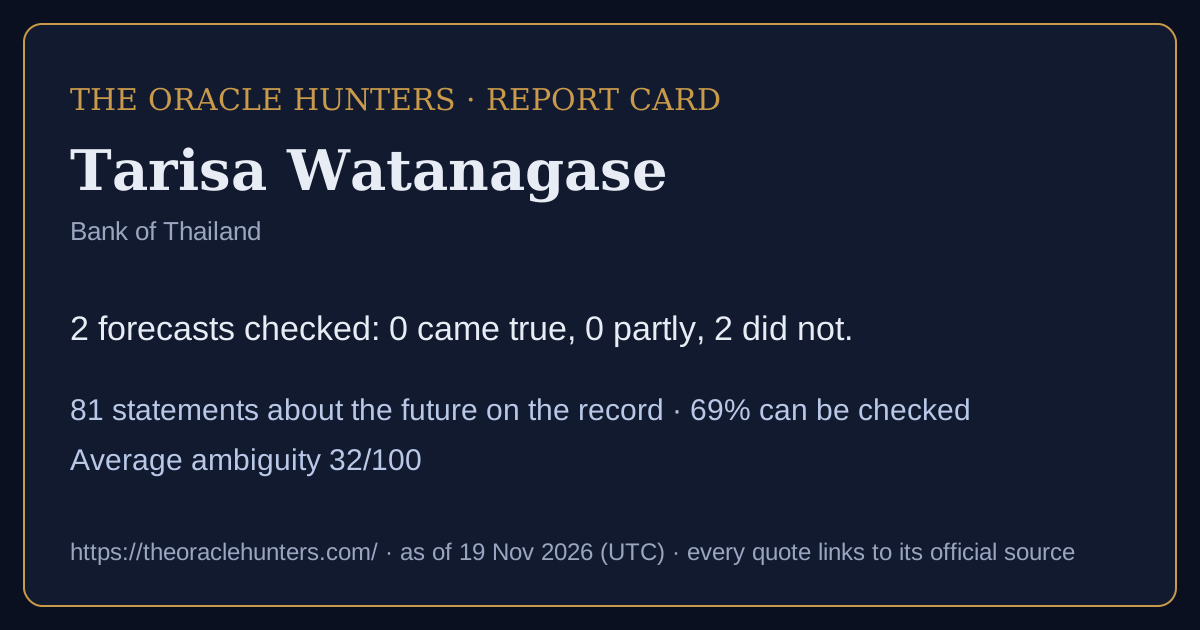
Track record: 2 forecasts checked: 0 came true, 0 partly, 2 did not.
81forecasts & commitments on the record
69%can be checked as stated
32average ambiguity (0-100)
0goalpost moves recorded
0confirmed U-turns
Timeline
came true partly did not not due / being checked / too vague
Calibration score: shown after 10 checked forecasts with a stated likelihood (now 0).
How they speak about the future: based on data 54, stated on authority 20, educated guess 7.
Kinds of claim: forecast 59, scenario (if… then) 8, commitment 7, mixed claim 7. · Download this report card as a picture
In the nine words
πρόγνωσιςInference from evidence51 · 63%μαντείαInspired knowledge15 · 19%πρόνοιαPreparing for the future8 · 10%προαναγγελίαPublic pre-announcement7 · 9%
How to read this
Each box is one sentence a public figure or institution said about the future, word for word, with a link to the official text. Can be checked means it names what will happen, by when, and how likely - so it can be compared with official figures later. Too vague to check means it does not. Ambiguity (0-100) is how many different ways the sentence can be read. When the date passes, the forecast is compared with official data and marked came true, partly or did not come true. Labels judge the sentence, never the person. Full guide and glossary.Checked
For the prospect of the Thai economy this year, the Bank of Thailand sees a growth rate of 02.0 percent and 2.0-4.0 percent next year.
Did not come true. Said: economic growth between 2% and 4% in 2010. Official figure for Thailand: 7.5% (World Bank open data). Missed. Off by 3.5 points. official data · checked 14 Nov 2026 · automatic check against official data (rules v3)
Inflation should subside next year, with headline CPI at around 3 to 4 percent.
Did not come true. Said: inflation between 3% and 4% in 2009. Official figure for Thailand: -0.8% (World Bank open data). Missed. Off by 3.9 points. official data · checked 14 Nov 2026 · automatic check against official data (rules v3)
On the record (81)
In fact, the export value in May continued to expand by 42.5 percent year-on-year in line with favorable expansions in all export categories and markets.
That said, we will put our best effort in considering the timing of interest rate increase carefully.
The momentum of the recovery is expected to continue into both 2010 and 2011.
You may remember that, the Bank of Thailand has reacted decisively and preemptively by lowering the policy interest rate by 250 basis points to a historically low level of 1.25 percent, while the Thai government launched massive stimulus packages and other measures to help relieve households' cost of living through the difficult time.
If there are no changes in our policy, the ratio of public debt to GDP will increase to over 60 percent by 2012.
Looking ahead, with the firming economic recovery, inflationary pressure is expected to increase further, with core inflation forecasted to surpass the midpoint of our target range of 0.5-3.0 percent by the end of the year.
Our latest economic projection as of January 2010 suggests an economic expansion of 3.3-5.3 per cent in 2010 and 2.8-4.4 per cent in 2011, with an increasing role of private investment replacing government expenditure, which will gradually subside since the need for continued fiscal stimulus wanes as the economic growth becomes self-sustaining.
But looking ahead, things will not stay this safe if both banks and the Bank of Thailand do not work closely to continuously strengthen risk management.
In the last year of the Plan, 2014, we may also consider entry in terms of full commercial bank license, if this adds value to the economy, through serving Thailand's international trade and investment interest, including trends in regional integration.
This high unemployment, if prolonged, could have a deep and lasting impact on both consumption and the potential growth of the US economy.
First , the IMF and market consensus expect the world economy to return to positive growth next year, owing primarily to monetary and fiscal policies of the industrialized economies that are expected to remain accommodative.
In 2010, the Thai economy is expected to stay on the course of a gradual recovery due to two important factors.
At the same time, the BOT is expecting that the Thai economy will return to a positive growth of 3.3-5.3 percent in 2010.
Recently, the BOT was invited to take part in the newly created Basel Consultative Group (BCG), which will meet for the first time during 28 to 29 October this year.
The BCBS will issue concrete proposals on these measures by the end of this year, after which, an impact assessment and calibration exercise would be completed by the end of next year.
We expect banks to be able to finalize and start using their ICAAP by the end of December 2010, with the first ICAAP Report submitted to the BOT within the first quarter of the following year.
Moreover, the second3 phase Financial Sector Master Plan, which will be announced this year, will also increase competition and further enhance financial efficiency and resiliency.
The latest IMF forecast expects the global economy to be stagnant this year and some economies in Asia to record negative growth.
For the prospect of the Thai economy this year, the Bank of Thailand sees a growth rate of 02.0 percent and 2.0-4.0 percent next year.
Did not come true. Said: economic growth between 2% and 4% in 2010. Official figure for Thailand: 7.5% (World Bank open data). Missed. Off by 3.5 points. official data · checked 14 Nov 2026 · automatic check against official data (rules v3)
We will continue to hold candid and two-ways dialogues with all the banks operating here to ensure that we can manage these challenges and dynamics of the global turmoil.
Global growth is projected to slow substantially in 2008 and only a modest recovery would begin later in 2009.
External position will remain strong with current account surplus for this year and next year, international reserves currently at around 104 billion US dollars, while external debt is 65 billion US dollars as of August, of which just over one-third is short-term.
The latest assessment of Monetary Policy Committee projected that growth is expected to moderate, to a range of 4.3 to 5 percent this year, and 3.8 to 5 percent next year.
Inflation should subside next year, with headline CPI at around 3 to 4 percent.
Did not come true. Said: inflation between 3% and 4% in 2009. Official figure for Thailand: -0.8% (World Bank open data). Missed. Off by 3.9 points. official data · checked 14 Nov 2026 · automatic check against official data (rules v3)
Going forward, with sustainable growth and development of ASEAN at stake, I have no doubt that we will be able to jointly find ways to overcome the present difficult global environment and together continue to prosper.
There is however an important catch in the cited projection and that is the implicit assumption that the ratio of real gross investment to real GDP recovers from the current level of 22% to 28-30% by the end of the period.
In fact, to cite James McCormack, the Head of Asia Sovereign of Fitch Ratings, at the firm's last week annual Thailand conference, unless political uncertainty significantly undermines Thailand's future growth prospect, it is unlikely that Thailand will be downgraded, for the country's sovereign credit fundamentals remain sound.
This may appear a far cry from the 1987-1996 period when the growth of the Thai economy averaged 9.5%.
Oil prices have fallen much lower than what we had anticipated during our last round of economic forecast in July which had headline inflation projection in the range of 7.5-8.8% for the year.
By 2026-2035, the economy's potential GDP growth rate under the balanced growth path assumption is projected to fall to 4.8-5.4% due to ageing population.
The fall in oil prices is also expected to have a significant impact on economic growth which was forecasted to be in the range of 4.8%-5.8% for this year.
The development makes a real difference only when we are committed to building strong fundamentals to support long-term growth to ensure that the people are really better off on a sustained basis.
In a pessimistic extreme scenario, the government budget disbursement may delay if the upcoming budget process in parliament is disrupted and mega-project investment could fall behind schedule.
By the end of this year, the Bank of Thailand's Monetary Policy Committee, jointly with the Minister of Finance, will be required to set an annual target for monetary policy for 2009.
Even if the driver reduces the speed of the car to 75 kilometers per hour, a 25% reduction perhaps as a result of a narrower roadway, he will still be charged with speeding.
Indeed, the latest issue of Asia Pacific Consensus Forecasts shows Thailand's GDP growth falling over the next three quarters before recovering in the second quarter of 2009.
Up to the end of the first quarter, the sentiment was lifted to a better prospect for Thailand, with many expecting average 6 percent growth for this year.
However, proliferation of internet banking, mobile banking, and e-payment also increases the risks of IT fraud, network security breach, and identity theft, etc. If these risks are not properly managed, they could have severe financial and reputational consequences for the banks.
A minimum loan-to-valuation ratio was also introduced to stem the incipient growth of high-priced residential loans that, if left unchecked, could have led to speculative property bubbles and threat to financial and economic stability down the road.
Due to continued high prices of energy and food, headline inflation is expected to be in a range of 4.0-5.0 percent for the whole of 2008.
Overall, the Monetary Policy Committee expects the Thai economy to grow by 4.8-6 percent.
The risks on growth and inflation make 2008 a very challenging year but we will be able to weather it because there is room for the right policy mix and we can capitalize on the economy's resiliency.
As the MPC meets next Wednesday 21 May, we will assess the latest data available and indicators on both growth and stability to decide on the appropriate stance of forward-looking monetary policy.
Clearly, we will have to wait quite sometime for the clear upturn of the US economy after the US Fed's sharp and substantial interest rate cuts to shore up the economy and confidence.
This year, the strengths of these three growth engines will be particularly important, since exports - the fourth engine - is expected to moderate in line with the global economic slowdown.
The government investment plans for 2008-2012, as they are, will address the entire spectrum of infrastructure deficiency our economy faces.
As you may already know, only four Thai banks have CDO investment exposures, accounting for merely 0.3 percent of the banking system's total assets.
As for the volatility emanating from international financial markets, my view is that the global financial environment may become more volatile for the rest of this year.
Turning to the external sector , this year, the moderating net external demand would result from the anticipated slowdown of the global economy, linked to the US economic and financial downturns through the international trade channel.
Overall, reflecting the solid fundamentals and the resiliency of the Thai economy, the Monetary Policy Committee expects that the Thai economy will grow by 4.8-6 percent this
Showing the newest 50 - the ledger has all 81.
Also said - not checkable as stated (12 newest)
Remarks about the future with no date, figure or likelihood that could be checked. They are kept on the record and shown here, but not scored.
The most notable example here is perhaps in the UK where the government will abolish the Financial Services Authority (FSA) and transfer its regulatory responsibility back to the Bank of England.
While the UK may be an extreme case, a growing consensus has emerged that central banks should play a key role in preserving the overall stability and smooth functioning of the financial system.
This means that, we will be able to take care of systemically important financial firms outside current regulatory purview if the situation warrants.
Despite challenges in the period ahead, we will try our best to ensure
The first part will be about the changing global view on financial stability policies as a result of the recent global financial crisis.
The second part will be a summary of what the Bank of Thailand has done with regard to the maintenance of Thailand's financial stability.
Unfortunately, the less good news is that a small open economy like Thailand will be prone to more shocks, especially through international trade and financial market linkages.
On the whole, we expect that the second quarter GDP growth would be less buoyant than that of the first quarter.
Nevertheless, economic data during April-May came out better than expected, reflecting the ongoing momentum of the Thai economic recovery led by exports.
As the Thai economy is getting stronger, returning fiscal and monetary policies gradually to pre-crisis normal levels will not obstruct the recovery path .
This will not only leave little room for the government to use more fiscal stimulus should there be a new crisis in the region or in the global economy but it could also put Thailand in the spotlight of the foreign investors who have become much more sensitive to the issue of fiscal sustainability.
Despite this advantage, the Bank of Thailand is not complacent and we will continue to prepare our banking sector for future challenges.