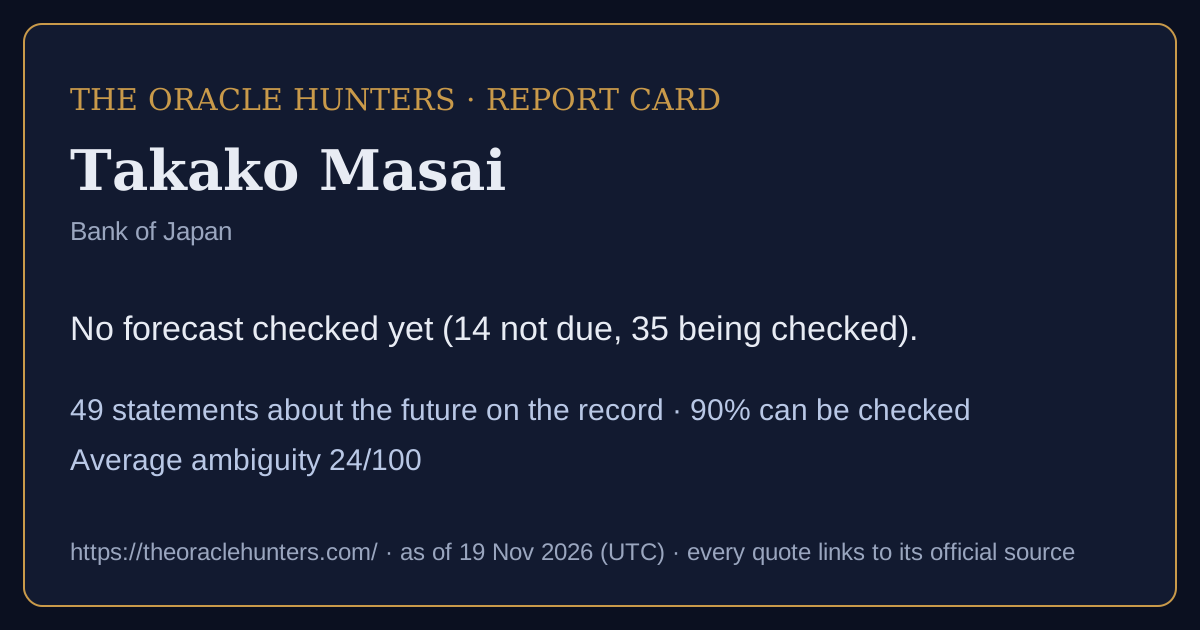
Takako Masai
Bank of Japan
Track record: No forecast checked yet (14 not due, 35 being checked).
49forecasts & commitments on the record
90%can be checked as stated
24average ambiguity (0-100)
0goalpost moves recorded
0confirmed U-turns
Timeline
came true partly did not not due / being checked / too vague
Calibration score: shown after 10 checked forecasts with a stated likelihood (now 0).
How they speak about the future: based on data 46, educated guess 3.
Kinds of claim: forecast 45, scenario (if… then) 2, mixed claim 2. · Download this report card as a picture
In the nine words
πρόγνωσιςInference from evidence46 · 94%πρόνοιαPreparing for the future2 · 4%εἰκασίαConjecture1 · 2%
How to read this
Each box is one sentence a public figure or institution said about the future, word for word, with a link to the official text. Can be checked means it names what will happen, by when, and how likely - so it can be compared with official figures later. Too vague to check means it does not. Ambiguity (0-100) is how many different ways the sentence can be read. When the date passes, the forecast is compared with official data and marked came true, partly or did not come true. Labels judge the sentence, never the person. Full guide and glossary.On the record (49)
In terms of the medians of the Policy Board members' forecasts in the October 2020 Outlook Report, the year-on-year rate of change in the CPI for all items less fresh food is minus 0.6 percent for fiscal 2020, 0.4 percent for fiscal 2021, and 0.7 percent for fiscal 2022.
In particular, as Gita Gopinath, Director of the Research Department at the IMF, has pointed out, the shortfall in GDP growth in 2020 to 2021 relative to pre-COVID-19 growth projections is expected to be larger for emerging and developing economies, except for China, than that for developed economies.
In terms of the medians of the Policy Board members' forecasts in the October 2020 Outlook Report, the real GDP growth rate is minus 5.5 percent for fiscal 2020, 3.6 percent for fiscal 2021, and 1.6 percent for fiscal 2022.
In fiscal 2022, the economy is expected to continue growing firmly, with demand at home and abroad increasing in a well-balanced manner.
Thereafter, in fiscal 2021, as the impact of COVID-19 wanes at home and abroad and the growth rates of overseas economies rise, an improving trend in the economy is expected to become evident, partly supported by accommodative financial conditions.
Looking at details of the outlook for each fiscal year, in the second half of fiscal 2020, with economic activity resuming and the impact of COVID-19 waning gradually, the economy is expected to continue picking up, mainly for exports and production, although downward pressure is expected to remain strong in the services industry in particular.
With regard to the outlook for prices, the year-on-year rate of change in the CPI for all items less fresh food is likely to increase gradually toward 2 percent, mainly on the back of the output gap remaining positive and medium- to long-term inflation expectations rising.
As for the future conduct of monetary policy, my view is that the Bank should not hesitate to take additional easing measures if there is a greater possibility that the momentum will be lost due to materialization of these risks.
The medians of the Policy Board members' forecasts of the year-on-year rate of change in the CPI for all items less fresh food presented in the January 2020 Outlook Report was 0.6 percent for fiscal 2019, 1.0 percent for fiscal 2020, and 1.4 percent for fiscal 2021.
In terms of the medians of the Policy Board members' forecasts in the January 2020 Outlook Report, the real GDP growth rate is 0.8 percent for fiscal 2019, 0.9 percent for fiscal 2020, and 1.1 percent for fiscal 2021.
Japan's economy is likely to continue on an expanding trend throughout the projection period -- that is, through fiscal 2021 -- as the impact of the slowdown in overseas economies on domestic demand is expected to be limited, although the effects of the slowdown are likely to remain for the time being.
Turning to inflation expectations, the expected inflation rate for the next five years surpassed 1 percent for the first time since 2013, according to an estimation by the Bank's staff based on the results of the Opinion Survey on the General Public's Views and Behavior .
The medians of the Policy Board members' forecasts of the year-on-year rate of change in the CPI for all items less fresh food presented in the July Outlook Report was 1.0 percent for fiscal 2019, 1.3 percent for fiscal 2020, and 1.6 percent for fiscal 2021.
In terms of the medians of the Policy Board members' forecasts in the July Outlook Report, the real GDP growth rate is 0.7 percent for fiscal 2019, 0.9 percent for fiscal 2020, and 1.1 percent for fiscal 2021.
In fiscal 2021, private consumption and housing investment are projected to increase because the effects of the reactionary decline to the scheduled consumption tax hike are
In fiscal 2020, the pace of increase in exports is expected to accelerate, with the growth rates of overseas economies rising, and government spending accompanying the hosting of the Olympic Games is expected to underpin the economy.
Japan's economy is likely to continue on an expanding trend throughout the projection period, which covers from fiscal 2019 through fiscal 2021.
The projections have been revised downward by 0.2 percentage point for each year from the previous ones released three months before, and differences in growth rates among regions have widened to some extent.
Nonetheless, with the output gap remaining positive and operating firmly as a driver for a rise in inflation, the year-on-year rate of change in the CPI is likely to increase gradually toward the price stability target of 2 percent.
In terms of the median of the Policy Board members' forecasts in the October 2018 Outlook Report, the year-on-year rate of change in the CPI (all items less fresh food) is 0.9 percent for fiscal 2018 and -- on a basis excluding the effects of the scheduled consumption tax hike -- 1.4 percent and 1.5 percent for fiscal 2019 and …
In terms of the median of the Policy Board members' forecasts in the October 2018 Outlook Report, the real GDP growth rate is 1.4 percent for fiscal 2018, and 0.8 percent each for fiscal 2019 and 2020.
From fiscal 2019 through fiscal 2020, the economy is expected to continue on an expanding trend, partly supported by external demand, although the growth pace is projected to decelerate due to a cyclical slowdown in business fixed investment and the effects of the scheduled consumption tax hike in October 2019.
According to the World Economic Outlook (WEO) released in October 2018 by the International Monetary Fund (IMF), the real GDP growth rate of the global economy is projected to be 3.7 percent on a year-on-year basis for both 2018 and 2019.
In light of these points, a complete exit from deflation under the price stability target of 2 percent will ultimately be desirable for households in Japan.
Amid the persistent deflationary mindset, it may take some time to achieve the price stability target of 2 percent.
The year-on-year rate of change in the CPI (all items less fresh food) is likely to increase toward 2 percent.
From fiscal 2019 through fiscal 2020, the economy is expected to continue on an expanding trend supported by external demand, although the growth pace is projected to decelerate due to a cyclical slowdown in business fixed investment and the effects of the scheduled consumption tax hike.
Looking at the medians of the Policy Board members' forecasts in the April 2018 Outlook Report, the year-on-year rate of change in the CPI (all items less fresh food) is projected to be 1.3 percent for fiscal 2018 and -- on a basis excluding the effects of the scheduled consumption tax hike -- 1.8 percent each for fiscal 2019 and …
Looking at the medians of the Policy Board members' forecasts in the April 2018 Outlook Report, the real GDP growth rate is projected to be 1.6 percent for fiscal 2018, and 0.8 percent each for fiscal 2019 and 2020.
Specifically, an increase is likely to be seen in investment, particularly (1) that related to the 2020 Olympic Games and urban redevelopment projects, (2) that aiming at improving efficiency and saving labor in order to deal with the labor shortage, and (3) in research and development for growth areas.
In fiscal 2019, it is expected to continue expanding, although the growth pace is projected to decelerate due to a cyclical slowdown in business fixed investment and the effects of the consumption tax hike scheduled in October 2019.
Reflecting this outlook, Japan's economy is likely to maintain growth during this projection period at a pace above its potential, mainly through fiscal 2018.
I expect there to be a strong possibility of the global economy continuing its steady growth through fiscal 2018.
It states that, in order to promote households' stable formation of assets, the government will further disseminate and promote the NISA system, including the introduction in January 2018 of the installment-type NISA, and enhance the financial and investment education that leads to improved practical knowledge of investment among households.
Looking at the medians of the Policy Board members' forecasts in the October 2017 Outlook Report, the year-on-year rate of change in the CPI (all items less fresh food) is projected to be 0.8 percent for fiscal 2017, 1.4 percent for fiscal 2018, and -- on a basis excluding the effects of the scheduled consumption tax hike -- 1.8 percent …
The degree of monetary easing will increase if the Bank contains such upward pressure and thereby maintains the shape of the yield curve.
In fiscal 2019, it is expected to continue expanding, although the growth pace is projected to decelerate due to a cyclical slowdown in business fixed investment and the effects of the scheduled consumption tax hike.
Reflecting this outlook, Japan's economy is likely to maintain growth at a pace above its potential mainly through fiscal 2018.
The Bank projects that the timing of the year-on-year rate of change in the CPI reaching about 2 percent will be around fiscal 2019.
Looking at the medians of the Policy Board members' forecasts in the July 2017 Outlook Report, the year-on-year rate of change in the CPI (all items less fresh food) is projected to be 1.1 percent for fiscal 2017, 1.5 percent for fiscal 2018, and -- on a basis excluding the effects of the scheduled consumption tax hike -- 1.8 percent …
Looking at the medians of the Policy Board members' forecasts in the July 2017 Outlook Report, the real GDP growth rate is projected to be 1.8 percent for fiscal 2017, 1.4 percent for fiscal 2018, and 0.7 percent for fiscal 2019.
## The 10 Strategic Public-Private Joint Projects toward GDP of 600 Trillion Yen
The Bank will maintain highly accommodative financial conditions, with a view to achieving the price stability target of 2 percent, and ensure the overcoming of deflation.
Individuals can feel great confidence when they do not need to be concerned about whether their wages will be cut, even if corporate performance underperforms to some extent, or whether they can find another job.
Thereafter, it is expected to increase toward 2 percent as the aggregate supply and demand balance improves and inflation expectations rise.
As for prices, the year-on-year rate of change in the CPI (all items less fresh food) is likely to increase from about 0 percent and become slightly positive, due mainly to the negative contribution of energy prices dissipating.
(1) in redevelopment projects in view of the 2020 Tokyo Olympics, (2) in research and development for growth areas, (3) in labor-saving machinery and equipment in order to deal with labor shortages, and (4) for maintenance and replacement of equipment to address deterioration from aging.
Looking at the medians of the Policy Board members' forecasts in the January 2017 Outlook Report, the year-on-year rate of change in the CPI (all items less fresh food) is projected to be minus 0.2 percent for fiscal 2016, 1.5 percent for fiscal 2017, and 1.7 percent for fiscal 2018 (Chart 4).
Looking at the medians of the Policy Board members' forecasts in the January 2017 Outlook Report, the real GDP growth rate is projected to be 1.4 percent for fiscal 2016, 1.5 percent for fiscal 2017, and 1.1 percent for fiscal 2018 (Chart 4).
Also said - not checkable as stated (5 newest)
Remarks about the future with no date, figure or likelihood that could be checked. They are kept on the record and shown here, but not scored.
In this report, the Bank presented its projections for Japan's economic activity and prices from fiscal 2019 through fiscal 2021.
The transmission mechanism envisaged by the Bank is that these factors will lead to a reduction in real interest rates, thereby producing positive effects on Japan's economic activity and prices (Chart 2).
Second, while it was confirmed that the combination of large-scale purchases of JGBs and the negative interest rate policy was effective in influencing the entire yield curve, there was concern over a possibility that this combination could in some cases push down the yield curve more than necessary, thereby having a negative impact on financial functioning.
Therefore, it may seem like it has taken a long time for the Bank to achieve this target.
I think that this will lead to an increase in growth expectations, and ultimately to a rise in inflation expectations.