Takahide Kiuchi
Bank of Japan
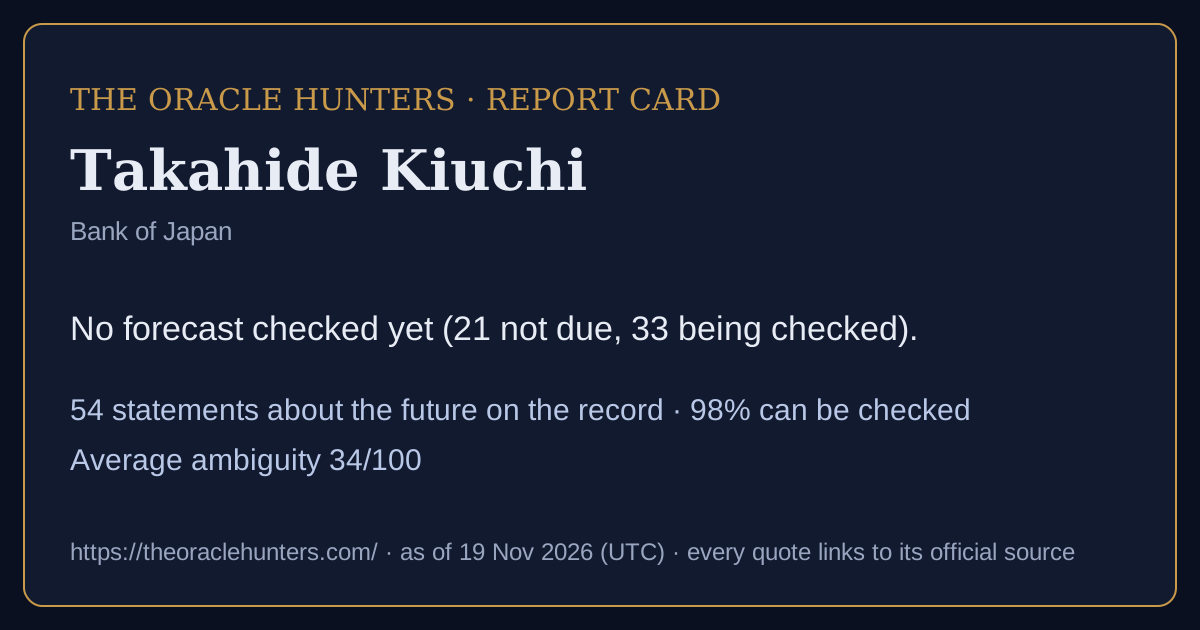
Track record: No forecast checked yet (21 not due, 33 being checked).
54forecasts & commitments on the record
98%can be checked as stated
34average ambiguity (0-100)
0goalpost moves recorded
0confirmed U-turns
Timeline
came true partly did not not due / being checked / too vague
Calibration score: shown after 10 checked forecasts with a stated likelihood (now 0).
How they speak about the future: based on data 49, stated on authority 3, educated guess 2.
Kinds of claim: forecast 46, mixed claim 6, scenario (if… then) 2. · Download this report card as a picture
In the nine words
πρόγνωσιςInference from evidence48 · 89%μαντείαInspired knowledge3 · 6%πρόνοιαPreparing for the future2 · 4%φρόνησιςPractical wisdom1 · 2%
How to read this
Each box is one sentence a public figure or institution said about the future, word for word, with a link to the official text. Can be checked means it names what will happen, by when, and how likely - so it can be compared with official figures later. Too vague to check means it does not. Ambiguity (0-100) is how many different ways the sentence can be read. When the date passes, the forecast is compared with official data and marked came true, partly or did not come true. Labels judge the sentence, never the person. Full guide and glossary.On the record (54)
On the other hand, my view is much more cautious than the baseline scenario: the year-on-year rate of change in the CPI (all items less fresh food) will likely remain well below 2 percent throughout the projection period through fiscal 2018.
I consider that Japan's economy is likely to continue growing generally at about the same level as the potential growth rate throughout the projection period that covers through fiscal 2018.
As for the outlook, it is likely to continue growing at a pace above the potential growth rate through the projection period - that is, through fiscal 2018 - on the back of highly accommodative financial conditions and the effects of the government's large-scale stimulus measures, with the growth rates in overseas economies increasing moderately.
However, as it is difficult to project the time frame in which such a positive change in the economy will occur, I believe that the price stability target of 2 percent should be set as the target to be achieved in the medium to long term and be regarded as a kind of symbol in the Bank's aim, along with …
The Bank's baseline scenario is that the timing of the rate of change reaching around 2 percent will likely be at the end of the projection period - that is, around fiscal 2018.
The timing of the year-on-year rate of change in the CPI (all items less fresh food) reaching around 2 percent will likely be at the end of the projection period - that is, around fiscal 2018.
Thereafter, the year-on-year rate of change in the CPI (all items less fresh food) is likely to be around 2 percent on average.
As for prices, the year-on-year rate of change in the consumer price index (CPI, all items less fresh food) is likely to be slightly negative or about 0 percent for the time being, due to the effects of the decline in energy prices, and thereafter accelerate toward 2 percent.
Meanwhile, assuming that crude oil prices will rise moderately from the recent level, the timing of the year-on-year rate of change in the CPI (all items less fresh food) reaching around 2 percent - the price stability target - is projected to be during fiscal 2017.
The outlook through fiscal 2018 envisages that, although sluggishness is expected to remain in exports and production for the time being, domestic demand is likely to follow an uptrend, with a virtuous cycle from income to spending being maintained in both the household and corporate sectors, and exports are expected to increase moderately.
In order to achieve the 2 percent price stability target, I think that it is vital to have a positive change in economic structure that would increase the underlying trend in inflation - through, for example, efforts by the government and firms - and that a considerable period of time will be required for this to take place.
Moreover, I do not assume that the year-on-year rate of change in the CPI (all items less fresh food) will reach the price stability target of 2 percent by fiscal 2018, the last year of the projection period in the April 2016 Outlook Report.
In the process of the change in economic structure, firms' and households' medium- to long-term inflation expectations - on which basis they carry out their economic activities - will become stable at around 2 percent, and this will support the actual inflation rate continuing to be stable at around 2 percent.
For fiscal 2017, however, the projection was more or less unchanged at 1.8 percent.
According to my baseline scenario for the outlook, such stable economic and price conditions will continue through fiscal 2017 - the projection period covered in the January 2016 Outlook Report.
In other words, Japan's economy is likely to continue growing at a pace above its potential through fiscal 2016, and thereafter, through fiscal 2017, is likely to maintain its positive growth, although with a slowing in its pace, due mainly to the effects of the consumption tax hike planned in April 2017.
Even at this point, I still hold the view that the year-on-year rate of change in the CPI (all items less fresh food) will be about 0 percent for the time being, and thereafter accelerate very moderately, and consider that the rate of change is unlikely to reach around 2 percent even through fiscal 2017 - the projection period covered …
On this basis, I expressed dissent from the description presented in the January 2016 Outlook Report regarding the year-on-year rate of change in the CPI (all items less fresh food) that the timing of reaching around 2 percent is projected to be around the first half of fiscal 2017.
I expect that such stable conditions will continue through fiscal 2017 - the projection period covered in the Bank's April 2015 Outlook Report and its interim assessment in July.
With regard to the year-on-year rate of increase in the CPI (all items less fresh food), the median of the Policy Board members' forecasts was more or less unchanged at 0.7 percent for fiscal 2015, 1.9 percent for fiscal 2016, and 1.8 percent for fiscal 2017, from the April forecasts.
In other words, Japan's economy is likely to continue growing at a pace above its potential through fiscal 2016 and maintain its positive growth in fiscal 2017, although with a slowing in its pace, due mainly to the effects of the consumption tax hike planned in April 2017.
In the Bank's interim assessment, the median of the Policy Board members' forecasts for the real GDP growth rate was revised somewhat downward to 1.7 percent for fiscal 2015, mainly due to the sluggishness in exports, but was more or less unchanged at 1.5 percent and 0.2 percent for fiscal 2016 and 2017, respectively, from the forecasts presented in April.
Even now, I still hold the view that the year-on-year rate of increase in the CPI (all items less fresh food) will be about 0 percent for the time being, and thereafter accelerate very moderately, and consider that the rate of increase is unlikely to reach 2 percent even in fiscal 2017.
Under these circumstances, I expressed dissent from the description presented in the April 2015 Outlook Report regarding the year-on-year rate of increase in the CPI (all items less fresh food) that the timing of reaching around 2 percent is projected to be around the first half of fiscal 2016.
Regarding the outlook for prices, in the October 2014 Outlook Report, I formulated a proposal to change the expression that the year-on-year rate of increase in the CPI is likely to reach around 2 percent in or around fiscal 2015.
According to the median of the Policy Board members' forecasts, the real GDP growth rate is projected to be minus 0.5 percent for fiscal 2014, which is lower than the forecast presented in the October 2014 Outlook Report.
the next two years or so, whether the outlook deemed most likely by the Bank is reasonable judging from the growth potential of Japan's economy at each point in time.
The rate of increase for fiscal 2016 will likely be more or less unchanged from the October forecast.
However, the rate is projected to be 2.1 percent for fiscal 2015 and 1.6 percent for fiscal 2016, which is higher in both cases than the forecasts presented in October, and the economy is likely to grow at a pace clearly above its potential.
In this regard, the inflation rate that the Bank should aim at achieving through monetary policy over roughly the next two years is expected to climb gradually, as the economy's growth potential rises along with the progress in structural reforms.
In such a situation, if weaker growth in private consumption restrains the rise in the inflation rate, it is expected that real wages will increase and private consumption will continue growing
It seems to be stable recently, mainly due to the stimulus measures, but if the growth rate declines due to adjustments in the real estate market, this will have negative effects on peripheral Asian economies and in turn on Japan's export environment.
Therefore, I do not think that such a situation will lead to achieving the price stability target, whereby the Bank aims at maintaining the inflation rate at around 2 percent in a stable manner.
Specifically, I proposed to change the expression that the year-on-year rate of increase in the CPI 'is likely to be around 1¼ percent for some time, follow a rising trend again from the second half of this fiscal year, and reach around 2 percent around the middle of the projection period' to a new expression that it 'is likely to …
The rate of increase was 1.3 percent for four consecutive months from December 2013 through March 2014 and, on a basis excluding the direct effects of the tax hike, marked 1.5 percent for April, 1.4 percent for May, and 1.3 percent for June.
The first perspective is examining, as regards economic activity and prices over the next two years or so, whether the outlook deemed most likely by the Bank follows a path of sustainable growth under price stability.
If medium- to long-term inflation expectations rise as a result of such efforts, it could become appropriate to set the target for the level of inflation at 2 percent, although I think that this will require considerable time.
Regarding the outlook, the yearon-year rate of increase in the CPI, excluding the direct effects of the consumption tax hike, is likely to be around 1-1/4 percent for some time.
Looking at the projections of global economic growth recently released by the International Monetary Fund (IMF), the growth for 2014 is projected to be at around 3.7 percent, mainly due to rises in growth rates of advanced economies.
The median of their forecasts for the year-on-year rate of increase in the CPI, excluding the direct effects of the consumption tax hikes, was 0.7 percent for fiscal 2013, 1.3 percent for fiscal 2014, and 1.9 percent for fiscal 2015.
According to the Bank of Japan's interim assessment released in January 2014 of the October 2013 Outlook for Economic Activity and Prices (hereafter the Outlook Report), the median of the Policy Board members' forecasts for the real GDP growth rate was 2.7 percent for fiscal 2013, 1.4 percent for fiscal 2014, and 1.5 percent for fiscal 2015.
to achieve this, households, firms, and financial markets need to act on the assumption that prices will increase by about 2 percent; in other words, that medium- to long-term inflation expectations be about 2 percent.
If the observed inflation rate hovers around 2 percent on average and firms and households act on the assumption that prices will increase by about 2 percent, this will lead to price stability in the medium to long term.
In my proposal, the price stability target of 2 percent is set as a medium- to long-term goal because I think the 2 percent target may become consistent with Japan's economic fundamentals only in the medium to long term.
My proposal is to replace the expression in the Statement on Monetary Policy with a new one stating that 'the Bank will aim to achieve the price stability target of 2 percent in the medium to long term.
First, with regard to the outlook for prices toward the latter half of the projection period, I proposed to change the current expression that the year-onyear rate of change in the CPI 'is likely to reach around 2 percent - the price stability target' to a new expression that 'the rate of increase in the CPI is expected to rise …
In the October 2013 Outlook Report, it is projected to reach 1.9 percent in fiscal 2015 in terms of the median of the Bank's Policy Board members' forecasts.
In the latest forecast in October 2013, which updated the July 2013 forecast, global economic growth was revised downward in just three months by 0.3 percentage point for 2013 and 0.2 percentage point for 2014, mainly due to the lower growth outlook for emerging and commodity-exporting economies including China.
According to the Organisation for Economic Co-operation and Development (OECD), the output gap in the advanced economies, after having reached minus 4.0 percent of GDP in 2009, is expected to exceed minus 3.0 percent in 2013, at minus 3.3 percent.
Under the current purchasing method - which makes a commitment in terms of the future level of the total size of the Program - the total size of the Program will be increased to 101 trillion yen by end-2013 from 65 trillion yen at end-2012, as had been planned earlier.
Showing the newest 50 - the ledger has all 54.