Sylvie Goulard
Bank of France
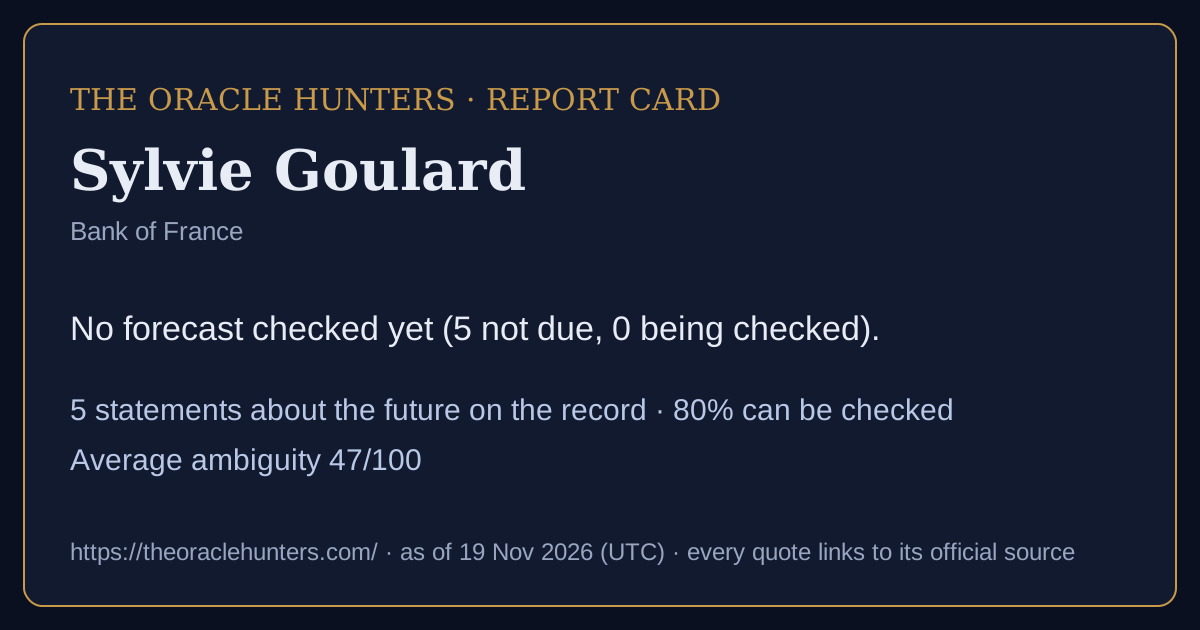
Track record: No forecast checked yet (5 not due, 0 being checked).
5forecasts & commitments on the record
80%can be checked as stated
47average ambiguity (0-100)
0goalpost moves recorded
0confirmed U-turns
Timeline
came true partly did not not due / being checked / too vague
Calibration score: shown after 10 checked forecasts with a stated likelihood (now 0).
How they speak about the future: based on data 2, educated guess 2, stated on authority 1.
Kinds of claim: mixed claim 3, forecast 1, scenario (if… then) 1. · Download this report card as a picture
In the nine words
πρόγνωσιςInference from evidence2 · 40%πρόνοιαPreparing for the future1 · 20%μαντείαInspired knowledge1 · 20%εἰκασίαConjecture1 · 20%
How to read this
Each box is one sentence a public figure or institution said about the future, word for word, with a link to the official text. Can be checked means it names what will happen, by when, and how likely - so it can be compared with official figures later. Too vague to check means it does not. Ambiguity (0-100) is how many different ways the sentence can be read. When the date passes, the forecast is compared with official data and marked came true, partly or did not come true. Labels judge the sentence, never the person. Full guide and glossary.On the record (5)
Professor Dasgupta also invites us not only to acknowledge that GDP growth will be limited at some point even if you are a techno-optimist, but also to think about new approaches to economic value and social well-being that do not rely on GDP.
It goes without saying that exploring these new frontiers of climate and nature in macroeconomics and finance should be done as seriously as possible, as we will be held to an even higher standard than our peers.
For instance, it is hoped that the COP15 that will take place in December in Montreal will lead to an international agreement to protect 30% of land and sea areas by 2030.
In short, if we are to hold a serious discussion about what an ecological transition means for central banks, including the impact it will have on output and other key macroeconomic variables, we need to be able to engage in a responsible and scientific manner on these difficult questions, rather than sweeping them under the rug.
The scientific community estimates that 60% of known infectious diseases and up to 75% of new or emerging infectious diseases are zoonotic in origin. 9 Hence, the Covid -19 (regardless of its origins, which have not yet been confirmed) should be considered a clear warning of what could happen if we fail to act on biodiversity loss. 10
Also said - not checkable as stated (7 newest)
Remarks about the future with no date, figure or likelihood that could be checked. They are kept on the record and shown here, but not scored.
Regional and national policies are also expected: the EU Green Deal contains several goals related to biodiversity, such as the need to increase organic farming practices from 9% to 25% cultivated areas.
We may understand the price of wood and some of the services provided by forests (such as climate regulation or flood prevention) but we will never understand all the interactions that exist within nature.
Even in such a dire situation, one may still be tempted to ask: why should macroeconomists, let alone central bankers, care about it?
They also have to take into account the impact that these structural changes will have on price stability.
Larry Summers recently stated : 'The central banking community has to date been roughly 50 to 100 times more focused on issues of climate finance than of issues of pandemic finance and on readiness to deal with the next pandemic when it comes' (session at the Atlanta Fed, 18 May 2021)
If central banks are to safeguard financial stability in the age of climate change, they will need to coordinate their actions with measures to be implemented by other players such as finance ministries or specialised government agencies.
In this context, The Green Swan reminds us that ecological risks (including but not limited to climate change) are so complex that we will never be able to accurately measure them, meaning that we should learn by doing.