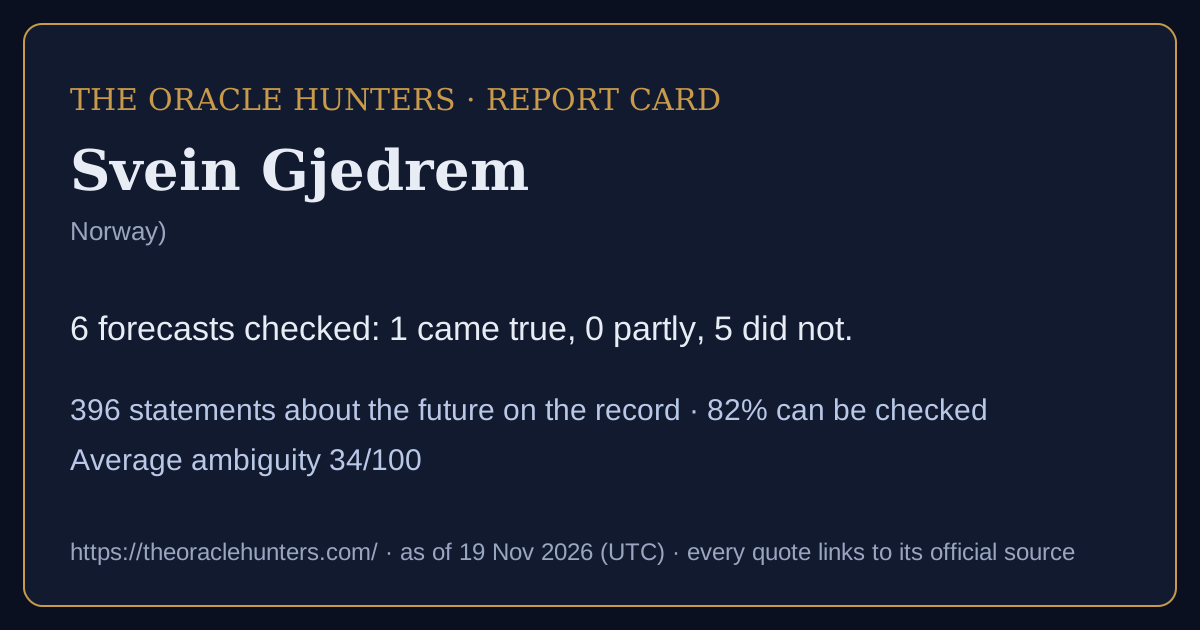
Svein Gjedrem
Norway)
Track record: 6 forecasts checked: 1 came true, 0 partly, 5 did not.
396forecasts & commitments on the record
82%can be checked as stated
34average ambiguity (0-100)
0goalpost moves recorded
0confirmed U-turns
Timeline
came true partly did not not due / being checked / too vague
Calibration score: shown after 10 checked forecasts with a stated likelihood (now 6).
How they speak about the future: based on data 275, educated guess 65, stated on authority 56.
Kinds of claim: forecast 272, scenario (if… then) 87, mixed claim 32, commitment 5. · Download this report card as a picture
In the nine words
πρόγνωσιςInference from evidence241 · 61%πρόνοιαPreparing for the future87 · 22%μαντείαInspired knowledge51 · 13%εἰκασίαConjecture9 · 2%προαναγγελίαPublic pre-announcement5 · 1%φρόνησιςPractical wisdom2 · 1%πρόβλεψιςSeeing the signs1 · 0%
How to read this
Each box is one sentence a public figure or institution said about the future, word for word, with a link to the official text. Can be checked means it names what will happen, by when, and how likely - so it can be compared with official figures later. Too vague to check means it does not. Ambiguity (0-100) is how many different ways the sentence can be read. When the date passes, the forecast is compared with official data and marked came true, partly or did not come true. Labels judge the sentence, never the person. Full guide and glossary.Checked
Furthermore, the key policy rate is expected to move up to about 5 per cent around the end of 2007.
Came true. Said: the policy interest rate at the end of the year around 5% in 2007. Official figure for Norway: 5.2% (BIS central bank policy rates (December)). On target. Off by 0.2 points. official data · checked 17 Nov 2026 · automatic check against official data (rules v4)
We expect inflation to rise through 2007
Did not come true. Said: inflation would rise in 2007. Official figures for Norway: 2.3% in 2006, 0.8% in 2007 (World Bank open data). official data · checked 14 Nov 2026 · automatic check against official data (rules v3)
Unemployment is expected to decline this year and next.
Did not come true. Said: unemployment would fall in 2005. Official figures for Norway: 4.3% in 2004, 4.4% in 2005 (World Bank open data). official data · checked 14 Nov 2026 · automatic check against official data (rules v3)
Registered unemployment is projected to increase from 3¼ per cent in 2002 to 4 per cent in 2003 and up to 4¼ per cent in 2004.
Did not come true. Said: unemployment below 4.25% in 2004. Official figure for Norway: 4.3% (World Bank open data). Missed. Off by 0.0 points. official data · checked 14 Nov 2026 · automatic check against official data (rules v3)
Price inflation is projected to fall to 2½ per cent by next year already.
Did not come true. Said: inflation around 2.5% in 2002. Official figure for Norway: 1.3% (World Bank open data). Missed. Off by 1.2 points. official data · checked 14 Nov 2026 · automatic check against official data (rules v3)
Inflation is expected to remain at around 2% for the next two years, with inflation rates of 2…% this year, 2% next year and 1¾% in 2001.
Did not come true. Said: inflation around 1.75% in 2001. Official figure for Norway: 3.0% (World Bank open data). Missed. Off by 1.2 points. official data · checked 14 Nov 2026 · automatic check against official data (rules v3)
On the record (396)
If they cannot be confident that the key rate is set to ensure stable inflation, they will expect higher inflation over time.
When equity prices increase rapidly, the equity allocation will exceed the strategic weight of 60 per cent.
With Fund withdrawals in line with the fiscal rule of 4 per cent, the return will be able to finance 15-20 per cent of government expenditure in ten years.
As from the 2011 accounting year, Norges Bank will shift to International Financial Reporting Standards (IFRS).
In the same period, public debt rose from 66 per cent of GDP to 85 per cent, and there are prospects that debt will approach 100 per cent of GDP in the next few years.
When Norway experienced payment difficulties in 1816, government debt stood at 6 million speciedaler, or about NOK 700 million at today's value of the krone, and was probably considerably smaller than annual GDP in the country at that time.
The most recent default episodes have left creditors with losses ranging between an estimated 30 and 75 per cent. 7 These experiences will probably influence interest rates on sovereign loans when a country's debt-servicing capacity is in question.
On 10 May the EU and the European Central Bank announced extensive support measures for EU countries, including the European Financial Stability Facility, which can provide loans to countries in difficulty up to a total limit of EUR 500 billion, with additional loans of up to EUR 250 billion made available by the IMF through its program facilities.
If the interest rate is higher than the rate of growth, the debt burden will be heavier and the government budget will have to be settled in surplus before interest payments.
Fiscal deficits in the UK and the US will reach 11-12 per cent this year and public debt is rising rapidly to high levels.
If we also give some weight to the interest rate given by a simple monetary policy rule - the Taylor interest rate rule (criteria 1, 2, 3 and 4), the key policy rate will remain at today's level for a period and then be raised gradually.
In autumn 2012 we expect an interest rate of close to 3½ per cent, while market participants expect an interest rate of around 2¾ per cent 3 .
Global economic growth at market prices is now expected to be about 3½ this year, and 4½ per cent in purchasing power parity terms.
We will most likely still be producing petroleum in 40 years' time, but oil production has declined in recent years after peaking in 2000.
According to the fiscal policy guidelines, petroleum revenues should be phased gradually into the economy, approximately in pace with the expected real return on the Government Pension Fund Global, which is estimated at 4 per cent per annum.
Capacity utilisation is expected to be close to a normal level in 2011 and to reach this level in the course of 2012.
The saving ratio is therefore expected to fall, and growth in private consumption is projected at 5 per cent in 2010.
The volume of petroleum investment is expected to drop further this year and next, followed by a pick-up in 2012 and 2013.
Revenue spending will rise further this year.
Market participants do not anticipate a rise in key rates in the US, the euro area and the UK until the end of 2010.
Fiscal tightening is expected to commence among our main trading partners as from next year, with the exception of Sweden.
With his presence at the World Economic Forum meeting in Davos last month, the Chair of the G20 aimed to 'drum up support for the idea of making the summit [in Korea later this year] a 'premier forum' where all major discussions on worldwide economic cooperation will take place' . 6
OECD government debt will grow for several years ahead and may increase from 80 per cent of GDP in 2008 to almost 120 per cent later this decade.
According to the fiscal policy guidelines, petroleum revenues should be phased in gradually into the economy, approximately in pace with the expected real return on the Government Pension Fund Global, which is estimated at 4 per cent.
- Securities already approved under the temporary rules may be pledged as collateral until maturity, at the latest until 15 February 2012
The collateral pool for covered bonds may comprise residential mortgages or mortgages for holiday homes with a loan-to-value ratio (LTV) of up to 75 per cent, commercial property mortgages with an LTV of up to 60 per cent or loans to public sector entities with an LTV ratio of up to 100 per cent.
- = Securities issued by banks will no longer be eligible as collateral for loans from 15 February 2012
Securities issued by banks will no longer be eligible as collateral for loans as from 15 February 2012.
To prevent a procyclical impact, this target will apply as of 2013. 10
A risk weight of for example 10 per cent for residential mortgage loans with a minimum Tier 1 capital requirement of 4 per cent would mean that NOK 1 in equity capital could be behind as much as NOK 250 in residential
From 15 February 2012, we will discontinue access to using bank issues as collateral for loans.
Therefore, from 1 December 2010 we will include foreign bank issues in the bank quota without increasing the percentage rate of 35.
If households know that the increase in public spending is temporary, and is subsequently matched by lower spending, state finances will not be a source of concern for households and firms further ahead.
If an upward shift in public spending is perceived as permanent, forward-looking households and firms will increase saving to meet higher tax payments in the future.
- The operational target of monetary policy shall be annual consumer price inflation of approximately 2.5 per cent over time.
If expectations of higher demand deteriorate, futures prices will fall and, in turn, prices for immediate delivery.
The level will rise ahead, even if the nominal krone exchange rate should remain unchanged, because wage growth is higher in Norway than abroad.
Inflation is slowing as a result of the decline in output and wage growth last year and the beginning of this year and is expected to fall to below 2 per cent in early 2010.
Mainland GDP is projected to decline by 1 per cent between 2008 ad 2009.
There are prospects that inflation will remain below 2.5 per cent for a period.
Up to autumn 2008, it appeared that capacity utilisation in the Norwegian economy would most likely decline to a normal level, inflation would stabilise around 2½ per cent and the key rate ahead could be held at what we consider to be a normal level - between 5 and 6 per cent.
Unemployment is projected to continue to rise to the end of the year and into next year.
To restrain the decline in activity in the Norwegian economy, central government expenditure will be increased by 10 per cent this year.
If developments move in line with our projections, the key interest rate may be reduced to 1 per cent in the latter half of this year.
Wage growth is expected to come down this year from a high level in 2008.
In order to curb the fall in activity, government expenditure will be increased by over 10 per cent this year.
Inflation is projected to fall below 2 per cent in 2010, before gradually moving up towards the target towards the end of the projection period as the output gap gradually closes.
Unemployment is projected to rise to almost 5 per cent at the end of the year.
Mainland GDP is expected to fall by 1 per cent this year.
Overall, the outlook and balance of risks suggest that the key policy rate should be gradually reduced further to a level of around 1 per cent in the second half of 2009.
Showing the newest 50 - the ledger has all 396.
Also said - not checkable as stated (12 newest)
Remarks about the future with no date, figure or likelihood that could be checked. They are kept on the record and shown here, but not scored.
On the other hand, it can be argued that Norway could be faced with a perilous situation, such as military conflict, for example, where the central bank itself finds that the government should use its power of instruction with regard to foreign exchange reserves and the central bank's management of monetary and liquidity policy.
Among other things, it should be able to play a greater role in appointments to the Executive Board and Bank management, for example, through a formal right to make recommendations. 41 This could give the Supervisory Council an even greater sense of ownership over the organisation and strengthen their sense of commitment.
Banks must not be given the scope to take on substantial liquidity risk in the belief or with the certainty that Norges Bank will intervene should foreign funding seize up.
The Ministry of Finance immediately submitted a report to the Storting (Report No. 24 (1989-90) where the Ministry of Finance wrote '..The write-down of loans from the central bank may […] represent an active use of central government funds that should be deliberated in the Storting in advance'.
This line of thinking presupposes that the government will bail out the banks.
Moving forward, Norges Bank's operational management of the Fund should probably shift towards absolute return and absolute risk.
It should be noted that the Fund is nevertheless considerably larger than expected 10-12 years ago.
It should also be considered whether the rules should be designed to provide for a greater degree of automaticity, less judgement and probably also greater transparency.
The projections published in the June Monetary Policy Report suggest that the key rate should be held at today's level to around the end of the year and then gradually be raised to a more normal level.
should not deviate too far from simple rules, monetary policy may become somewhat more robust. 1
This reflects that the interest rate is an instrument that should react to all news that may influence the inflation outlook.
With these thoughts on central banks and macroprudential policies, I would remind you that we organize this conference hoping that we shall be able to take something useful away for our further work on financial stability.