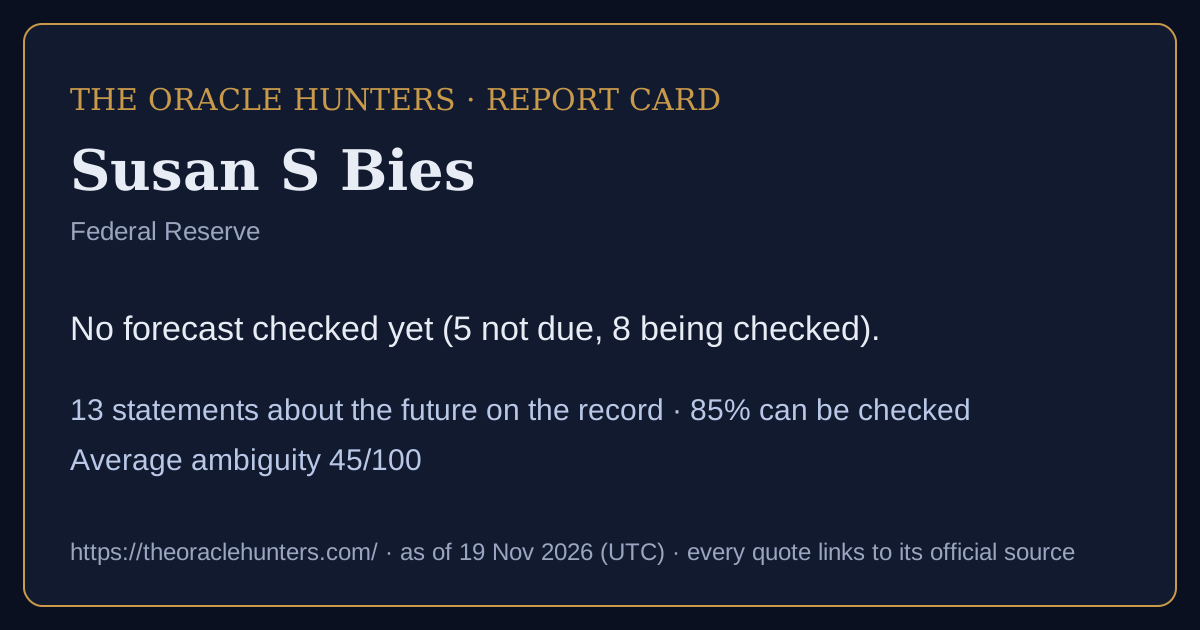
Susan S Bies
Federal Reserve
Track record: No forecast checked yet (5 not due, 8 being checked).
13forecasts & commitments on the record
85%can be checked as stated
45average ambiguity (0-100)
0goalpost moves recorded
0confirmed U-turns
Timeline
came true partly did not not due / being checked / too vague
Calibration score: shown after 10 checked forecasts with a stated likelihood (now 0).
How they speak about the future: based on data 7, stated on authority 4, educated guess 2.
Kinds of claim: forecast 9, scenario (if… then) 3, mixed claim 1. · Download this report card as a picture
In the nine words
πρόγνωσιςInference from evidence6 · 46%μαντείαInspired knowledge4 · 31%πρόνοιαPreparing for the future3 · 23%
How to read this
Each box is one sentence a public figure or institution said about the future, word for word, with a link to the official text. Can be checked means it names what will happen, by when, and how likely - so it can be compared with official figures later. Too vague to check means it does not. Ambiguity (0-100) is how many different ways the sentence can be read. When the date passes, the forecast is compared with official data and marked came true, partly or did not come true. Labels judge the sentence, never the person. Full guide and glossary.On the record (13)
If the labor force participation rate remains at its current level, then what might be thought of as the “equilibrium” growth rate of payroll employment--that is, the increase consistent with a stable unemployment rate--would be about 140,000 per month.
However, the large markup of prices over costs--the margin is currently well above its historical average--could act as a shock absorber if cost strains were to intensify.
As a consequence, the elements now appear to be in place for some easing of resource utilization rates over the next year or so and a reduction in inflationary pressures.
However, if the labor force participation rate instead declines 0.2 percentage point over the next year, as suggested by the Fed’s staff research, then the comparable equilibrium payroll employment growth would be closer to 110,000 per month.
In particular, consumption likely was restrained earlier this year by the rise in energy prices, which took a large bite out of household budgets.
But if history is a guide, in an expanding economy job creation will eventually outstrip job destruction, and lower the unemployment rate.
So far this year, the financial condition of these plans have likely improved due to the rising stock market and higher contributions, although the precise extent of that improvement will not be known until year-end financial statements are released.
Indeed, the PBGC estimates that its annual tally of underfunding in GLYPH<147>financially troubledGLYPH<148> companies could exceed $80 billion this year.
Accordingly, equity analysts are calling for S&P 500 profits to advance 5 percent more in the third quarter and by a similar amount in the fourth quarter of this year, before rising an additional 13 percent in 2004; and profits at small firms are expected to continue outpacing those at large firms.
Homes sales and new residential construction remained very strong during the summer, although the rise in mortgage rates could result in some cooling in the housing sector in coming months.
In the case of banks with assets greater than $500 million, management publicly reports on its assessment of the effectiveness of controls over financial reporting and the external auditor is required to attest to this self-assessment - a process that soon will be in place for public companies as well.
By the time the first proxy-voting reports are required to become public in 2004, I expect that the initial steps toward corporate governance education will already have been taken.
To take an example from the world of banking, where the discipline of risk management is relatively well developed, an accounting report might say that the fair value of a loan portfolio is $300 million and has dropped $10 million from the previous report.
Also said - not checkable as stated (12 newest)
Remarks about the future with no date, figure or likelihood that could be checked. They are kept on the record and shown here, but not scored.
For example, to the extent that the aging of the baby boomers reduces the growth in labor force participation and hence potential output, the benchmark we use for assessing the macroeconomic implications of actual GDP growth will need to be lower.
Instead, new jobs will need to be created in other sectors of the economy to replace them.
As in-house or independent counsel you should fulfill your duties with the competence, integrity, and independence expected of members of the bar and be sure that any material concerns that you have concerning the company's conduct are raised to appropriate levels within the organization.
Therefore, a clear priority for companies should be to refocus on the basics of internal controls and risk management, and to review how these basics should be applied from the inception of projects rather than in hindsight.
You most likely already know the details of this important piece of legislation including, in particular, the provisions directly affecting attorneys practicing before the Securities and Exchange Commission.
Members of that committee should use the reports to be sure business strategy, changing business processes, management reorganizations, and positioning for future growth are conducted within the
Even if you have billed a customer for services, if you do not think you are going to collect the fee, you should not recognize the revenue and should set up a reserve for bad debt.
Managers should also look at the organization's business plan to see how risk exposures are expected to change and to determine whether new controls, or changes in existing controls, are needed to manage that level of risk.
The test of the models will come when we hit a period of significantly higher unemployment or falling incomes.
Bankers believe that a single point of contact will help a customer identify the range of the bank's services, will provide a consistent level of service quality, and will increase the cross-selling of services.
The related lesson is that compliance with a similar requirement in Sarbanes-Oxley will require monitoring by bank regulators to make certain the goal of strengthening accountability and governance is achieved.
With the improvements in credit and asset/liability management, failures in operational controls and corporate governance will continue to be a larger source of losses for banks in the future.